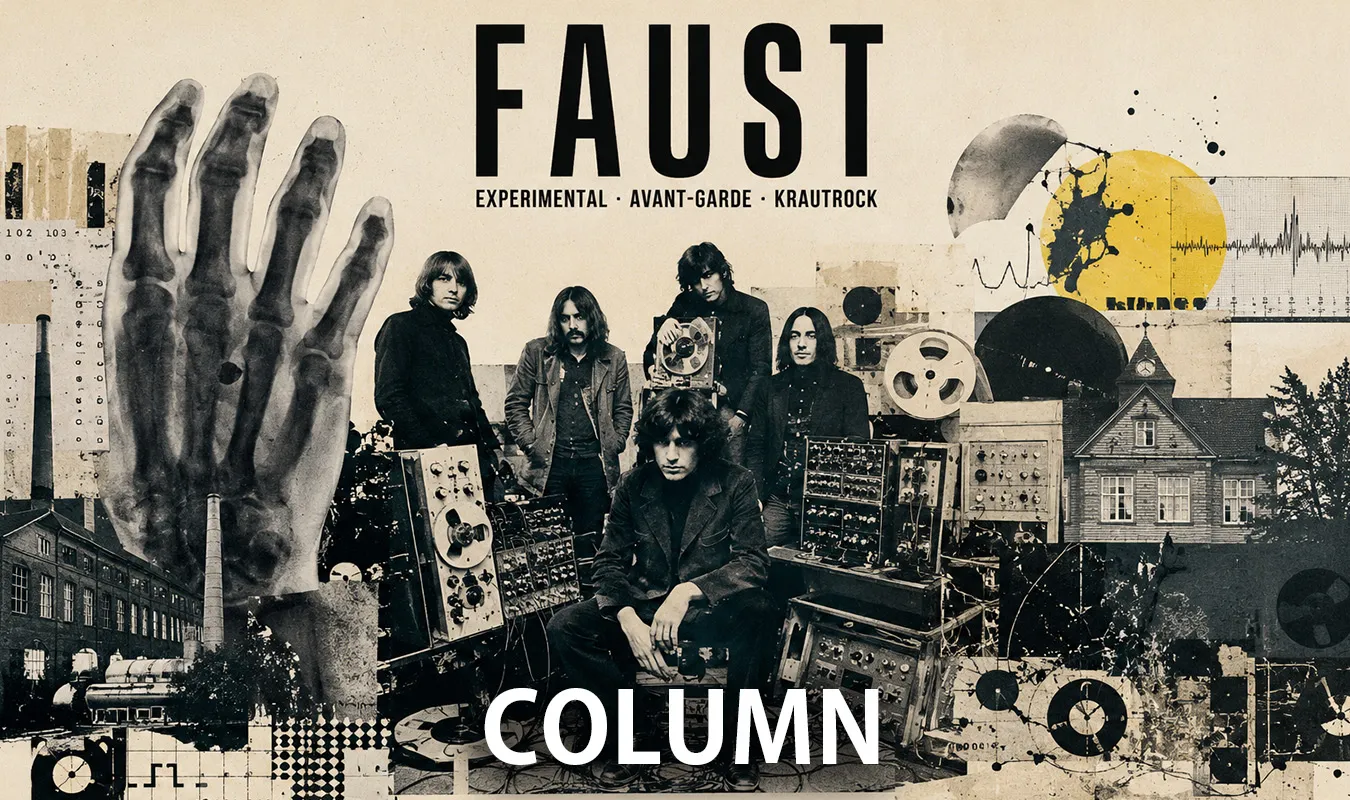
[Column] What was Faust? A German avant-garde that deconstructed rock with noise and experimentation.

Column en Experimental Krautrock Noise
[Column] What was Faust? A German avant-garde that deconstructed rock with noise and experimentation.

A band that appeared to “destroy” rock

Text: mmr|Theme: Tracing the history, musicality, recording techniques, and influence of Faust on Krautrock, which was born in Germany in the 1970s.

In the early 1970s, there was growing discomfort in West Germany with the direct imitation of British and American rock. The younger generation after World War II was trying to create their own culture from scratch.

Faust was born in this atmosphere.

Faust was clearly different from your average rock band. Although their music consisted of guitar, drums, and bass, there was almost no concept of a ““completed song’’ in their music. The recording tape is cut, radio noise is layered, metal sounds and environmental sounds are mixed in, and suddenly there is silence, and then an intense rhythm begins.

Rather than saying that they were playing rock music, it would be more accurate to say that they were using the form of rock as an experiment.

Faust later became a symbol of the German experimental music scene known as ““krautrock.’’ However, at the time, they themselves were not particularly aware of such genre names. What they were looking for was freedom from existing musical structures.


West German music scene before Faust was formed

In West Germany at the end of the 1960s, new artistic movements were gaining momentum due to the spread of student movements and counterculture. Similarly, in the music scene, an increasing number of young people are seeking their own unique expressions that are not copies of American rock.

Groups such as Can, Amon Düül II, Neu!, Tangerine Dream, and Cluster emerged in this vein.

Faust, while alongside these bands, takes a particularly collage-like and destructive direction.

graph TD A[The void in postwar German culture] --> B[Rebuilding youth culture] B --> C[Expansion of experimental music] C --> D[Birth of Krautrock] D --> E[Faust formed]

Heretical group created by the producer

The central figure in the birth of Faust was music journalist and producer Uwe Nettelbeck.

He formed Faust with a group of musicians with the goal of creating ““innovative German rock.’’

The following people participated as members:

-Werner “Zappi” Diermaier

  • Jean-Hervé Peron
  • Rudolf Sosna
  • Hans Joachim Irmler
  • Günther Wüsthoff

They signed a deal with Polydor that prioritized a spirit of experimentation over commercial success. This contract gives Faust a relatively free production environment.

Special environment: studio on former factory site

Faust was based in an old school/factory in Wümme, northern Germany.

This wasn’t just a recording studio, it was a combination of living space and laboratory. The members continued to record day and night while living together.

This environment greatly influenced Faust’s musical formation.

In normal commercial studios, recording times are limited. However, Faust was able to record endless improvisations and edit them later.

As a result, songs are constructed through “editing” rather than “performance.”

Faust was not just a rock band, but an early experimental group that turned recordings into works of art.


Shock presented by debut work “Faust”

Their self-titled album Faust, released in 1971, had a huge impact on rock listeners.

This album largely ignores traditional song structures.

It was a collage of short phrases, noise, conversations, electronic sounds, and fragmented rhythms, and even the boundaries between songs were vague.

Unusual design of transparent jacket

The album was released in a transparent vinyl jacket.

Inside is an image of a hand that looks like an X-ray photograph, visually differentiating it from conventional locks.

This design symbolized Faust’s musical attitude.

In other words, it is an attitude that rejects ““rock as a product.’’

Collapse of song structure

From the beginning of the album, Faust eschews the usual rock compositions.

Immediately after the guitar riff begins, a noise interrupts, a tape is suddenly played in reverse, and conversational audio is played.

This was not an accident; it was a deliberate edit.

Faust used tape editing as a compositional act.

flowchart TD A[improvised performance recording] --> B[tape editing] B --> C[fragmentation] C --> D[Rebuild] D --> E[Faust songs]

Connection with tape music

Faust’s methodology was also connected to 20th century contemporary music.

In particular, similarities with Pierre Schaeffer”s musique concrète and Karlheinz Stockhausen”s electronic music experiments are pointed out.

However, Faust was not a purely modern musician.

They mixed rock, blues, psychedelic, and improvisational music.

This coexistence of “nobility” and “chaos” was Faust’s greatest characteristic.

Critic and listener reactions

Reactions at the time were widely divided.

While some critics praised it as an innovative work, there were also many who criticized it as ““incomprehensible” and ““noisy”.

Although it did not lead to commercial success, it had a huge influence on the experimental music scene that followed.

Underground musicians, especially in Britain and the United States, regarded Faust as an important pioneer.

"”Faust’’ was more than a collection of songs, it was an experimental record that deconstructed the rock medium.


The pop sensation that began to emerge with “So Far”

On 1972’s So Far, Faust began displaying relatively more compact song structures than his previous albums.

However, it was not an approach to a typical pop song.

Rather, they have progressed to the stage of ““understanding pop structure and then destroying it’’.

The weirdness of “It’s A Rainy Day, Sunshine Girl”

The song “It’s A Rainy Day, Sunshine Girl” on the album is known as a relatively catchy Faust song.

Although it has simple repetitive phrases and a minimalist beat, it has an unstable and crumbling atmosphere.

This feeling would also be connected to later post-punk and industrial.

Connection between video and music

During the ““So Far’’ period, short videos corresponding to each song were also produced.

The footage of the members performing strangely provided a visual indication of Faust’s artistic direction.

For them, music was not a separate medium, but a comprehensive form of artistic expression.

graph TD A[music] --> D[Faust expression] B[picture] --> D C[performance] --> D

A new sense of rhythm

Faust’s performance may seem chaotic at first glance, but it actually had a very unique sense of groove.

Drummer Zappi Diermaier in particular created a hypnotic atmosphere by mechanically repeating simple beats.

This sense of repetition also resonates with later techno and minimal music.

Comparison with Neu!

Faust’s contemporaries Neu! were also known for their repetitive beats.

However, there is a clear difference between the two.

Whereas Neu! was minimal and straightforward, Faust always mixed in noise and digressions.

In other words, while Neu! created a ““futuristic drive feeling,” Faust created an ““experimental space on the verge of collapse.”

With ““So Far,’’ Faust began to show a unique pop sensibility that wasn’t just about noise.


“The Faust Tapes” and price destruction

In 1973, Faust releases The Faust Tapes.

This work attracted a lot of attention not only for its content but also for the way it was sold.

Strategy of low price sales

Virgin Records in the UK sold the album at the same low price as a single.

As a result, many listeners purchased the album out of curiosity, and the album’s sales exceeded expectations.

However, many buyers were surprised by the contents.

This is because the album has almost no unified song structure, and fragmentary recorded material appears one after another.

Completed form as a collage work

"”The Faust Tapes”’ can be said to be the culmination of Faust”s collage aesthetic.

Rock, electronic sounds, ethnic music-style phrases, noise, and environmental sounds keep switching at high speed.

In modern times, it feels similar to sampling culture, but at the time, everything was done by tape editing.

timeline title Faust主要作品 1971 : Faust 1972 : So Far 1973 : The Faust Tapes 1973 : Faust IV

Production of “coincidence”

Faust favored editing that sounded haphazard.

However, in reality, very detailed editing work was carried out.

This can also be considered an influence of Dadaism and Surrealism.

Creating a new order while destroying the order.

DIY spirit before punk

Faust’s attitude had a strong influence on later punk music.

It is a sense of prioritizing ideas and impulses over technical perfection.

Faust was particularly appreciated by the British post-punk generation.

Throbbing Gristle, Cabaret Voltaire, and This Heat all retain a strong Faustian spirit of experimentation.

"”The Faust Tapes’’ was a work that deconstructed the very concept of a rock album.


“Faust IV” and its most famous songs

Faust IV, also released in 1973, is the most widely known of Faust’s works.

A long song called “Krautrock”

The album’s opening track, “Krautrock,” is a repetitive track that lasts approximately 12 minutes.

A simple bass line and drums go on and on, with noise and guitar floating on top.

This song later became a symbol of the genre name ““krautrock.’’

The strange pop nature of “The Sad Skinhead”

On the other hand, “The Sad Skinhead” has a relatively straight rock feel.

However, its repetition and unsettling nature were alien to normal rock.

It”s not that Faust can”t make ““normal songs,” it”s that he ““didn”t want to end it normally.”

Relationship with Virgin Records

Virgin Records treated Faust as an important experimental artist.

At the time, Virgin was still an emerging label, and it felt like it was competing with the established industry.

Faust”s experimental nature also greatly contributed to Virgin”s image formation.

Conflict with commerciality

However, Faust remained distant from the commercial market.

Although the label wanted more straightforward work, Faust consistently prioritized experimentation.

As a result, the band gradually became stagnant.

graph TD A[experimental spirit] --> C[Faust] B[commercial request] --> C C --> D[tense relationship]

"”Faust IV’’ was the moment when Faust sounded most like a rock band, and the moment when it was most out of the ordinary.


Disband, reevaluate, and restart

In the mid-1970s, Faust went into hiatus.

However, its influence actually expanded over time.

Reassessment since the 1980s

As post-punk, industrial, and noise music spread, Faust began to be reevaluated as a “pioneer.”

It received enthusiastic support, especially in the British underground music scene.

Many alternative bands have been influenced by Faust, including Sonic Youth.

Impact on noise culture

Faust’s importance lies not only in its use of noise.

They treated noise not just as a destructive sound, but as a musical structure itself.

This had a decisive influence on later noise music.

Connection with electronic music

Faust’s repetitive structure and sense of editing are deeply connected to later electronic music.

Particularly in techno and experimental electronica, Faustian approaches are repeatedly referenced.

Their music was important not only in rock history, but also in the history of recording culture.

Reunion and continued activities

Faust has been restarted intermittently since the 1990s.

Although the membership changed, the spirit of experimentation was maintained.

The live performances were highly improvisational, with different developments each time.

graph TD A[Faust] --> B[post punk] A --> C[noise] A --> D[industrial] A --> E[techno] A --> F[alternative]

Far from becoming obsolete, Faust was a band that was better understood over time.


Faust’s greatest legacy

Faust’s greatest achievement lies in the extreme expansion of his ““degree of freedom in music production.’’

Turned recording into composition

In traditional rock music, recording was used to preserve performances.

However, for Faust, recording was the very place where he produced his works.

Tape editing, cutting, pasting, and introducing chance.

These techniques are also applicable to current DAW production.

Affirmed “failure”

Faust did not eliminate playing mistakes and noise.

Rather, he accepted them as part of his work.

This way of thinking would later lead to lo-fi culture.

Crossed music genres

Faust began as a rock band, but crossed over into contemporary music, noise, electronic music, improvisational music, and artistic expression.

Therefore, they cannot fit into a single genre.

Even today, it is difficult to classify Faust.

However, their unclassifiable nature was their essence.

Why is it still listened to today?

We live in an era where sampling, editing, and collage are commonplace.

But Faust was already ahead of the curve in the early 1970s.

That”s why it doesn”t sound old even when you listen to it now.

In fact, it can be said that much contemporary music exists in a post-Faust world.

Faust did not update rock, but rewritten the very concept of “music production”.


Chronology

Year Events
1971 Debut album “Faust” released
1972 “So Far” announced
1973 “The Faust Tapes” announced
1973 “Faust IV” announced
1975 Stagnant activity
1980s Re-evaluation underway
1990s Restart
Since the 2000s Continuous live activities

Main characters

Name Role
Jean-Hervé Péron Bass, vocals
Werner “Zappi” Diermaier Drums
Hans Joachim Irmler Keyboard
Rudolf Sosna Guitar
Günther Wüsthoff Electroacoustics
Uwe Nettelbeck Producer

List of major works

Title Release year Features
Faust 1971 Collage-like debut
So Far 1972 Fusion of pop and experimentation
The Faust Tapes 1973 The culmination of editorial aesthetics
Faust IV 1973 Best known masterpiece

At the end

Faust wasn’t a band with huge hits.

However, they continued to thoroughly doubt the fixed idea that ““music should be like this.’’

This attitude spread not only to later experimental music, but also to punk, electronic music, noise, and alternative culture as a whole.

Many people may be confused when they first hear their work.

But that confusion was at the heart of Faust.

Prioritize the sense of the unknown over ease of understanding.

Faust was always looking for ““music that doesn’t exist yet.’’

The history of Faust was not the history of rock, but the history of the very possibility of “free sound.”


Monumental Movement Records

Monumental Movement Records