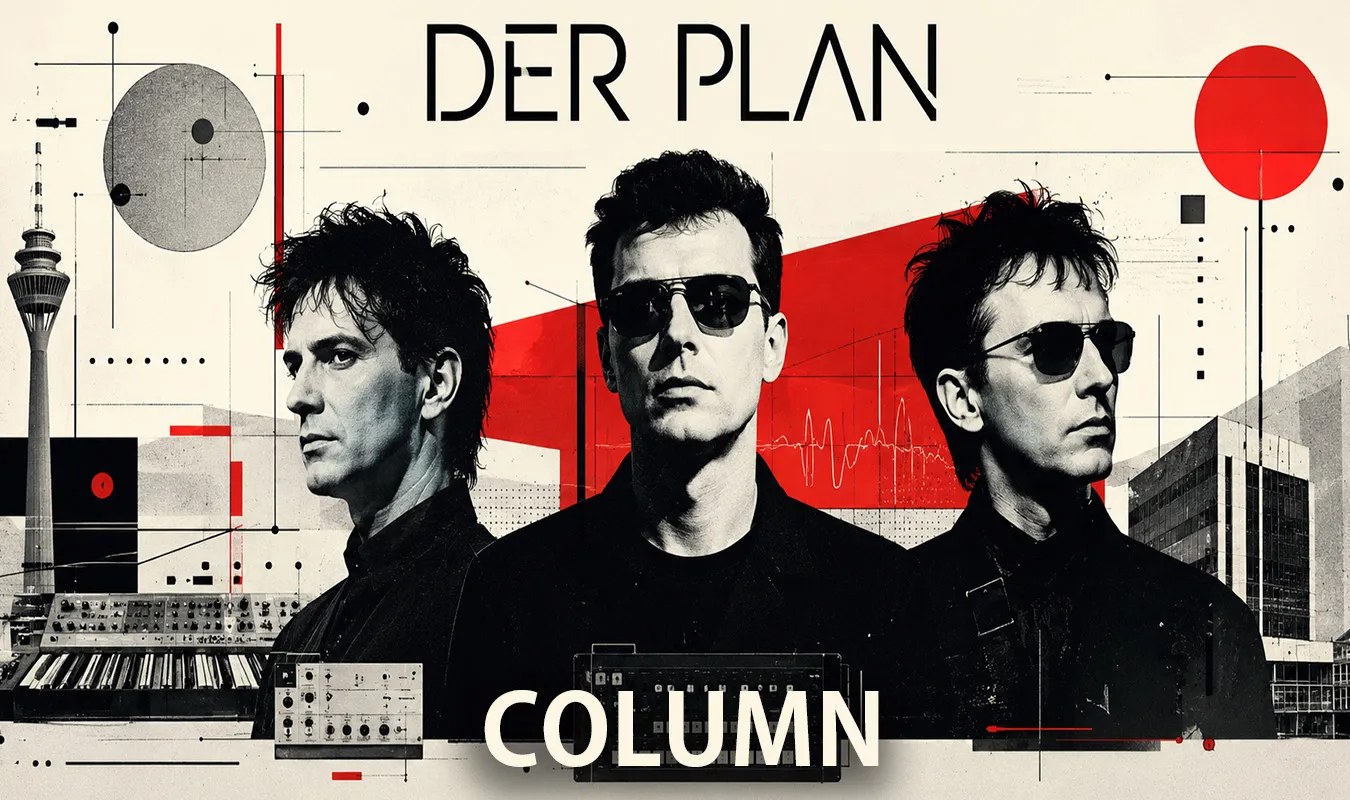
[Column] Der Plan──Another future of electronic music drawn by German avant-pop

Column en Avant Pop Experimental Krautrock
[Column] Der Plan──Another future of electronic music drawn by German avant-pop

Birth in 1979 and the atmosphere of Düsseldorf

Text: mmr|Theme: Der Plan, who overturned the conventional wisdom of pop with humor and electronic music, traces the original trajectory carved into the history of German experimental music.

The flow of electronic music and art around Düsseldorf, Germany from the late 1970s to the early 1990s was not just the development of a musical genre, but also a redesign of urban culture and technological sensibilities. Among them, Der Plan was able to create a unique position by combining humor and an experimental spirit.


Pop experiment born from an industrial city

Der Plan was formed in 1979 by Frank Fenstermacher, Moritz R, Robert Görl and Chrislo Haas. The city of Düsseldorf was known as one of the centers of post-Kraftwerk electronic music, providing an environment where mechanical rhythm and artistic experimentation intersected.

In the German music scene at the time, there was a strong movement to explore new forms of expression while breaking the rock format, and Der Plan was born in this trend. However, they were not just avant-garde artists, but instead chose the position of experimentation under the guise of pop, anticipating the later ““avant pop’’ feel.

The initial membership composition was fluid, and the group’s character as a project-type group was already strongly evident at this point.

The starting point for Der Plan was an experimental field for electronic pop where urban mechanics and playfulness intersect.


Initial member changes and sound reorganization

Nuclei formed in a short period of time

Shortly after their debut, Robert Görl and Chrislo Haas left the group, and with the addition of Kurt Dahlke (Pyrolator), Der Plan’s sound took a major turn. Pyrolator combines electronic music with punk sensibilities and will form the core of the group.

With this change, Der Plan became more than just a band, but a production unit with studio-like thinking. Structural design was more important than instrumentation, and music came to be treated as a ““construction” rather than a ““performance.”

This period was characterized by an extreme mix of pop melodies and mechanical rhythms, which also influenced later synthpop and parts of industrial.

Early fluctuations transformed Der Plan from a fixed band to an experimental production


Experimentality and electronic music development during the Pyrolator era

Coexistence of humor and mechanicality

After joining Pyrolator, Der Plan became more clearly focused on electronic music. The traditional rock structure was deliberately dismantled, with synthesizers, rhythm machines, and tape manipulation taking center stage.

An important characteristic of this period is ““humor.’’ Der Plan was not a serious avant-garde, but rather had a lightness that parodied pop culture. However, its lightness was not just a joke, but also a sharp observation on media society.

The music is fragmented, and the lyrics and structure are discontinuously arranged, so the listener receives a collage-like experience rather than a unified narrative.

Der Plan from the Pyrolator era was a device that dismantled the structure of electronic music with laughter.


1993 Dissolution and Underground Rating

A silent influence

In 1993, Der Plan ceased its activities. This breakup was not dramatic, but rather was perceived as a natural progression. Because of its project-like nature, the end was more like a halt than a clear collapse.

At this point, Der Plan was more of an influence in the underground scene than a commercial success. In particular, he left an indirect influence on electronic music, experimental pop, and noise artists in Germany and abroad.

Their work was later reevaluated and became an important piece of German electronic music in the 1980s.

Even after disbanding, Der Plan remained a reference point for electronic pop experimentation.


2004 restart and branch of Der Plan V.4.0

Collision and redefinition of old and new

In 2004, Moritz R restarts Der Plan with new members Achim Treu and JJ Jones. However, this activity caused a difference of opinion with the original members, and it became a branched form under the name Der Plan V.4.0.

This period is characterized by the problem of originality. The historical meaning of the name Der Plan and the direction of the new project did not necessarily match, and the group’s identity became multiple.

Musically, while incorporating elements of modern electronic music, they sought a direction different from the humorous experimentation of their early days.

The restart was also an attempt to redefine the very concept of Der Plan.


2014 Reunion and Andreas Dorau Birthday Party Live

Short-term revival as a return to origins

In January 2014, the original trio reunited for a short live performance at Andreas Dorau’s 50th birthday event. This reunion has a strong meaning as a symbolic reunion rather than a resumption of long-term activities.

The reunion of friends who share the history of the Düsseldorf scene temporarily brought back the experimental spirit of the past. Although the performance is short, it is an important opportunity to recreate the feeling of the early days.

This event will be marked as a “reconnection” moment in Der Plan’s history.

The 2014 reunion was a musical ritual that momentarily connected past and present.


Continuity from 2017 to the 2025 project

Relocation to modern times

In 2017, new singles and albums will be released, and the original trio will once again take center stage. The approach taken here is not just to recreate the past, but to reconstruct it.

Furthermore, in 2025, the original members will also participate in the Der Plan cover work project, showing a movement to reinterpret history itself. This is not just nostalgia, but an attempt to re-edit material from the past from a modern perspective.

Der Plan’s history is not linear, but rather has a fragmented reboot structure.

Der Plan has become a project that treats time not as a straight line but as an intermittent reconstruction.


Chronology of discography and influence

Fragmentary genealogy of electronic pop

Der Plan’s activities need to be understood not as a single album history, but as a fragmented project history. Below is a structure that visualizes the flow.

graph TD A[1979 Formed] --> B[Initial member change] B --> C[Pyrolator subscription and digitalization] C --> D[Establishment of avant-pop in the 1980s] D --> E[1993 Disbanded] E --> F[2004 V.4.0 restart] F --> G[2014 Original reunion] G --> H[2017 New return] H --> I[2025 Cover Reinterpretation Project]

This flow is not just a chronology of activities, but also a history of re-editing identity.

Furthermore, Der Plan’s influence has spread beyond the direct inheritance of genres, through the ideas of humor, collage, and structural destruction in electronic music.

Especially in the context of German electronic music, they are positioned as introducing a more playful and human distortion to the mechanical nature of the post-Kraftwerk era.

The essence of Der Plan was not the music genre, but the redesign of the structure itself.


Monumental Movement Records

Monumental Movement Records