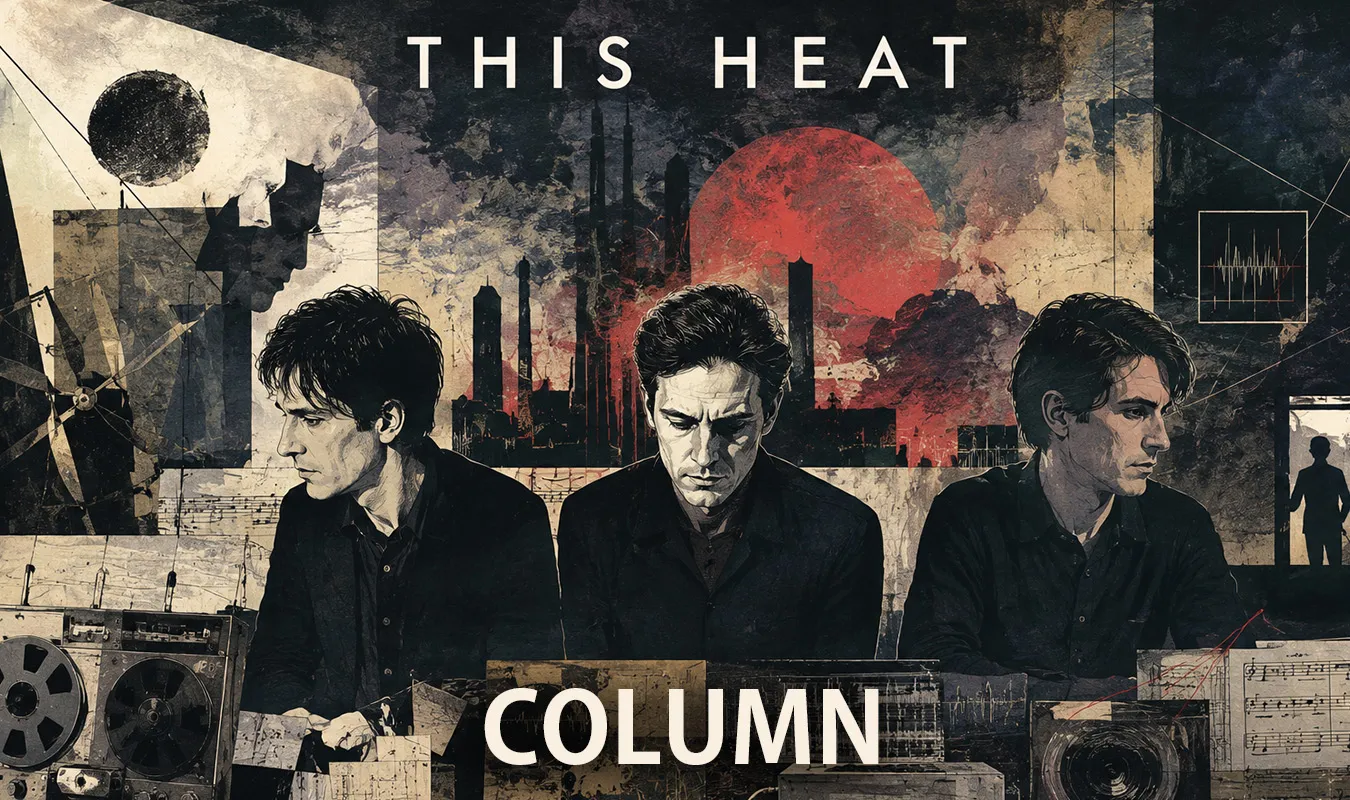
[Column] This Heat: The deepest part of post-punk recorded in an era of discontinuity

Column en Avant-Garde Experimental Post Punk
[Column] This Heat: The deepest part of post-punk recorded in an era of discontinuity

What was This Heat?

Text: mmr|Theme: Cold War anxiety, urban confinement, the DIY spirit, and an obsession with recording technology itself. This Heat transformed post-punk into not just an update of rock, but an act of questioning the sound itself.

In Britain in the late 1970s, post-punk music was rapidly branching out. Bands becoming more political, groups moving towards dance, artists moving closer to electronic music. Among them, This Heat was trying to dismantle the existing rock structure itself.

Formed in 1976, This Heat was started by Charles Hayward, Charles Bullen and Gareth Williams. Although it is generally classified as post-punk, its music defies simple genre classification.

They mixed repetitive funk, contemporary music, tape manipulation, improvisation, ambient sounds, minimal music, noise, and electronic sounds, and brought the tension of a rock band to the mix.

At a time when many post-punk bands were updating their performance style, This Heat was trying to change the very concept of recording.

For them, the studio was not a place for recording. The studio itself was an instrument.

graph TD A["Punk"] --> B["DIY spirit"] A --> C["Political unrest"] A --> D["Approaching experimental music"] B --> E["This Heat Formation"] C --> E D --> E E --> F["Tape editing"] E --> G["Improvisation"] E --> H["Noise and Repetition"]

At the end of the 1970s, Britain was surrounded by an ominous atmosphere, including an economic crisis, rising unemployment, strikes, the expansion of far-right groups, and fears of nuclear war. This Heat’s music is directly imbued with the tensions of the era.

Their work is often described as “apocalyptic.” However, it is not a staged darkness. The feeling of a time when cities and society were truly unstable has been firmly established in the sound.

This Heat was shaking up the musical system itself, not from within the post-punk genre, but from outside it.


Background of the members

Charles Hayward

Charles Hayward was in Quiet Sun before This Heat. Quiet Sun was a progressive rock band with ties to Roxy Music, but Hayward gradually began to feel distant from the group due to its complex technical principles.

He wanted music that was more direct, more physical, and at the same time moved toward unknown sounds.

Hayward as a drummer was very unique. Instead of stabilizing the beat, he breaks up the repetition little by little. Although the tempo is maintained, the listener feels as if the ground is distorting.

This feeling had a strong influence on later post-rock and math rock.

Charles Bullen

Charles Bullen was in charge of guitar, tape manipulation, and electronic sound processing. His guitar is completely different from a typical rock guitar.

Rather than building around riffs, they used fragmented noises, metallic resonances, repetitions, and sustained notes to create space.

Sometimes you can”t even tell that it”s a guitar.

Gareth Williams

Gareth Williams was one of This Heat’s most unpredictable players.

He took on a wide range of roles including keyboards, tape editing, singing, and percussion, and brought a strong sense of experimentation to the band.

Williams” sense is extremely fragmented, with a child”s-song-like melody appearing out of nowhere, then immediately descending into crumbling noise.

This Heat’s instability was exacerbated by his presence.

flowchart TD A["Charles Hayward"] --> D["Rhythm construction"] B["Charles Bullen"] --> E["Guitar and noise"] C["Gareth Williams"] --> F["Tape Editing and Chaos"] D --> G["The uniqueness of This Heat"] E --> G F --> G

There was no clear division of roles among the three. Rather, they continued to invade each other”s territory. That ambiguity kept This Heat”s music from becoming fixed.

This Heat’s sound was created not as a result of the three individuals’ individualities harmonizing, but as a result of constant conflict.


Experimental space called Cold Storage

Cold Storage is absolutely essential when talking about This Heat.

Cold Storage was an independent studio built in a converted former cold storage warehouse in south London. They used it as their home base, recording, editing, and experimenting.

It was crucial to have a space of our own, away from the constraints of a commercial studio.

They cut tapes, spun them backwards, changed speeds, created loops, mixed in ambient sounds, and reimagined improvisations.

Rather than completing the song after recording, the recording process itself was composing.

This is also connected to later sampler culture and DAW-like ideas.

flowchart TD A["Performance"] --> B["recording"] B --> C["Tape cutting"] C --> D["Reverse rotation"] D --> E["edit"] E --> F["Rebuild"] F --> G["Complete song"]

Cold Storage wasn’t just a studio, it was a laboratory.

Music and noise, coincidence and intention, performance and editing. This is where the boundaries become blurred.

There were very few rock bands in the late 1970s that integrated recording and editing into their songwriting concepts to this extent.

Cold Storage could be called the “fourth member” of This Heat.


Debut album “This Heat”

1979’s self-titled album This Heat occupies a unique place in post-punk history.

This album doesn’t have the stability that a normal rock album has.

The album unfolds as a kind of disturbing collage, a series of short snippets, noises, tape edits, repetitions, ambient sounds, and disconnected rhythms.

“Horizontal Hold” was especially symbolic.

As the title suggests, which refers to television interference, the song has a structure in which the signal fluctuates intermittently and is disrupted.

"”24 Track Loop’’ is an important song that combines minimal music and tape experimentation, and influenced later industrial, drone, and noise scenes.

flowchart TD A["Rock"] --> E["This Heat"] B["Tape Music"] --> E C["Minimal Music"] --> E D["Noise"] --> E E --> F["Extending Post Punk"]

This work was not a commercial success. However, it had a strong impact on some listeners and musicians.

In particular, the contradiction of being a rock band, yet denying the framework of rock, inspired many subsequent generations.

"”This Heat’’ pushed post-punk beyond dark rock into the realm of sonic experimentation.


“Deceit” and music from the era of nuclear war

Deceit, released in 1981, is often referred to as This Heat’s best work.

During this period, the Cold War was once again intensifying. The fear of nuclear war existed as a real thing and was deeply embedded in people’s way of life.

"”Deceit’’ is deeply engraved with the atmosphere of that era.

From the album’s opening song, “Sleep,” it sounds like the world is already on the verge of collapse.

Military rhythms, urgent vocals, and unstable harmonies. The song is not just a political message, but a sound that expresses the ““psychological state of fear’’ itself.

“Cenotaph” is particularly known as a representative song.

Although it has content that evokes a world after nuclear war, it is not a simple protest song.

Rather, quiet resignation and strange beauty coexist.

flowchart TD A["Cold War"] --> B["Fear of nuclear war"] B --> C["Social anxiety"] C --> D["Deceit"] D --> E["Cenotaph"] D --> F["Sleep"] D --> G["Paper Hats"]

Deceit was an album that perfectly combined politics and experimentation.

There were many political bands in post-punk, but Rather than shouting slogans, This Heat expressed the sense of social collapse.

"”Deceit” was a work that translated the anxieties of the Cold War era into sound, not as an ““atmosphere,” but as a structure itself.


This Heat as a live band

This Heat has a strong impression of focusing on studio work, but their live performances were also extremely unique.

They actively used tape playback, noise manipulation, and improvisation in their live performances.

As a result, the performance changed greatly each time.

It didn’t have the reproducibility of a normal rock live performance, and what was more appealing was the state of being on the verge of losing control.

For the audience, it felt more like being thrown into a giant sound system than listening to a song.

In particular, Hayward’s drumming was overwhelming live.

Although it seemed like they were playing a simple beat, they kept subtly shifting their accents, making the entire space unstable.

flowchart TD A["Live performance"] --> B["Improvisation"] A --> C["Tape playback"] A --> D["Noise operation"] B --> E["Unpredictable development"] C --> E D --> E

Many people in the audience at the time were confused.

However, on the other hand, a group of people who strongly support this chaos are also emerging.

This Heat’s live performance was not a recreation of a song, but a space where they shared a “state on the verge of collapse.”


Disbandment and too short period of activity

This Heat disbanded in 1982.

It lasted only a few years.

However, the impact it left in such a short period of time was enormous.

It is said that there were multiple reasons for the group’s disbandment, including differences in musical direction, mental fatigue, and financial problems.

Gareth Williams, in particular, gradually began to distance himself from band activities.

This Heat’s music was always dense and on edge.

While this was a source of creativity, it was not something that could be sustained over a long period of time.

After their split, Hayward and Bullen formed Camberwell Now, continuing elements of This Heat.

Meanwhile, Williams has retreated from the spotlight.

flowchart TD A["This Heat"] --> B["Dissolution 1982"] B --> C["Camberwell Now"] B --> D["Individual activities"] C --> E["Continuation of experimental spirit"]

Because it was so short-lived, This Heat has become something of a myth.

But it”s not the mystery that”s important. The fact is that the recordings that have actually survived are still extremely cutting-edge.

This Heat wasn’t a band that disappeared in a short period of time, but a band that reached the future in a short period of time.


Huge impact on subsequent generations

This Heat’s influence quietly spread from the 1980s onwards.

Particularly since the 1990s, many areas such as post-rock, experimental music, industrial, noise, math rock, and avant-rock have been reevaluated.

Many later artists have cited This Heat as an influence, including Slint, Stereolab, Tortoise, Sonic Youth, Radiohead, and Black Midi.

The reason they were praised was not just because of their ““unusual music.’’

This Heat maintained the format of a rock band while destroying its internal structure.

This was a very important point.

It was because they experimented while maintaining the band format, rather than moving toward completely modern music, that they were able to connect with many subsequent generations.

flowchart TD A["This Heat"] --> B["Post Rock"] A --> C["Industrial"] A --> D["Noise"] A --> E["Experimental Rock"] B --> F["Tortoise"] C --> G["Various experimental music"] D --> H["Noise scene"] E --> I["Black Midi"]

Furthermore, the attitude of treating recording editing as an act of composition has become even more important in the digital age.

DAW editing is commonplace these days, but This Heat pushed it to the extreme during the analog tape era.

This Heat was already putting ideas into practice in the late 1970s, anticipating the modern music production environment.


A band that turned “anxiety” into music

If you view This Heat as simply experimental music, you lose sight of its essence.

What makes their music special is not its skill or avant-garde, but the fact that it translated the ““anxieties of the times’’ into sound in a very specific way.

The Cold War, the sense of urban decay, a surveillance society, information noise, and economic instability.

These elements are very relevant to today’s world.

That’s why This Heat never gets old, even in modern times.

In fact, for listeners living in the digital age and beyond, their fragmented and unstable sonic sensibilities may even have a more realistic feel to them.

Fragmented information.

Endless noise.

A sense of constant tension.

This Heat was already expressing them over 40 years ago.

flowchart TD A["Late 1970s"] --> B["Cold War Anxiety"] B --> C["This Heat"] C --> D["Fragmented sound"] D --> E["Modern Digital Society"]

Rather than prophesying the future, their music may have been the result of an extreme pursuit of ““what kind of sounds would humans make when society becomes unstable?’’

This Heat”s work was music that didn”t try to explain the atmosphere of the times, but let you hear the atmosphere itself.


Chronology

Year Events
1976 This Heat Formation
1977 Started working with Cold Storage
1979 “This Heat” announced
1980 “Health and Efficiency” published
1981 “Deceit” announced
1982 Dissolution
Late 1980s Re-evaluation underway
1990s Influence spread to post-rock generation
Since the 2000s Established as an important work of experimental rock

Discography overview

“This Heat” (1979)

Although it is a debut work, it is already completed.

An unusual post-punk piece that mixes noise, tape editing, minimalism, and improvisation.

“Health and Efficiency” (1980)

EP work.

Funk-like repetition and experimental sounds are further enhanced.

“Deceit” (1981)

A masterpiece that captures the tensions of the Cold War era.

An album that combines politics and sonic experimentation to the extreme.

The number of works by This Heat is small. However, its density exceeds that of many long-lived bands.


Why is This Heat still talked about?

This Heat was never a band that achieved mass popularity.

However, the reason why they continue to be talked about even today is clear.

This is because he did not treat “experiments” as mere novelties.

Their experimental nature was deeply connected to the sense of the times and social anxiety.

Therefore, the sound never gets old.

And while genre-crossing has become commonplace these days, This Heat has been traversing rock, noise, contemporary music, electronic music, and improvisation long before that.

They weren’t aiming for genre fusion.

As a result of simply continuing to choose the ““necessary sound,’’ genre boundaries began to disappear.

flowchart TD A["Rock"] --> E["This Heat"] B["Avant-Garde"] --> E C["Tape Music"] --> E D["Improvisation"] --> E E --> F["Bridge to modern experimental music"]

This Heat aren’t the type of band to be preserved as legends of the past.

Rather, it is an existence that continues to be rediscovered every time I search for new music.

This Heat was not a ““difficult masterpiece,’’ but a band that updated the very possibilities of music.


At the end

There”s no sense of security in This Heat”s music.

It’s not easy to listen to either.

But that instability was at their core.

They were trying to record the rifts of an era rather than beautiful melodies.

That’s why the sound resonates with a strange reality even today.

Post-punk is not enough to describe this band.

This Heat recorded the moment when rock changed from “music” to “situation itself.”

And that record remains futuristic even after more than 40 years.

Listening to This Heat’s work is not like appreciating a masterpiece from the past, but rather an experience that connects to the unstable times themselves.


Monumental Movement Records

Monumental Movement Records