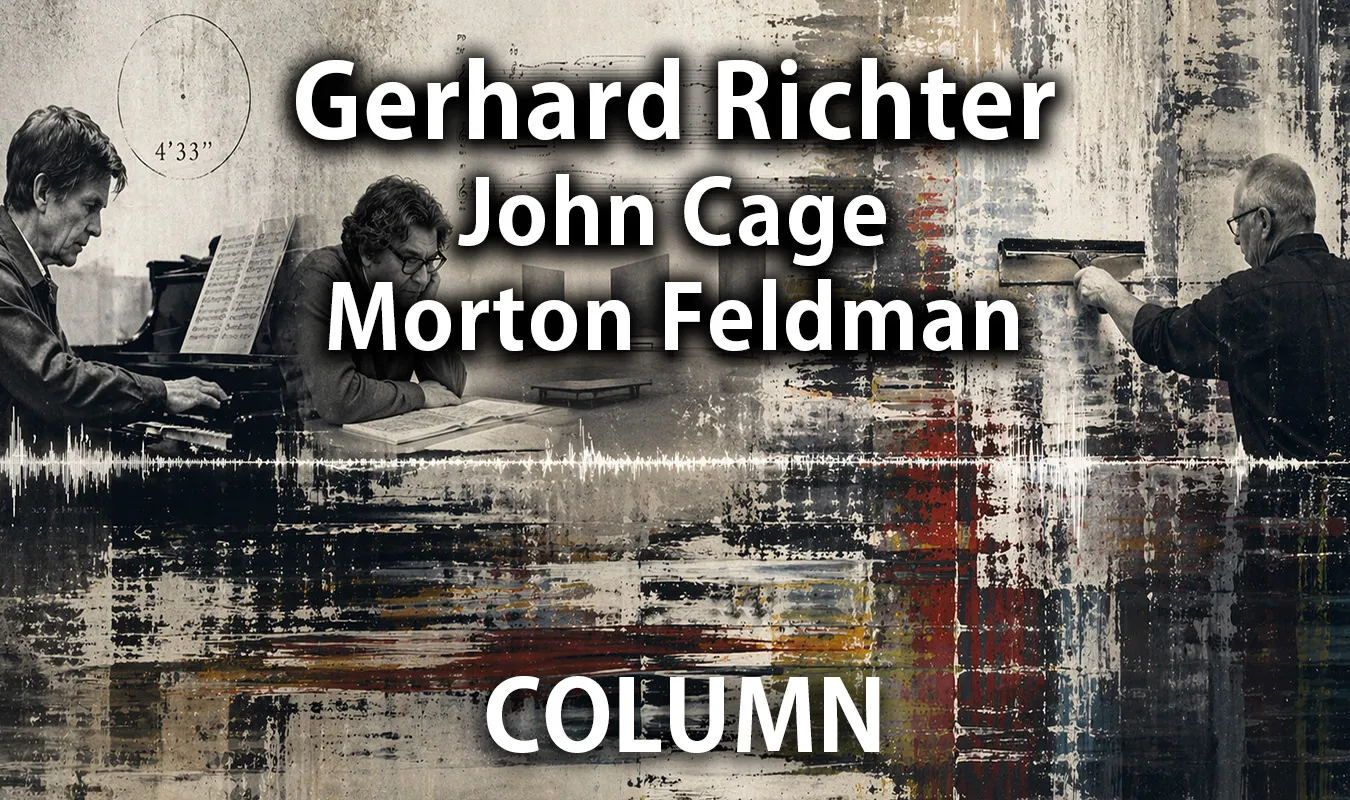
[Column] The moment when randomness and silence changed painting: The depths of Richter and music

Column en Art Experimental Music
[Column] The moment when randomness and silence changed painting: The depths of Richter and music

When silence and coincidence enter the screen

Text: mmr|Theme: The influence of musical ideas of randomness and silence on the layered structure and perception of paintings

Paintings are altered by “auditory thinking”

In postwar art, painting was not just a visual medium, but transformed into a place that encompassed time, chance, and the process of perception itself. Behind these changes, the ideas of music, especially experimental music, are quietly flowing into the world.

Typical examples at this intersection are German painter Gerhard Richter, musician John Cage, and Morton Feldman.

They don’t have a lot of direct collaboration left behind. However, their shared awareness of issues - ““abandoning control,” ““introducing chance,” and ““the meaning of silence’’ - deeply resonates across visual and sound art.

What is especially important is that music has shifted from being a ““structure” to a ““state.” In other words, composing is no longer an act of building order, but has become an act of arranging phenomena and designing ways to open up perception.

This change corresponds perfectly to the layered structure in Richter’s paintings and the accidental creation of traces created by the squeegee.

Just as music opens up in time, painting also begins to have time in its layers.


John Cage: The method of chance

Choosing to let go of control

The core of John Cage”s philosophy was to eliminate the composer”s intentions to the utmost. Rather than “dominating sound,” he aimed to “allow the situation in which sound exists.”

A typical example is 4 minutes 33 seconds. In this work, the performers do not make any sounds, and the environmental sounds become the work itself.

This idea has the following structure:

*Music is not a “sound played” but a “phenomenon that is heard”

  • Randomness is a component, not noise
  • The artist is not the subject of production, but a mediator.

In his compositions, Cage introduced random processes, such as the I Ching, to dismantle intentional structures.

This idea also has a strong influence on painting. Richter”s actions of blurring photographs and stretching paint with a squeegee are similar to Cage”s in that they blur the line between intention and chance.

The important point here is that “coincidence” is not just random. It is a highly engineered framework for accepting uncontrollable factors.

Coincidence is not disorder but “structure outside of intention”


Morton Feldman: Aesthetics of silence and persistence

What happens in places where the sound is about to disappear

Morton Feldman’s music is characterized by extremely low volumes, long durations, and ambiguous structures.

His works often span several hours, and the changes in sound are so gradual that they are almost imperceptible. However, hearing becomes sensitive to minute differences, and the sense of time itself changes.

Feldman was closely associated with painters, especially abstract expressionist artists. Among them, his relationship with Mark Rothko is famous, and his music is often talked about as a painterly space.

Feldman features:

  • Avoiding clear rhythms and structures
  • A series of minute changes
  • A state close to “almost silent”

These are very similar to the overlapping layers in Richter’s abstract paintings.

In Richter’s work, paint is applied, scratched off, and layered again and again. As a result, faint traces of the past remain in the final painting, visualizing the accumulation of time.

This is the same type of ““persistence” and ““memory reverberation” in Feldman’s music.

Silence is not a blank space, but a state of sharpened perception.


Gerhard Richter: The structure of musical painting

Time as a layer

Gerhard Richter’s work oscillates between figurative works that look like photographs at first glance and intensely abstract works.

However, underlying this is a consistent methodology. It deals with the “uncertainty of seeing.”

His creative process:

  1. Draw based on a photo
  2. Obfuscate information by blurring it
  3. Stretch the layers with a squeegee in abstraction
  4. Traces of the underlying layers are exposed.

This process corresponds to the following structure in music:

  • Noise and signal obfuscation
  • Time accumulation by layers
  • A mix of intention and coincidence

The squeegee technique is particularly important. By dragging the paint, the screen undergoes unpredictable changes. This “uncontrollable operation” encompasses both Cage-like contingency and Feldman-like persistence.

Paintings are not finished images, but traces of a process.


Common structure between music and painting

Layers/Time/Perception

The following three concepts are common to all three:

1. Layer

  • Sound: Overlapping acoustics
  • Painting: layered paint

2. Time

  • Music: Persistence and Change
  • Paintings: Traces of the production process

3. Perception

  • Hearing: Concentration on minute differences
  • Vision: Perception in ambiguity

These can be diagrammed as shown below.

graph TD A[coincidence] --> B[Demolition of the structure] B --> C[Generating layers] C --> D[Time visualization] D --> E[transformation of perception]

This trend is not just a technique of art or music, but an attempt to redefine the very nature of experience.

Art has moved away from the object to the process of perception itself.


The role of sound at the production site

Music that was actually playing

Although there is limited evidence that Richter himself always played specific music, given his historical background and friendships, it is highly likely that the following types of music were present in his production environment:

  • Avant-garde music (Cage, Feldman)
  • Minimal music
  • Atonal/experimental music

These musics do not have rhythms or melodies that encourage concentration. Instead, it blends into the space as part of the environment.

What is important during production is ““sound that does not distract.’’ Like Feldman’s music, sounds that are present but unassertive do not interfere with visual thinking.

Furthermore, Cage’s acceptance of environmental sounds transforms the studio itself into a part of the creation of the work.

Sound is not a background, but an element that makes up the production environment itself.


Chronology: Intersecting streams of thought

timeline 1950 : John Cage 偶然性の導入 1952 : 4分33秒 初演 1960 : Morton Feldman 静寂と持続の作品群 1962 : Gerhard Richter 制作開始 1970 : 抽象絵画への移行 1980 : スクイージー技法の発展 2000 : 大規模抽象作品の展開

Masterpiece: Embodiment of randomness, silence, and layers

John Cage《4 minutes 33 seconds》 (1952)

This work is treated as an extreme turning point in music history.

The performer sits at the piano, but does not make any sounds. Instead, the breathing of the audience, the creaking of the chairs, and the sounds of the external environment emerge as ““works.’’

The important point of the cage is not ““silence” but ““manifesting environmental sounds”.

The structure presented by this work is as follows:

  • Composition = not sound design
  • Space = musical instrument
  • Coincidence = component

This idea is strongly connected to the ““controlled collapse”’ in Richter”s later paintings.

It”s not that there is no sound, it”s just that the sound that is already there is being heard.


Morton Feldman《Rothko Chapel》(1971)

This work was written for the chapel space of painter Mark Rothko.

The music is extremely quiet, fragmented, and sustained. There is almost no clear melody or development.

The following three features:

  • Sound appears extremely slow
  • Intervals between notes act as spaces
  • The space itself becomes music

Feldman deals with the “quality of time” rather than the “structure of sound.”

In this work, sound is not in the foreground or background, but exists as “particles of perception.”

This is similar to the overlapping layers in Richter’s abstract paintings.

The sound does not progress. just staying there


Gerhard Richter《Abstract Painting》 (series from the 1980s)

Richter’s abstract works are created by dragging paint with a squeegee (a large spatula-like tool).

This operation causes the following symptoms:

  • Underlying colors are partially exposed
  • Intentional shape collapses
  • Accidental layers are fixed

What is especially important is that it is an act of ““causing” rather than ““drawing.”

Musically speaking, this process is more like ““setting up a generative environment’’ than improvisation or composition.

Richter’s works are not completed drawings, but exist as traces of time.

A painting is not an image, but a surface on which time has accumulated.


Visual structure comparison diagram

Below is an auxiliary diagram showing the structural relationship between the three.

graph TD A[John Cage] --> A1[coincidence] A1 --> A2[Emergence of environmental sounds] B[Morton Feldman] --> B1[silence] B1 --> B2[dilution of time] C[Gerhard Richter] --> C1[layer structure] C1 --> C2[visual coincidence] A2 --> D[Restructuring of perception] B2 --> D C2 --> D D --> E[Art = transition to a place of experience]

Supplement: Common denominator: production space

What all three have in common is that they deal with the ““conditions under which a work occurs” rather than the ““work itself.”

  • Cage: The environment where sound is created
  • Feldman: An environment where time collapses
  • Richter: An environment that makes vision unstable

In other words, rather than creating works of art, they are designing ““devices that change perception.’’

From this point of view, the boundary between music and painting disappears, and the two belong to the same problem system.

Art is not about representing something, but about rewriting the rules of perception.


The ““Anecdote/Legend Part’’ can be added or expanded to existing columns without disrupting the flow. While increasing the overall density, only episodes that can be told based on facts are selected.


Anecdotes and practices surrounding chance and silence

John Cage: The moment I heard silence

The most well-known event that determined John Cage’s thinking was his experience in an anechoic chamber at Harvard University.

He went into the room to experience complete silence, but says he ended up hearing two sounds. One is a high pitched sound and the other is a low pitched pitch. They were the sounds of their own nervous system and blood flow, respectively.

This experience led him to the conclusion that ““complete silence does not exist.’’

This anecdote is not just an anecdote, but serves as the ideological basis for 4 minutes 33 seconds. In other words, this work did not ““eliminate sound,” but ““exposed the ever-present sound.”

Cage is also known for his emphasis on chance in his daily life. He used the I Ching not only in his compositions, but also in the content of his lectures and the structure of his texts, and continued to avoid intentional meaning generation.

For him, art was not expression, but ““acceptance of phenomena.’’

Chance is the way humans perceive the order that the world already has.


Morton Feldman: Music where time collapses

Morton Feldman is a composer who fundamentally changed the way “time” is treated in music.

What is most symbolic of his anecdotes is his attitude toward extremely long works. Although some of his later works are over five hours long, he did not consider them “long.”

In his words, the problem is not the length, but “the way we perceive time.”

Feldman continued to use the same pattern with slight variations to avoid repetition. As a result, the music does not progress and becomes adrift.

He also placed strong demands on his performers. It is necessary to maintain an extremely low volume for a long period of time, and playing becomes a matter of sustained concentration rather than technique.

His work ““String Quartet II’’ lasts approximately six hours, and many audience members are known to leave their seats midway through. However, the experience itself is part of the work.

More importantly, Feldman was strongly influenced by the visual arts. In particular, he had deep interactions with abstract expressionist painters, and the idea of ​​viewing music as ““space’’ was born from there.

Music does not unfold in time, it exists within time.


Gerhard Richter: Between control and destruction

There is a constant tension between chance and control in Gerhard Richter’s work.

His work in the studio is often recorded, but what is particularly impressive is the act of daring to destroy a work that is nearing completion.

A squeegee is used to spread out the layers of paint, exposing the lower layers. As a result, a composition that took several hours to construct can collapse in an instant.

However, this “destruction” is not a failure. Rather, it is a means to bring out a structure that goes beyond intention.

Richter himself has repeatedly said, ““You can’t plan a good painting.’’

He is also known for his technique of blurring photographs. This is not just a style, but an attempt to visualize the “uncertainty of memory.”

The photograph, which is supposed to be clear, becomes ambiguous, and the viewer is placed in a state of trying to “see.”

This process is similar to Feldman”s subtle changes in music and Cage”s manifestation of environmental sounds.

Only when you let go of control does the work begin to move autonomously.


Legendary moments that intersect

Cage meets Feldman

John Cage and Feldman first met at a concert at the New York Philharmonic in 1950.

On the night that Webern”s work was performed, the audience”s reaction was mixed, and the venue was in an uproar.

After the performance, the two of them happened to sit next to each other, and they started talking not about music, but about the nature of music, and immediately hit it off.

This encounter determined the future direction of American experimental music.

Although they both sought to liberate themselves from “structure,” their methods were contrasting:

  • Cage: Demolition by chance
  • Feldman: Dilution through silence

These two approaches end up at the same point - a transformation of perception.

Even though the methods were different, we were aiming for the same horizon.


The distance between Richter and musical thinking

Richter is not a musician. However, there is a clear “musical structure” to his production.

They are not rhythms or melodies, but abstract elements such as:

  • Layer = harmony
  • Squeegee = Noise
  • Blur = attenuation

Although these are not direct applications of music theory, they resonate strongly with auditory thinking.

Furthermore, in his works, ““stopped time” and ““fluid time” exist simultaneously. This can be thought of as a visualization of Feldman”s duration and the temporality of Cage”s environmental sounds.

The painting is still, but time continues to move inside it.


Expanded structure diagram

graph TD A[coincidence] --> B[relinquishing control] B --> C[generation process] C --> D[layer formation] D --> E[accumulation of time] E --> F[transformation of perception] G[silence] --> H[dilution of sound] H --> E I[Visual obfuscation] --> D

What the legend shows

These anecdotes and production practices are more than just interesting stories. Each represents a decisive turning point that will change the very nature of art.

Cage deconstructed the ““presence of sound,” Feldman the ““sense of time,” and Richter the ““certainty of vision.’’

The result is not a work of art, but a ““place of experience’’.

Watching and listening become part of the work itself.

This structure continues into current sound art, installations, and even digital expression.

Art is not a completed object, but a process that continues to open as an experience.


Conclusion: The boundary between seeing and listening

John Cage, Morton Feldman, and Gerhard Richter. Although these three researchers belonged to different fields, they were all working on the common challenge of ““redesigning perception.’’

Music moves toward silence, and painting moves toward ambiguity. As a result, both have become media that present ““experiences” rather than ““meanings.”

What is important is that this change is still continuing. Chance and layered structure continue to be central concepts in contemporary sound art and data art.

Art has moved from being about what it represents to how it is perceived.


Monumental Movement Records

Monumental Movement Records