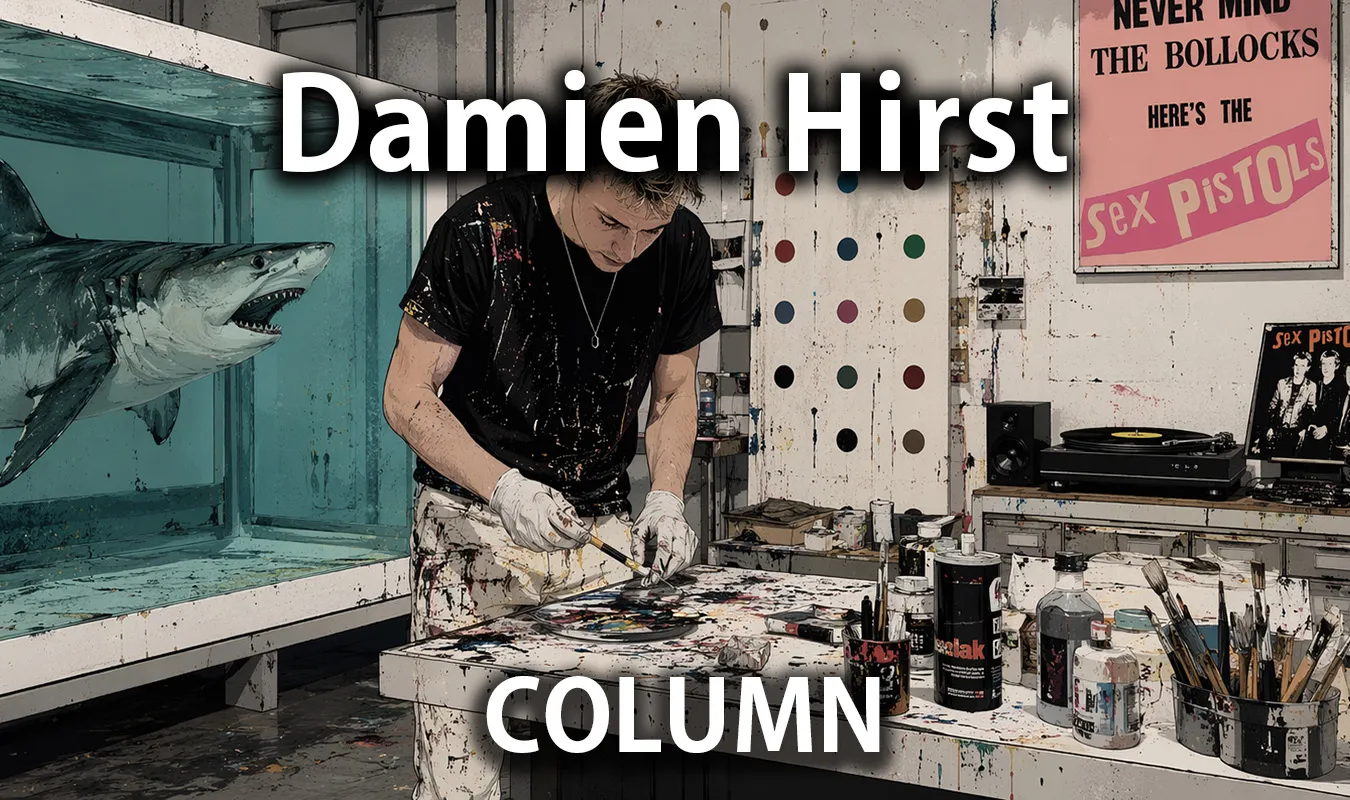
[Column] Damien Hirst and the speed of punk: the rhythm of production driven by anti-establishment
Column en Art Music Punk
Introduction: Noise and speed in the studio
Text: mmr|Theme: Interpreting the influence of music flowing in the production environment on the speed and ideology of works in contemporary art since the 1980s, based on the relationship between Damien Hirst and punk.
From the late 1980s to the 1990s, British contemporary art underwent a major transformation. At the center of this was Damien Hirst. His works are often talked about in terms of their visual intensity, such as animals soaked in formalin and the arrangement of medical instruments, but there was a clear ““sound’’ in the background of his creation.
The symbol of this sound is punk, represented by The Sex Pistols.
Punk was more than just a music genre; it was an attitude of speed, destruction, and hostility to the system. In Hearst’s studio, music functioned not as decoration, but as an engine that accelerated the tempo and decision-making of his productions.
Music was not just a background, but functioned as a device that determined the speed of production itself.
What is punk? Aesthetics of anti-establishment and immediacy
1970s London Explosion
When The Sex Pistols appeared in Britain in the late 1970s, economic recession and youth unemployment were becoming more serious. In such a social situation, their music possessed a thoroughgoing simplicity and aggression.
As seen in their signature song “God Save the Queen,” punk is premised on a blatant rejection of existing value systems. Impulse and immediacy take precedence over sophistication of playing technique.
Thoughts on DIY and destruction
An important characteristic of punk is its DIY spirit. Make it yourself and present it yourself. The process does not involve institutions or authorities.
This structure strongly resonates with criticism of academicism and the market system in art. Before Hearst, galleries and critics determined values in the art world, but punk had the power to override that very structure.
Punk was not only music, but also a thinking model for short-circuiting the existing system.
Hearst’s early activities and musical environment
Goldsmiths College and autonomous exhibitions
While studying at Goldsmiths College in London, Damien Hirst held the exhibition ““Freeze’’ (1988), which he curated himself. This act itself is already punk-like.
His attitude of creating his own space without relying on existing galleries overlaps with the independent movement in the music scene.
Studio atmosphere
It is said that music was always playing at Hearst’s production sites. Punk and rock music in particular played an important role in maintaining a sense of speed.
In his work, which involved repetitive tasks and mass production, music was not used to maintain concentration, but rather to encourage acceleration and decision-making.
Music at the production site existed not to deepen thinking but to speed up judgment.
Art as speed: changes in the production process
Strategy of not getting lost
The punk aesthetic lies in the immediacy of ““doing before thinking.’’ This attitude can also be seen in Hirst’s production.
His formalin works, one of his masterpieces, have a very direct process from conception to realization. Once the concept is decided, we immediately turn it into material.
Assistant systems and industrial production
From an early stage, Hearst established a production system using assistants. This is reminiscent of Andy Warhol’s Factory, but its operation is more efficient.
From a musical perspective, this is more of a “production” than a band. It has a structure that produces a large amount of output while maintaining a rhythm.
The production scene has changed to a system driven not by the inner self of the individual but by rhythm and division of labor.
Transformation of anti-establishment: Inside the system
YBA and the market
Hirst dominated the art market in the 1990s as a central figure of Young British Artists.
What is important here is the process by which punk anti-establishmentism is absorbed into the market. The attitude that once denied the system has instead become a factor that creates market value.
Works as provocations
Works that use animal carcasses and medical equipment raise ethical debates. This is similar to the provocative nature of punk.
However, the provocation is no longer external to the system, but operates within it. Within the institutions of galleries and museums, a structure has emerged in which criticism is commodified.
Anti-establishment has not disappeared, but has transformed into a form that is converted into value within the system.
Resonance of music and visuals: Works as rhythm
Repetition and structure
The repetition in Hirst’s spot paintings is similar to musical rhythm. A series of homogeneous patterns is similar to minimal music, but the speed of execution is more punk-like.
Contrast between noise and silence
The noisy energy of punk and the inorganic stillness of Hirst’s work. Although this contrast may seem contradictory at first glance, they actually have the same structure.
The void that comes after too much energy. Its amplitude creates the strength of the work.
The violence of sound and the silence of sight are just different expressions of the same amplitude.
Chronology: Intersection of music and art
Structure diagram: the role of music in production
Conclusion: An era where speed becomes valuable
To understand Damien Hirst’s production, you need to listen not only to the visual elements but also to the music that was playing in the studio.
Punk, exemplified by The Sex Pistols, was more than just an influence, it provided an underlying logic of production. Speed, immediacy, anti-establishment. All of these are directly connected to the generation of new value in contemporary art.
And now, its value has become inseparable from the market. What was once a rebellion has now become part of the most efficient production strategy.
When speed itself is converted into value, art appears as movement rather than thought.