[Column] New Age Steppers: The revolution of an action label that reconnected the strata of post-punk and dub
Column en 70s 80s Dub Post-Punk![[Column] New Age Steppers: The revolution of an action label that reconnected the strata of post-punk and dub](/../assets/images/column-new-age-steppers.webp)
Prologue: Destruction and Reconstruction of London in 1979–80
Text: mmr|Theme: About the history of the “mixed team” that symbolized On-U Sound and the innovations it left behind
In London at the end of the 1970s, even though the punk explosion had subsided, society was still plagued by many rifts such as unemployment, division, strikes, and discrimination against immigrants. The scene seemed like a wasteland, but its crevices became a hotbed of music. Post-punk artists quickly moved beyond the rock format into dub, reggae, African percussion, noise, electronic sounds, and DIY recording techniques.
It was precisely during these complex times that a young producer named Adrian Sherwood rose up and began forming the vast network that would become known as On-U Sound. And the earliest ““symbols” and ““thoughts themselves” were none other than New Age Steppers.
Chapter 1 Who were the New Age Steppers?
New Age Steppers (hereinafter referred to as NAS) is not a normal “band”. The members changed with each album, and the style, which was a mix of post-punk and reggae musicians, was almost unheard of at the time.
The core person
- Adrian Sherwood: Producer/Director of On-U Sound
- Ari Up (The Slits): Vocals
- Mark Stewart (The Pop Group): Vocals
- George “Bingy Bunny” Valentine (Roots Radics): Guitar
- Style Scott (Roots Radics): Drums
- Bruce Smith (The Pop Group): Drums
- Steve Beresford, Dan Shears, Eskimo Fox and many more
This structure was born from the confluence of ““reggae session culture” and ““post-punk experimentalism.” In other words, what are New Age Steppers?
“Musical body as an intersection of genres = hybrid project”
It was an existence that valued ““variability and contact’’ rather than a fixed identity.
Chapter 2 Adrian Sherwood and the formation of On-U Sound
Sherwood had been involved in reggae labels and distribution since the 1970s, and had deep connections with Jamaican musicians. At the same time, he interacted with post-punk acts such as The Slits, The Pop Group, The Fall, and Alternative TV, and intuitively understood the ““distrust of the existing music system’’ that they felt.
In 1979, he started On-U Sound to maximize his experiments. NAS was the earliest symbol of this, establishing the impression that “On-U Sound = a cross-border, DIY sound laboratory.”
Chapter 3 Innovation in Sound: Fusion of Post-Punk x Dub
● Post-punk aggression
- Rough and minimalistic
- Destroy the structure of the lock
- Noise, improvisation, politics
● Jamaican Dub Method
- Rhythm-centered
- Spatial processing (echo/delay)
- Track “deconstruction and re-editing”
The core of the NAS recordings was Sherwood’s desktop dub mix, and rather than using the played sounds as they were, they were rearranged and spatially processed after recording to give them new life. In particular, the tight grooves of the Roots Radics group and the rough and wild energy of the post-punk side create a ““shaking and tension’’.
This fusion was shocking even for Britain at the time. This is because there was a deep cultural gap between the Jamaican immigrant community and the white punk/avant-garde crowd in London, and there were very few musical projects that directly interacted with each other.
NAS is recorded as an early example of straddling that gap and creating a space for co-production.
Chapter 4 Ari Up and “weapon called voice”
The face of NAS is Ari Up, a member of The Slits. Her vocals were a unique blend of Jamaican toast, post-punk screams, and girlish abandon.
Ari has been deeply into reggae since his teens, so joining NAS was a natural progression. Her voice is often primal, shaking, breaking, tearing, and dancing. This flows throughout the work as an “energy of resistance against society.”
Their version of the cover song “Fade Away” is known as one of the strongest reinterpretations in post-punk history.
Chapter 5 Changes by album (1981–2012)
■ “New Age Steppers” (1981)
A debut work that most symbolizes the spirit of NAS. Ari Up”s presence, Roots Radics’ performance, and Sherwood”s tabletop dubs all came together to set the standard for hybrid music.
Representative song
- Fade Away
- My Love
- Love Forever
■ “Action Battlefield” (1981)
It’s more aggressive and has a strong post-punk feel. Mark Stewart’s participation strengthened the agitation.
■ “Foundation Steppers” (1983)
It’s the most “reggae-like” song as NAS, and the sense of stable groove increases. This work also has strong socio-political themes.
■ “Love Forever” (2012)
After Ari Up’s death, Sherwood released a memorial work that included unreleased recordings. A very important document that contains Ari’s final energy.
Chapter 6 Place in music history: Why are New Age Steppers important?
1. Pioneering project that transcends genre boundaries
NAS led the way in creating a structure that put post-punk and dub on the same table and centered on “experiment.”
2. The core of On-U Sound
Without NAS, subsequent On-U projects such as African Head Charge, Dub Syndicate, and Tackhead would not have been born.
3. Popularization of the concept of “mixed membership system”
The ““collective philosophy,’’ which does not limit music to fixed band members or genres, was inherited by the later Bristol scene, Trip Hop, and the world’s underground.
4. Symbol of cross-border culture
It is also emblematic in British cultural history for its practical collaboration between immigrant communities and white post-punk figures.
Chapter 7 Recording technology and studio aesthetics
Sherwood’s studio method is “About half of the work is created after recording” It was so dub-like that the engineering itself was an act of composition.
Key technologies
*Roland Space Echo
- Spring Reverb
- 4-track to 8-track analog processing
- Emphasis on drum/bass separation
- Cut and paste live recording material
- Dub method that turns fader operations into performances
This aesthetic continues in current electronic music/ambient/bass music.
Chapter 8 Social and Cultural Background: Connections with UK Immigration History
NAS was more than just a musical project; it became serious in the UK in the 1970s and 1980s.
- Youth unemployment
- Immigration discrimination
- Skinhead violence
- Brixton Riots
- Cuts in public services
It has a background of social issues such as.
Ari Up had a long history with the Jamaican immigrant community, and Mark Stewart had an anti-capitalist stance. Even if NAS did not directly post political lyrics, ““making music as an experiment’’ in a multicultural society was itself a political practice.
Chapter 9 Dissipation and expansion of influence
After 1983’s “Foundation Steppers,” works under the NAS name ceased. But its influence spread far and wide.
● Area affected
- Bristol’s Massive Attack, Tricky, Smith & Mighty
- UK Dub, Digital Dub
- Experimental / Post-Industrial *Alternative Dance
- DIY label culture
NAS can be said to be an extremely modern model in that it has made “crossing genres” the norm.
Chapter 10 Re-evaluation and the death of Ari Up (2010)
Ari Up passed away in 2010. Deeply affected, Sherwood compiled unreleased takes and past recordings and released them as 2012’s ““Love Forever’‘.
This work not only concluded the history of NAS, but also reaffirmed the importance of Ari.
Chapter 11 “Thoughts” left behind by New Age Steppers
NAS is based on “Do not divide music along the lines of nationality or genre” This is the idea.
And this thought
- Multicultural coexistence
- Anti-authoritarianism
- DIY spirit
- Ethics of collaboration It is still deeply alive today in the form of
The prototype for the “genre-crossing creation” that 21st century musicians routinely engage in is surprisingly close to what NAS did.
Chronology
1979 Adrian Sherwood begins preparations to launch On-U Sound 1980 Recording of New Age Steppers begins (Ari Up, Mark Stewart, Roots Radics participate) 1981 “New Age Steppers” released 1981 “Action Battlefield” released 1983 “Foundation Steppers” released 1984-2000 NAS activities virtually ceased 2010 Ari Up passed away 2012 “Love Forever” released (Memorial work including unreleased material)
Structure map of New Age Steppers
Producer] --> B[Ari Up
The Slits] A --> C[Mark Stewart
The Pop Group] A --> D[Roots Radics
Session Musicians] D --> D1[Style Scott
Drums] D --> D2[Bingy Bunny
Guitar] B --> E[New Age Steppers
1981-2012] C --> E D1 --> E D2 --> E E --> F[On-U Sound
Experimental Dub] F --> G[African Head Charge] F --> H[Dub Syndicate] F --> I[Tackhead]
Conclusion: New Age Steppers is “current” music
Although the work was made over 40 years ago, the sound of New Age Steppers still sounds new today. This is the premise of music production after the Internet.
- Collaboration across borders
- Genre hybridization
- Fusion of production and engineering *DIY studio culture
NAS, which pioneered these trends in the early 1980s, can be said to be the prototype of modern music.
The sound they left behind was intense, rough, swinging, bouncy, and sometimes destructive, but at its core, it was about being free. That freedom continues to be felt in On-U Sound’s work and underground scenes around the world.
Explore more like this
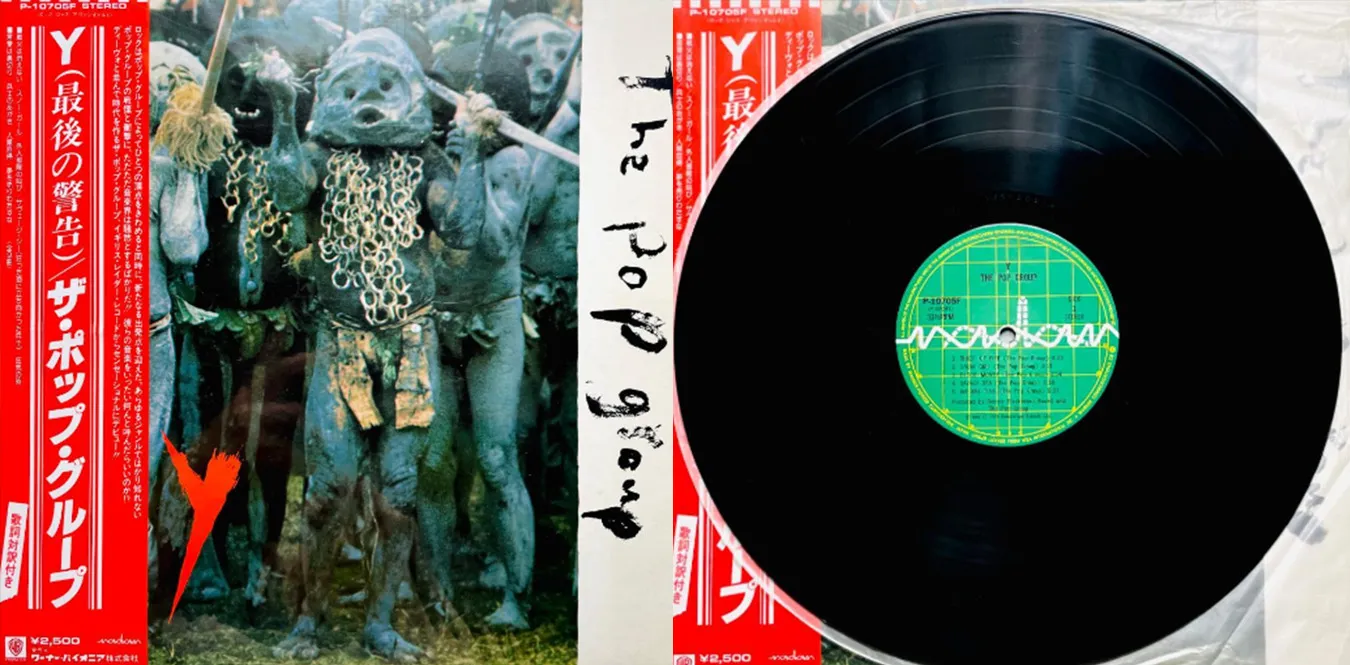
The Pop Group = The Pop Group – Y = Y (last warning)
The Pop Group is a post-punk band from Bristol, England, formed in 1977.
![[Column] Tatsuro Yamashita: Analog aesthetics and changes in sound after transition to digital](/../assets/images/column-yamashita-tatsuro.webp)
[Column] Tatsuro Yamashita: Analog aesthetics and changes in sound after transition to digital
Production environment, equipment, recording methods, studio culture, media specifications
![[Column] Kronos Quartet: The trajectory of a string quartet that continues to innovate and take on challenges](/../assets/images/column-kronos-quartet.webp)
![[Column] James Chance and the Contortions: No Wave pioneers and their musical analysis](/../assets/images/column-james-chance-and-the-contortions.webp)
![[Column] Penguin Cafe Orchestra - An imaginary paradise that resonates between ambient and folklore](/../assets/images/column-penguin-cafe-orchestra.webp)
[Column] Penguin Cafe Orchestra - An imaginary paradise that resonates between ambient and folklore
Prologue: Reverberations of a “fictional cafe” found nowhere else in the world
![[Column] Parliament / Funkadelic: The whole story of the P-Funk revolution - deciphering space myths, groove techniques, and cultural heritage](/../assets/images/column-parliament-funkadelic.webp)
[Column] Parliament / Funkadelic: The whole story of the P-Funk revolution - deciphering space myths, groove techniques, and cultural heritage
Prologue: What is P-Funk? A cosmic cultural revolution that goes beyond “funk”
![[Column] Toots and the Maytals — The soul of reggae etched by live performances](/../assets/images/column-toots-and-the-maytals-live-history.webp)
[Column] Toots and the Maytals — The soul of reggae etched by live performances
Introduction: The birth of reggae and the origins of live culture
![[Column] Marvin Gaye: Between Love and Pain - Salvation and Destruction as Seen by the God of Souls](/../assets/images/column-marvin-gaye.webp)
[Column] Marvin Gaye: Between Love and Pain - Salvation and Destruction as Seen by the God of Souls
From Motown star to lonely wanderer to tragic end
![[Column] Mobile Suit Gundam and the universe of music - Mobile suits as a symphony](/../assets/images/column-gundam.webp)
[Column] Mobile Suit Gundam and the universe of music - Mobile suits as a symphony
I. Starting point in the 1960s: Beyond musical institutions
![[Column] The Pop Group - The rebellious sound and historical background born in Bristol](/../assets/images/column-popgroup.webp)
[Column] The Pop Group - The rebellious sound and historical background born in Bristol
Prologue: The seeds of an explosion that the era is pregnant with
![[Column] From Joy Division to New Order: The evolution of Manchester sound](/../assets/images/column-joy-division-new-order.webp)
[Column] From Joy Division to New Order: The evolution of Manchester sound
Prologue: From Silence to a Sea of Electronics — Manchester Dawn
![[Column] Ambient: From](/../assets/images/column-ambient2.webp)