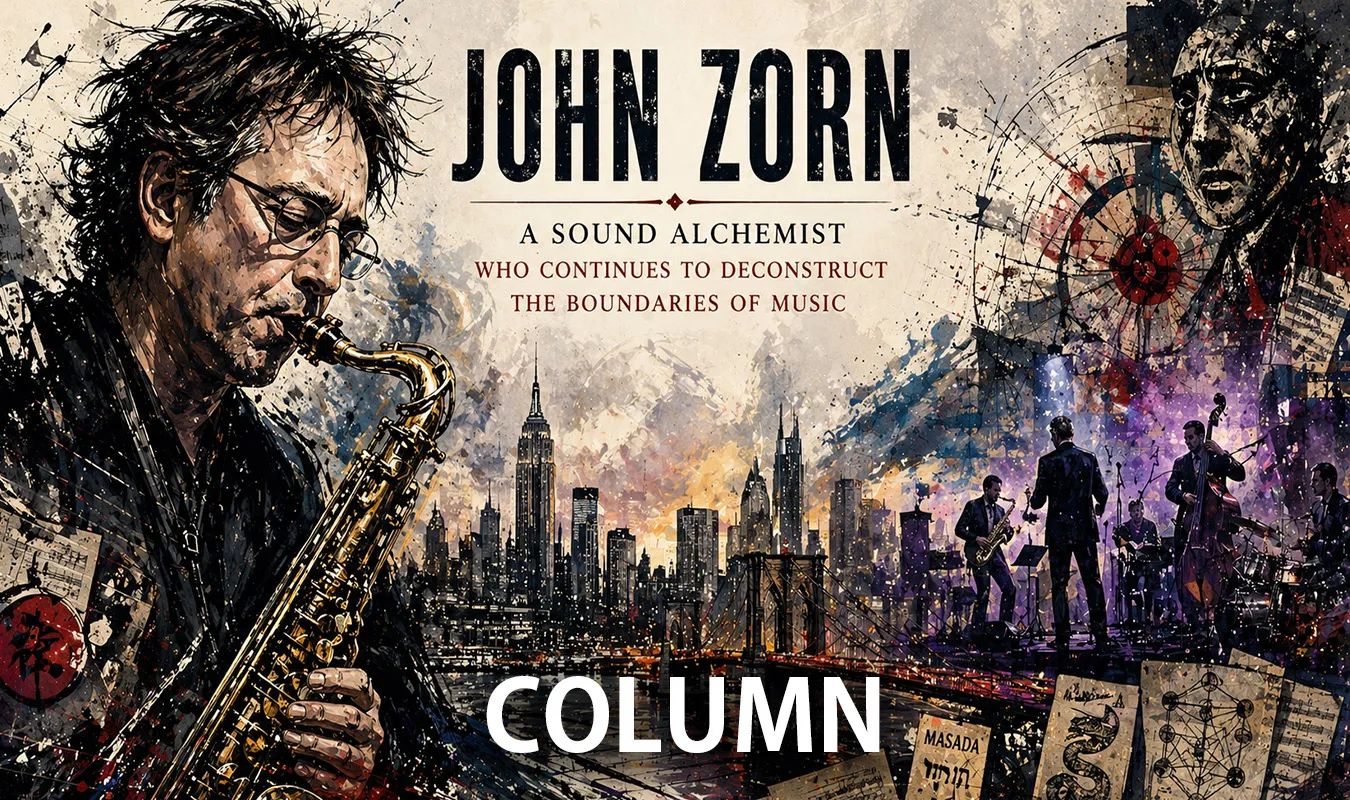
[Column] John Zorn: An alchemist of sound who continues to dismantle the boundaries of music
Column en Avant-Garde Improvisation Noise
John Zorn
Text: mmr|Theme: John Zorn’s creative philosophy that continues to cross genres and the trajectory of musical experiments born from the city of New York
A maverick musician who crosses noise, jazz, and film music
When you first hear the name John Zorn, few people can describe his music in one sentence. Although he is a jazz saxophonist, his work extends beyond free jazz to include noise, hardcore, classical music, and even film music and Jewish music.
Born in New York, USA in 1953, Zorn was exposed to classical and contemporary music from an early age, and eventually became interested in rock and jazz through records. What determined his view of music was a strong sense of discomfort with the framework of existing genres.
From an early stage, Zorn took the position that ““music is an event, not a category.’’ As a result, his works are characterized by sudden shifts in tone, sudden changes in genre, and contrasts between silence and explosion.
John Zorn is a rare musician whose creation is in itself the act of breaking genres.
New York Downtown Scene and Experimental Spirit
Improvised networks fostered by loft culture
From the late 1970s to the 1980s, Zorn was heavily involved in New York’s downtown scene. During this period, New York became a place for artists outside the established music industry to perform experimentally in lofts and small clubs.
Particularly influential were the ideas of radical musicians such as Ornette Coleman and John Cage. Improvisation, chance, and the deconstruction of structure. These had a direct influence on Zorn’s compositional method.
In this environment, Zorn established a unique composition method called “game piece”. This is a method of controlling performance based on rules rather than musical scores, and the real-time decisions of the performers shape the music.
His masterpiece ““Cobra’’ is a symbol of this, in which Zorn, who plays the role of a conductor, gives instructions to the performers using cards and gestures, creating both improvisation and structure at the same time.
New York”s underground culture was Zorn”s testing ground for redefining music itself.
Representative albums and musical breakthroughs
A discography where fragments and stories intersect
Zorn’s body of work is vast, but one of his most important albums marks a turning point in his thinking.
First up is Naked City (1989). This work by the band of the same name had a shocking structure that switched genres in seconds, and it instantly made Zone famous. Jazz, hardcore, and film music collide, and the very continuity of music is dismantled.
Next was “Torture Garden” (1989). This is even more extreme, with each song lasting anywhere from a few seconds to less than a minute. Before the listener can “taste” the music, they are thrown into the next snippet.
In the 1990s, Masada Project’s ““Masada: Alef’’ (1994) was an important turning point. Although it is based on Jewish melodies, it has been reconstructed in an improvised jazz format. This is a work where melodic beauty comes to the fore rather than intensity, and another side of Zorn becomes clear.
Furthermore, ““Spillane” (1987) is an album that can be described as a ““literary work of sound” composed based on text and images. The worldview of hard-boiled author Mickey Spillane is recreated in sound, with narration and music intricately intertwined.
"”The Gift’’ (2001) is unique in the 2000s and beyond. Incorporating elements of lounge and surf music, it presents a relaxed side that differs from the violent sound image of the past.
Zone’s albums are experimental devices that each present a different view of music.
Naked City and genre explosion
A collage of sounds that cuts through the world in a short time
Formed in 1989, the band Naked City was the project that instantly made Zone famous. The band’s members include musicians from a variety of backgrounds, including Bill Frisell and Yamatsuka Eye.
Their songs have an extreme style, switching from jazz to grindcore to surf rock in seconds. The album ““Naked City’’ consists of film-like fragments strung together at high speed to form a structure that resembles a sonic montage.
This technique comes from film editing techniques that Zorn was influenced by, specifically jump cuts. The idea of treating music not as a temporal continuum but as a collection of fragments becomes clear here.
Naked City is a project that presents music as a “collision” rather than a “flow”.
Reinterpretation of film music and soundtracks
Visual music where darkness and beauty coexist
Zorn has also composed music for numerous films, most famously for the TETSUO series by Japanese film director Tsukamoto Shinya.
These soundtracks are characterized by metallic noises and ominous rhythms, and serve to amplify the violence of the images. On the other hand, another aspect of Zone is a group of tranquil and religious works.
The Masada project in particular has produced many beautiful pieces based on Jewish melodies. This series later evolved into the concept of ““Radical Jewish Culture,’’ an attempt to reconstruct cultural identity through music.
Zone’s music simultaneously contains the opposites of violence and prayer.
Anecdotes and the reality of creation
Extreme production attitude and aesthetics of silence
There are many anecdotes about Zorn, many of which speak to his thoroughness.
For example, he is known for rarely giving interviews. He strictly avoids media exposure and maintains the position that ““the music itself should speak for itself.’’
Additionally, recording, photography, eating and drinking are prohibited at the live space “The Stone.” This is an intentional restriction to prevent the musical experience from becoming a consumer product, and positions music as a temporary experience.
Furthermore, during their recordings during the Naked City era, they required the members to “switch genres within seconds,” forcing the performers to concentrate extremely hard. These extreme demands demonstrate that Zorn’s music is not accidental but highly engineered.
Another famous episode is that Zorn has been cautious about reproducing and distributing his works for many years, and has thoroughly controlled distribution. This decision was made to protect the context of the music and the listening experience.
Zorn’s anecdotes are an extension of his musical philosophy.
Tzadik label and community formation
Independent labels as infrastructure that supports music
In 1995, Zorn founded his own label, Tzadik. This label is not just a place to present works, but also functions as an archive of experimental music.
Tzadik provides an environment where artists who are not bound by genre can freely present their work. This clearly shows the emphasis on artistry over commerciality.
Zorn also established the live space ““The Stone’’ in New York, creating the performance venue itself. Recording, eating and drinking are prohibited here, and a space is maintained where the focus is purely on music.
Zone designs not only the music, but also the environment in which it is created.
Structure of composition method
Three layers of fragments, rules, and improvisation
There are three main elements to Zorn’s compositions.
The first is “fragmentation.” It is composed of short motifs and genre switching. Secondly, there are “rules”. A control structure typified by game pieces. Thirdly, “improvisation.” The performer’s judgment determines the final sound.
These are not mutually exclusive and exist simultaneously. As a result, Zone’s music takes on a different form each time, yet maintains a consistent aesthetic.
Zone’s music is not a fixed piece of music, but a system that continues to generate it.
Chronology
Organizing the trajectory of creation in chronological order
Zone’s career is constantly being updated with new projects.
Influence on contemporary music
Inheriting the methodology of breaking boundaries
Zorn’s influence extends beyond mere imitation of musical styles. Rather, what is important is that the very attitude of ““breaking boundaries’’ has been inherited by many artists.
Genre mixing and fragmented structures are common in contemporary experimental music, noise, and even some electronic music. Zorn took it to the extreme, pushing the limits of what was possible.
His activities also contribute to the development of the DIY spirit and independent label culture. The idea here is that music lives not only within the industry, but also within the community.
John Zorn’s greatest achievement lies in expanding the way music is made.
Conclusion
A challenge to the very concept of music
John Zorn’s work is never easy for the listener. However, this difficulty is what gives us the power to reconsider the possibilities of music.
Rejecting genre, deconstructing structure, and institutionalizing improvisation. The essence of his art lies in the fact that all of this is fraught with contradictions.
Zorn”s music is not a finished work, but an ongoing process. It has a different meaning each time you listen to it, and it continues to be updated by the listener”s own interpretation.
John Zorn exists to keep music from ending.