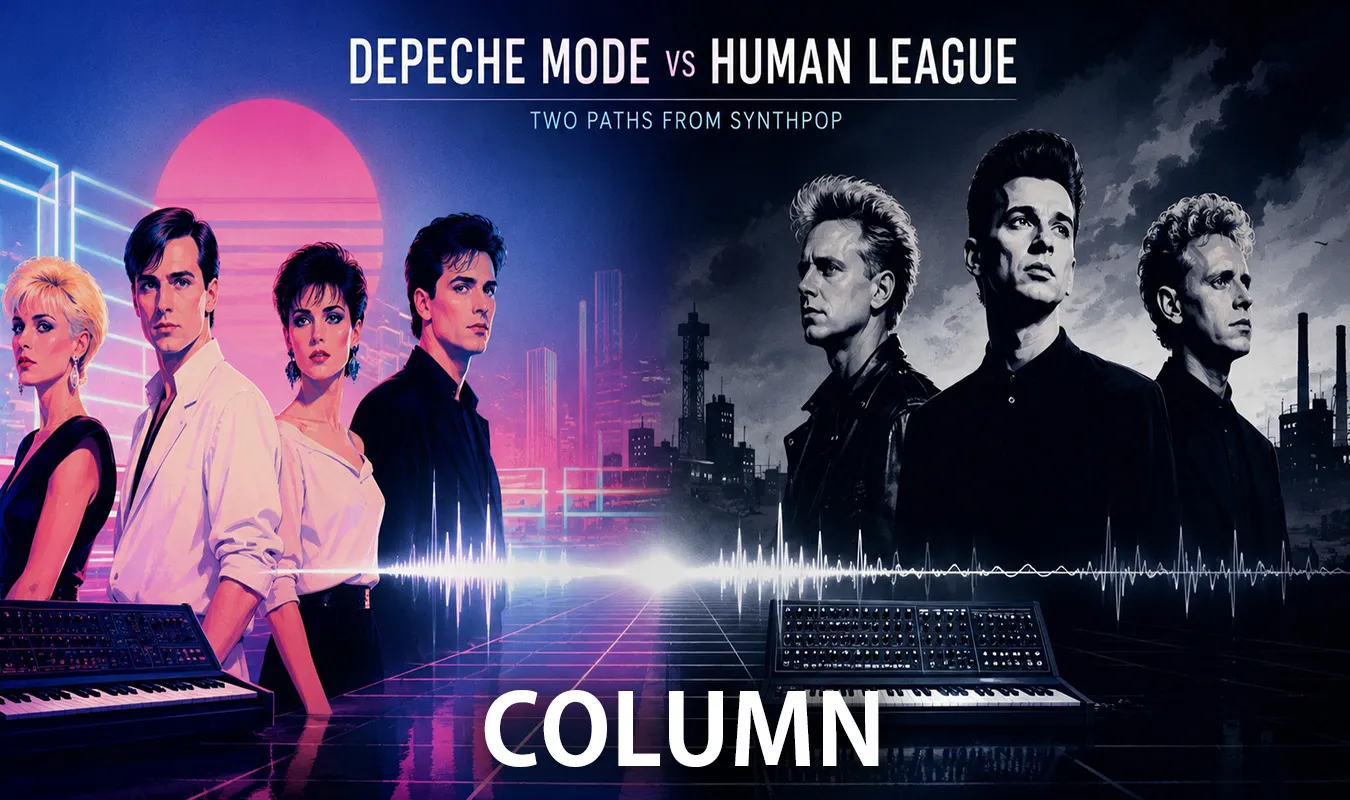
[Column] Two evolutionary lines of synth pop: The divergence and integration of 1980s electronic music depicted by Depeche Mode and Human League

Column en 80s New Wave Synth Pop
[Column] Two evolutionary lines of synth pop: The divergence and integration of 1980s electronic music depicted by Depeche Mode and Human League

Introduction: How electronic music redefines “humanity”

Text: mmr|Theme: Comparing two groups representing British synth pop in the 1980s and deciphering their differences and commonalities from multiple perspectives, including musicality, philosophy, social background, commerciality, and influence on contemporary music.

In the early 1980s, synthesizers became more than just musical instruments. It’s not an extension of rock or an embellishment of disco. It appears as a presence that changes the design philosophy of music itself.

Depeche Mode and the Human League played a key role in this. Although both belong to the same British synth pop trend, the direction of their evolution is vastly different. One side has progressed to ““electronic music that sinks into the dark side of emotion,” and the other has progressed to ““the democratization and mechanization of pop.”

This difference is not just a difference in musicality, but also a turning point in the era of the 1980s itself.

Synthpop was not music to replace humans, but an experiment in redesigning humans.


Chapter 1: The starting point of the Human League: the industrial city of Sheffield and the pop-up of machines

The Human League was formed in Sheffield in 1977. At first, they were an experimental electronic music group, with a stance that differed greatly from that of a rock band.

At the time, they prioritized structure over melody and system over emotion. In other words, it was close to the idea of ​​”“electronic music as a substitute for humans.’’

However, the turning point came around 1980. Due to the reorganization of the members, a new lineup including female vocals was created, and the musicality immediately became more pop-oriented.

This change led to their 1981 album Dare.

The hit song “Don’t You Want Me” became an iconic work, combining mechanical sequences with human drama.

graph TD A["1977 Experimental Electronic Music"] --> B["Member reorganization"] B --> C["Shift to pop-oriented"] C --> D["1981 Dare"] D --> E["Worldwide hit"]

The essence of the Human League was to “humanize machines.” Rather than making electronic sounds cold, they purposely connected them to the human emotional structure.

Human League reinvented pop by making machines more human-like


Chapter 2: The emergence of Depeche Mode - electronic physicality stripped of emotion

Depeche Mode was formed in Basildon in 1980. In the early days, they belonged to the upbeat synth pop trend, but their essence gradually moved in a different direction.

Of particular importance are Martin Gore”s songwriting and Dave Garn”s vocals.

Their music gradually became less and less ““pop.’’ What emerged instead were themes of desire, dependence, power, and religiosity.

From 1986”s ““Black Celebration,” 1987”s ““Music for the Masses,” and 1990’s ““Violator,” Depeche Mode transcended synth pop and transformed into ““dark electronic rock.”

“Enjoy the Silence” in particular was groundbreaking in that it presented silence itself as a musical concept.

graph TD A["1980 結成"] --> B["Early synth pop"] B --> C["Darkening"] C --> D["Deepening the theme"] D --> E["Violator 1990"] E --> F["GLOBAL IMPACT"]

By stepping outside of pop, Depeche Mode paradoxically achieved huge popularity.

Depeche Mode achieved deeper emotions by reducing emotion


Chapter 3: Differences in sound design philosophy - lightweight pop vs. heavy electronic

The difference between the two is most noticeable in the structure of the sound.

Human League’s sound is light. The rhythm is orderly, and the synths bring the melody to the forefront. The space is bright and connected directly to the dance floor.

On the other hand, Depeche Mode’s sound is heavy. The bass line is compressed and the rhythm is mechanical, yet gives a strong sense of physicality. The space between sounds is designed as “silence.”

This difference is also a difference in ideology.

Human League is “extroverted pop”; Depeche Mode is an “introvert drama.”

graph TD A["Human League"] --> A1["Lightweight sound"] A --> A2["Pop structure"] A --> A3["extroversion"] B["Depeche Mode"] --> B1["Weight Sound"] B --> B2["Dark structure"] B --> B3["introversion"]

Both were synth pop, but the music was heading in opposite directions.

Even if the same synthesizer has a different design concept, a completely different universe will be created.


Chapter 4: 1980s British context: between industrial and post-industrial

To understand these two bands, the social background of 1980s Britain is important.

Cities such as Sheffield and Basildon were in the process of transitioning from centers of industrialization to post-industrial societies.

It was a time when machines were taking over jobs and at the same time machines were creating culture.

In the early days of Human League, they directly translated the coldness of industrial cities into music. However, in his later years, he moved towards reusing it as pop music.

Depeche Mode did the opposite, digging deeper into the emptiness of industrial society and connecting with spiritual themes.

In other words, they both looked at the same society but interpreted it in different ways.

British synthpop in the 1980s was a device for translating social changes into sound


Chapter 5: The Role of Vocals: Humans as a Medium of Emotions

Human League’s vocals often take on a duet structure, functioning as a dialogue between a man and a woman. This is a very easy-to-understand structure for pop music.

In particular, “Don’t You Want Me” has a strong narrative, making it easy for listeners to empathize with it.

On the other hand, for Depeche Mode’s Dave Gahan, his voice itself functions as an “emotional compression device.” The focus is on the texture of the voice rather than the meaning of the lyrics.

In other words, Human League is a “song as a language”. Depeche Mode is “voice as acoustics”.

graph TD A["Human League"] --> A1["Interactive Vocal"] A --> A2["Storytelling"] B["Depeche Mode"] --> B1["single vocal"] B --> B2["Focus on texture"]

This difference fundamentally changes the listener experience.

Human League tells you a story, Depeche Mode soothes your senses


Chapter 6: Global Expansion - The Divergence of Pop and Alternative

From the late 1980s to the 1990s, the evaluation axes of the two diverged further.

Human League were firmly attached to the pop charts and established themselves as 80’s pop icons.

Meanwhile, Depeche Mode gained strong support from the American market and the alternative rock crowd, and grew into a stadium-class band.

At this stage, the roles of both parties become clear.

Human League is the “completed form of synth pop” Depeche Mode is the “conquest of synth pop.”

graph TD A["Human League"] --> A1["Pop market"] A --> A2["80s iconization"] B["Depeche Mode"] --> B1["Alternative"] B --> B2["Stadiumization"]

What is important is that we have arrived at different destinations from the same starting point.

Synthpop was not just one genre, but contained multiple futures.


Chapter 7: Heritage: A dual influence on contemporary music

These two lineages are still alive in modern electronic music and indie pop.

Human League’s influence remains in the clarity of dance music and electropop. The structure is simple, with an emphasis on immediate pleasure.

Depeche Mode’s influence is strong in their reinterpretations of darkwave, industrial, and post-punk. Music functions as a device for dealing with deep emotions.

In other words, contemporary music continues to oscillate between these two directions.

Modern electronic music oscillates between the brightness of the Human League and the depth of Depeche Mode.


Monumental Movement Records

Monumental Movement Records