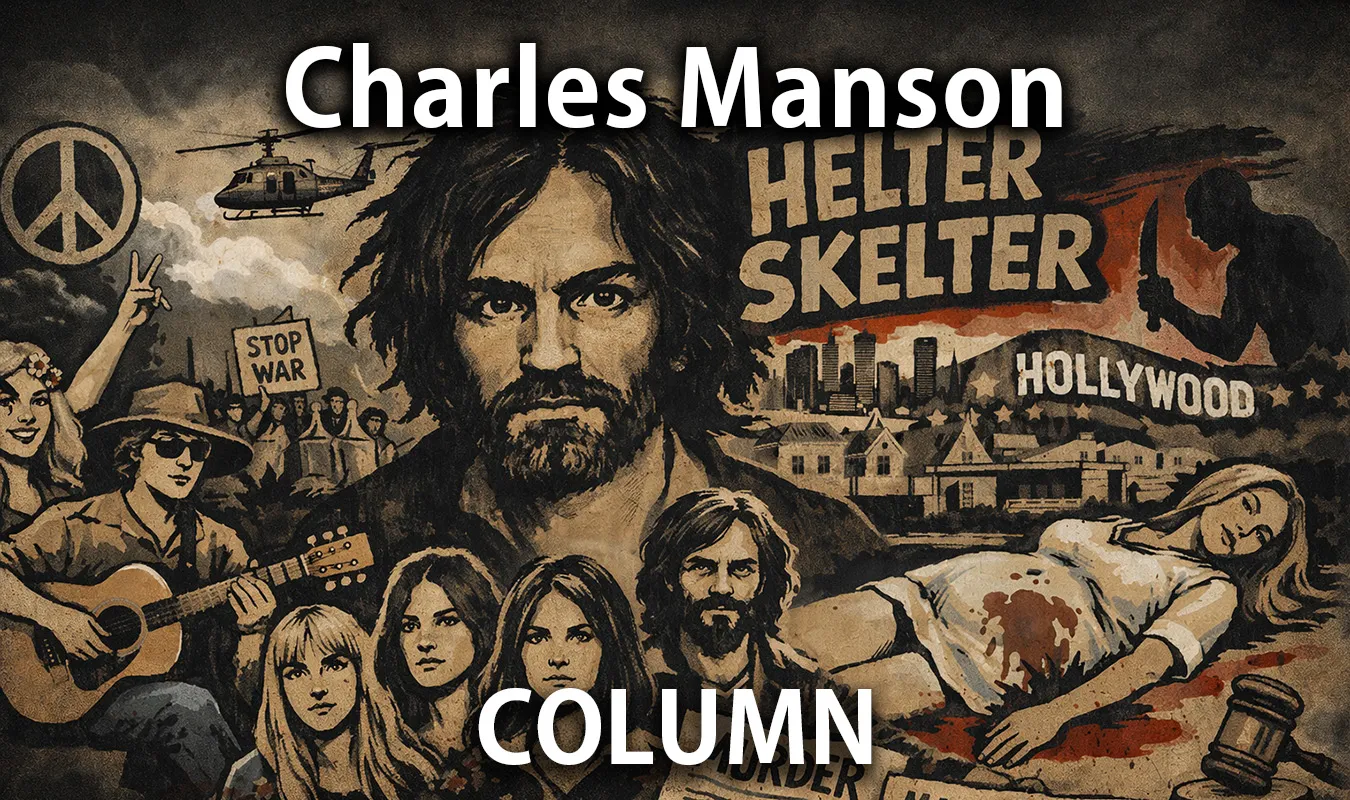
[Column] Charles Manson and the 1960s: The intersection of ideals and collapse
Column en 60s Culture Rock
Introduction: The shadow lurking in an ideal era
Text: mmr|Theme: In the 1960s, when ideals and freedom reached their peak, deciphering the structure of madness that was born behind the scenes.
The word 1960s brings to mind images of freedom, love, music, and liberation. Young people who sought to break away from existing values questioned institutions such as the nation, family, and religion, and sought new ways of living.
However, its brilliance was always based on balance. When social systems are shaken, people gain freedom, but at the same time they also face anxiety and confusion. Charles Manson was the person who absorbed and embodied that anxiety in an extreme way.
He is not just a criminal, but someone who entered the cracks of the times, distorted the ideals that existed there, and turned them into violence. In this article, we will decipher the structure of Manson by overlapping the individual Manson with the era of the 1960s.
The more ideals were strongly sought after in an era, the more extreme distortions were likely to occur behind the scenes.
1960s America: Explosion of ideals and social rifts
Birth of counterculture
In America in the 1960s, young people who had grown up in postwar prosperity began to question the values of their parents’ generation. Suburban living, consumerism, and the Cold War system brought stability, but they also created a sense of confinement.
The counterculture emerged as a reaction to this. The Summer of Love in 1967 was a particularly symbolic event. Young people from all over the United States gathered in Haight-Ashbury to experiment with a “new society” through communal living, free love, and drug experiences.
Music was at the center of it all. The Beatles released works that focused on spiritual expansion, and Bob Dylan offered a sharp look at politics and society. Music was not just entertainment, it was a thought itself.
War and division
At the same time, however, American society was deeply divided. The Vietnam War was at the center of this, and young people were fiercely opposed to the draft system. The reality of war enters everyday life through television, and trust in the nation is shaken.
Furthermore, the rise of the civil rights movement, the violent backlash against it, and the assassinations of political leaders continued, destabilizing society as a whole. The gap between ideals and reality was rapidly widening, and behind hope there was always anger and fear.
The expansion of freedom was also a force that shook the foundations of society.
The formation of Manson: an entity emerging from the periphery
Unstable childhood
Charles Manson was born in 1934 into extremely unstable circumstances. His mother was young and her livelihood was fragile, so he spent his childhood moving between institutions and relatives’ homes.
As a boy, he had already started committing crimes, and was arrested for theft and fraud, and sent to a correctional facility. During this period, he learns ““what is power” and ““what is control”. The environment in which violence and psychological pressure were common had a decisive influence on the development of his personality.
Self-development in prison
Manson spent much of his youth in prison, where he developed his own ideas. He gained knowledge from books and other inmates, and at the same time honed his skills in manipulating people.
Although he has not received any formal education, he learns how to use words and behave in a charismatic manner. His ability lay not in knowledge but in ““the power to penetrate the psychology of others.’’
The experience of being excluded from society developed the skills of domination
California and the Community Experiment
Contact with hippie culture
In 1967, Manson was released from prison and headed to California. It was truly the center of counterculture, a place where young people who were liberated from existing values gathered.
He adapts to his environment and skillfully adopts hippie language and values. Love, freedom, spiritual awakening - he used these words to attract young people.
Establishment of “family”
Eventually, a group of young women forms around him. They lived together, shared drugs, and accepted Manson’s word as absolute.
On the surface it looked like a peaceful and free commune, but in reality it was a complete domination structure. Individual will is gradually dismantled and replaced with Manson’s ideology.
People who came together in search of freedom eventually became bound to the most inconvenient relationships.
Music and Fantasy: Distorted Messages
Obsession with music
Manson had a strong desire to succeed in the music industry. He wrote his own music and was working towards a record deal, but that never happened.
This setback pushed his ideas in a more extreme direction.
Interpretation of “Helter Skelter”
Manson created his own interpretations of the songs on The White Album. In particular, he reinterpreted the phrase “Helter Skelter” as a symbol of racial war and made it central to his apocalyptic ideology.
This interpretation was entirely his own and had no relation to reality. However, within a closed community, it functioned as the only truth.
Meaning becomes reality when it is shared, but in a closed world it remains distorted and fixed.
1969: The emergence of violence
Commitment of Murder
In August 1969, under Manson’s direction, members of the Family commit multiple murders in Los Angeles. Among them was actress Sharon Tate.
The crime was extremely brutal and had a strong impact on society. This was not just a crime, but was seen as an event with symbolic meaning.
Society’s reaction
This incident led to a major change in people’s views on hippie culture. Community and free life, which had previously been described as ideal, began to be reevaluated as dangerous and chaotic.
The media covered this incident extensively, emphasizing the ““end of an ideal era.’’
One act of violence has rewritten the image of an entire era.
Chronology: 1960s and the Manson Incident
Diagram: Structure from ideal to collapse
Media and Mythologization
The Manson incident is being consumed not just as a crime, but as a ““story.’’ Newspapers, television, and books depicted him as a symbol of evil, and his image expanded.
At the same time, his existence came to be talked about as a kind of myth, and influenced culture such as music and movies.
Even though the incident is over, its image continues to be amplified in culture.
The end of the 1960s and beyond
After the Manson incident, American society rapidly turned toward realism. In the 1970s, stability and order became more important than ideals.
Although the counterculture did not disappear completely, its pure ideals were lost and it morphed into a more complex and multilayered form.
The ideal did not disappear, but instead transformed into a more cautious form.
Conclusion: Distortion created by the times
Charles Manson was both unique and a product of his time, the 1960s. The gap that was created in the midst of major changes in society made existences like him possible.
This incident shows the dangers of freedom and ideals. No matter how beautiful an idea may be, when it loses its balance with reality, it can collapse in unexpected ways.
The 1960s are not just a part of the past, but pose questions that are relevant to the present day. What is freedom, what is community, and to what extent are people influenced by others?
That question still lingers within us.
History is not a finished event, but a mirror that illuminates the present.