[Column] Deciphering the sound space of the Ambient × Rap meditation playlist
Column en Ambient Hiphop Rap![[Column] Deciphering the sound space of the Ambient × Rap meditation playlist](/../assets/images/column-ambient-rap.webp)
Fusion of Ambient and Rap ─ Possibility as meditation music
Text: mmr|Theme: Interpreting the meditative sound space created by the fusion of Ambient and Rap from the perspectives of history, technique, and experience
At first glance, Ambient and Rap seem to be completely opposite music genres. Ambient evolved from the electronic sounds of the 1970s, including Brian Eno, and emphasizes spaciousness, silence, and spatial depth. Rap, on the other hand, is a culture that was born in the Bronx, New York in the late 1970s, centering on rhythm and linguistic expression to convey city life and social messages.
The fusion of the two began to emerge gradually from the end of the 1990s. DJ Shadow’s “Endtroducing….” (1996) is known as a pioneering work that made full use of sampling and fused beats and ambient. In recent years, the work of Nujabes and J Dilla has inspired meditative playlists that combine hip-hop beats with ambient textures.
The intersection of silence and rhythm creates a new reflective sound space
Chronology: Evolution of Ambient × Rap
Throughout history, rap has merged with ambient music to expand the meditative experience.
Mechanism of fusion seen from music theory
In Ambient x Rap, the balance between beat and texture is important. Ambient uses sustained sounds, pads, and field recordings to create spatial depth. Rap uses drum machines and samples to provide rhythm and groove.
The points are as follows:
- Tempo: 70-90 BPM, slow to medium and corresponds to the heartbeat
- Harmony: Ambient chords do not interfere with the Rap beat and maintain a floating feeling
- Spatial production: Enhance immersion with reverb and delay
Bringing calmness and concentration to the mind and body through the combination of acoustics and rhythm
Representative artists and albums
Nujabes
Modal Soul (2005) has many tracks perfect for meditation playlists. It features a hip-hop sound that is a fusion of jazz and ambient.
J Dilla
Donuts (2006) is a series of short loops, with an ambient beat that invites meditative concentration.
Flying Lotus
“Cosmogramma” (2010) is a crossover piece of electronica, jazz, and hip-hop. Features futuristic ambient Rap sound.
The artist’s individuality and production methods color the meditative sound space in a variety of ways.
Meditation playlist example (about 60 minutes)
Below is a specific example of a meditation playlist structure. The early part is mostly ambient, the middle part has a rap beat, and the final part focuses on lingering sound.
| Time | Song title | Artist | Features |
|---|---|---|---|
| 0:00-5:30 | Weightless | Marconi Union | Quiet ambient |
| 5:30-10:00 | Luv(sic) Part 3 | Nujabes feat. Shing02 | Gentle Rap flow |
| 10:00-15:00 | Midnight in a Perfect World | DJ Shadow | Sampling x Ambient |
| 15:00-20:30 | Lady Brown | Nujabes feat. Cise Starr | Jazz Ambient Rap |
| 20:30-25:00 | Two Can Win | J Dilla | Improving concentration through loops |
| 25:00-30:30 | See Thru to U | Flying Lotus | Complex beat and sense of space |
| 30:30-35:00 | Reflection Eternal | Talib Kweli & Hi-Tek | Strengthening rhythm and guiding self-reflection |
| 35:00-40:30 | World”s End Rhapsody | Nujabes | Meditative melodies and samples |
| 40:30-45:00 | Donuts (Outro) | J Dilla | Maintain immersion with beat loops |
| 45:00-50:30 | Nightfall | Flying Lotus | Ambient and lingering |
| 50:30-60:00 | A Long Journey | Marconi Union | Final stage relaxation, regulating heartbeat |
Playlist design allows listeners to go beyond just listening to music and experience an inner journey
Technical characteristics of recorded sound sources
- Sampling: Loop short cuts of old jazz and natural sounds
- Filtering: Emphasizes low frequencies and amplifies perceived vibrations
- Stereo image: The feeling of being surrounded by the spread of left and right sound images
- Minimize tempo changes: Avoid sudden changes and maintain a meditative flow
Technological innovations maintain immersion in the sound space and mental space
The spread of streaming culture and playlists
Since the 2010s, Lo-Fi Hip Hop/Ambient Rap playlists have expanded on Spotify and YouTube. The tags ““Concentration,” ““Meditation,” and ““Work’’ allow listeners to access songs without hesitation.
Digital distribution personalizes the music experience and accelerates the proliferation of meditation spaces
Summary: The meditative future of Ambient x Rap
The fusion of Ambient and Rap creates a new experience at the intersection of musical genres. History, theory, production methods, and listener experience interact to provide an introspective space that goes beyond mere appreciation.
With technological advances such as AI-generated music and binaural recording, meditation playlists have the potential to become more personalized and provide a deeply immersive experience.
Our inner journey opens at the intersection of silence and beat.
Explore more like this
![[Column] Kendrick Lamar: The structure and thinking that expanded hip-hop into epic poetry](/../assets/images/column-kendrick-lamar.webp)
[Column] Kendrick Lamar: The structure and thinking that expanded hip-hop into epic poetry
Prologue: The moment when hip-hop becomes a story
![[Column] Early hip-hop culture before Bambaataa: A chain of expressions that naturally arose from the scene in the Bronx](/../assets/images/column-early-hiphop.webp)
[Column] Early hip-hop culture before Bambaataa: A chain of expressions that naturally arose from the scene in the Bronx
Prologue: Hip-hop started ‘before it was defined’
![[Column] Lyrics translation and cultural transfer issues: When words cross the border of music](/../assets/images/column-lyric-translation.webp)
[Column] Lyrics translation and cultural transfer issues: When words cross the border of music
Prologue Lyrics don’t just convey “meaning”
![[Column] Scott Herren / Prefuse 73: Poet of Beats and Fragments](/../assets/images/column-scott-herren-prefuse73.webp)
![[Column] DMX: Howling Soul - Between violence and prayer](/../assets/images/column-dmx.webp)
[Column] DMX: Howling Soul - Between violence and prayer
DMX: Howling Soul - Between Violence and Prayer
[Column] DMX: Howling Soul - Between violence and prayer
DMX: Howling Soul - Between Violence and Prayer
![[Column] A brief history of East Coast hip-hop — from the Bronx to Brooklyn to the world](/../assets/images/column-eastcoast-hiphop-history.webp)
[Column] A brief history of East Coast hip-hop — from the Bronx to Brooklyn to the world
East Coast hip-hop was born from the block parties of New York in the 1970s.
![[Column] Deep dive into trip hop: Massive Attack / Portishead / DJ Shadow / DJ Krush](/../assets/images/column-triphop.webp)
[Column] Deep dive into trip hop: Massive Attack / Portishead / DJ Shadow / DJ Krush
##Trihop Recommendations by age, anecdotes, and documentaries.”
![[Column] Overview of West Coast hip-hop — from its origins to the underground](/../assets/images/column-westcoast-hiphop-history.webp)
[Column] Overview of West Coast hip-hop — from its origins to the underground
West Coast hip-hop was born out of Los Angeles street culture in the late 1970s.
![[Column] David Toop and genre-less musical thinking - Exploration of sounds by era](/../assets/images/column-david-toop.webp)
[Column] David Toop and genre-less musical thinking - Exploration of sounds by era
David Toop and genre-less musical thinking - Exploration of sounds by era
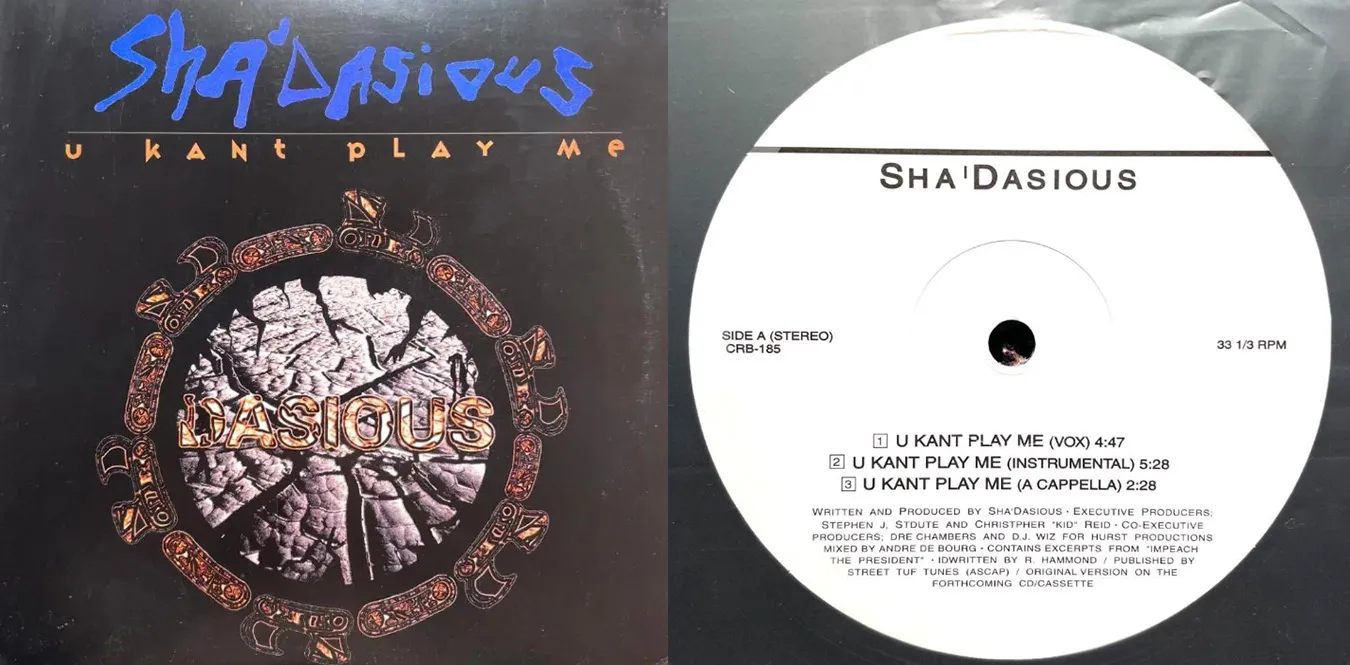
Sha'dasious – U Kant Play Me
Sha’dasious – U Kant Play Me / Phunk Wucha Heard Shadacious