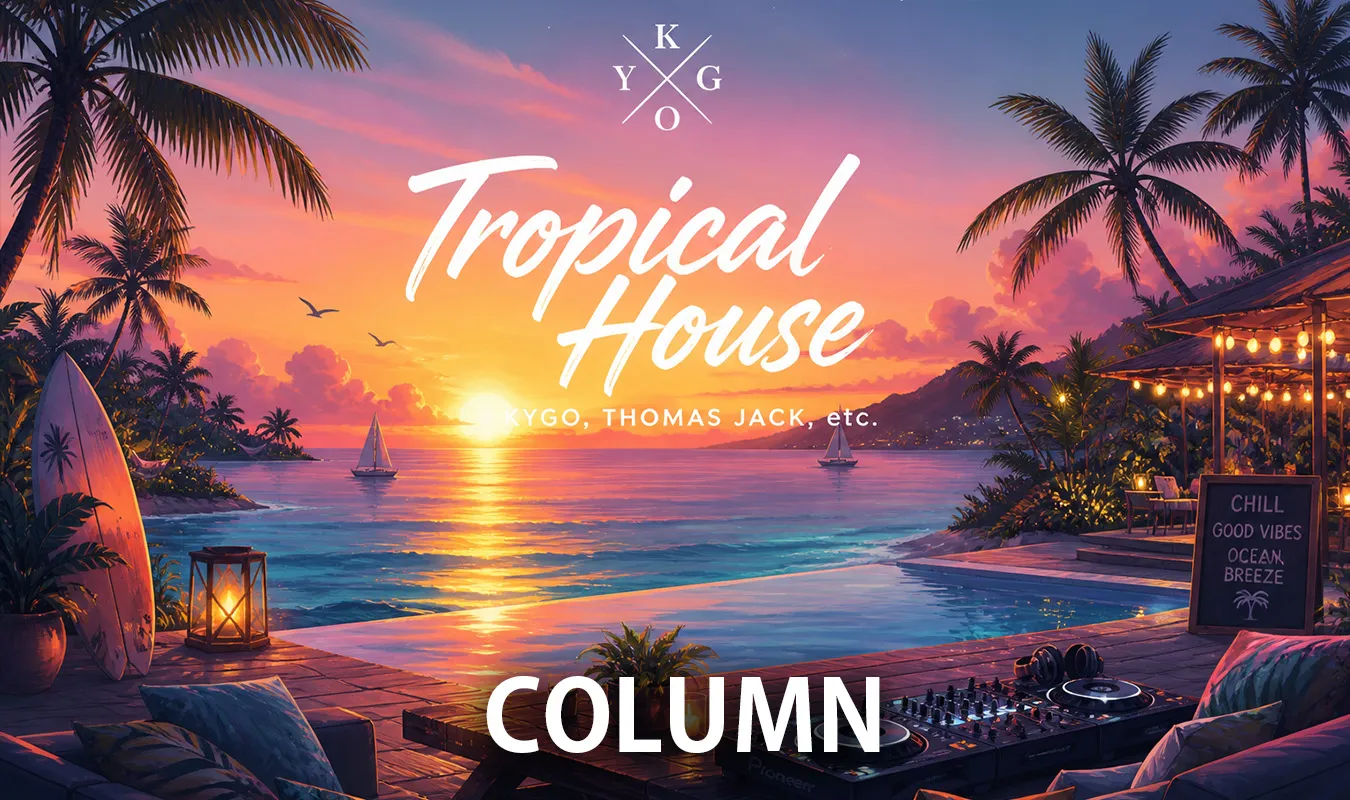
[Column] The birth and expansion of tropical house: The contours of EDM changed by the sound image of the tropics

Column en EDM House Pop
[Column] The birth and expansion of tropical house: The contours of EDM changed by the sound image of the tropics

What is Tropical House?

Text: mmr|Theme: Tropical house emerged as a gentle counter to the overheated dropism of EDM, and traces the transition that changed the very vocabulary of pop music.

Acoustic design with a sense of calm and openness

Tropical house is a subgenre of house that was established in the early 2010s, and is a style characterized by a slightly slower tempo, soft synth sounds, and Caribbean/tropical instrument tones. A major feature of this music is that it emphasizes a sustained and smooth groove, rather than the strong build-up and drop contrast seen in traditional EDM.

At the core of this genre is an ““aural climate.’’ The acoustic design uses marimba, steel pan, soft pluck sounds, and deep spatial processing of reverb to give the listener a sense of “warmth” and even “humidity.”

Also, while the vocals are often emotional, they are not overly dramatic, and are placed so that they blend into the flow of the sound. This is the result of a strong awareness of the playback environment not only in clubs, but also on radio and streaming.

Sustained comfort rather than excessive stimulation is the starting point for this genre.


Background and context of birth

EDM saturation and its backlash

In the early 2010s, EDM was at the height of its global boom. At festivals, sounds that emphasized loud volume, high speed, and exhilaration became mainstream, and the impact of the drop was increasingly determining the value of a song.

However, on the other hand, a feeling of fatigue from this excess energy also spreads. The discomfort that club music had begun to function as ““instantaneous experiences to be consumed” rather than ““music to listen to” became the fertile ground for the birth of a new trend.

In this trend, styles such as deep house, chill out, and Balearic were reevaluated. By combining these elements with pop structures, tropical house opened up to a wider audience.

Impact of Internet and Streaming

Platforms like SoundCloud and YouTube have been essential to the expansion of tropical house. These media made it possible to spread music without relying on traditional clubs or labels.

Particularly within the remix culture, there have been many attempts to reinterpret existing pop songs in a tropical house style, which has resulted in rapidly increasing recognition of the genre.

Tropical house is also music that grew up in networks rather than clubs.


Main artists and their roles

Style with Kygo

Norwegian Kygo is an icon of tropical house. His songs set the tone for the genre with their piano-driven melodies and transparent sound design.

His representative remixes and original songs all have structures that attract listeners through the strength of their melodies, while avoiding excessive decoration. This was a clear departure from EDM”s “drop-centricity’.

Thomas Jack and the establishment of the genre name

Thomas Jack from Australia is known as the person who popularized the name ““tropical house.’’ His DJ sets and mixes brought a tropical image to the fore, forming the genre’s visual and sensual identity.

In this way, tropical house was not just a musical style, but also became associated with a ““lifestyle” and ““image.”

For the establishment of a genre, not only sounds but also words and images were essential.


Detailed analysis of musical characteristics

Rhythm and tempo

The tempo of tropical house is generally around 100 to 115 BPM, which is slightly slower than regular house. This tempo setting indicates a direction that emphasizes relaxed fluctuations rather than physical exhilaration.

The kick is modest, and the side chain pumping is also moderately suppressed. Instead, percussion and offbeat rhythms support the overall groove.

Sound Design

Its distinctive feature is a synthesized sound that imitates natural sounds and acoustic textures. Sounds like flute, guitar, and marimba are often used, and these are reconstructed through digital processing.

Furthermore, in spatial processing, emphasis is placed on spaciousness and transparency. Reverb and delay are not just effects, but function as part of the music, creating a space that envelops the listener.

Structure and expansion

Tropical house song structures are relatively simple, and there are few sudden developments. Rather than the contrast between build-up and drop, the focus is on the layered structure that gradually changes.

In this respect, it can be said that tropical house has shifted from ““music for clubs” to ““music for everyday life.”

The arrangement of sounds and the flow of time itself shapes the listening experience.


Influence on pop music

Crossover progression

Tropical house has a very high affinity with pop music. In fact, many pop artists have adopted this style and achieved chart success.

This is the result of the genre’s ““easy listening” and ““emotional openness” being accepted by a wide range of listeners. What is important is that while it is rooted in club culture, it has adapted to everyday environments such as at home and on the move.

Fit with the streaming era

Tropical house has become strongly associated with playlist culture on streaming services like Spotify. It has been consumed by many listeners as a song that fits the theme of relaxation and chill.

As a result, music functions not only as a standalone work but also as part of the environment.

Tropical house is also a genre that has changed the way music is used.


Chronology

timeline 2010 : ディープ・ハウス再評価の流れ 2012 : SoundCloudでチル系リミックスが増加 2013 : Kygoがリミックスで注目を集める 2014 : Thomas Jackが「トロピカル・ハウス」を提唱 2015 : 商業的成功とポップへの浸透 2016 : 世界的なヒット曲がチャートを席巻 2018 : ポップ・EDMの標準語法として定着 2020 : ローファイやチル系との融合が進行

Structural model diagram

flowchart LR A[Tempo drop] --> B[relaxing groove] B --> C[soft synth] C --> D[spatial extent] D --> E[Emotional but gentle vocals] E --> F[Adaptation to everyday listening]

Now and beyond

Diffusion and blurring of genres

Currently, tropical house is gradually losing its boundaries as a clear genre. Its elements have spread to pop, R&B, lo-fi, and even ambient, and function as a single ““style” and ““texture.”

This phenomenon shows that genres exist not as fixed frameworks but as fluid networks.

Possibility of re-evaluation

On the other hand, there are also signs that past tropical house works are being reevaluated. This is because it is being reconsidered not just as a trend, but as an important expression that symbolizes the music culture of the 2010s.

Tropical house is not a dead genre, but continues to live on in different forms.


Monumental Movement Records

Monumental Movement Records