[Column] The Secret History of Pirate Radio — The musical revolution born of illegal radio waves

Column en Grime Jungle Radio UK Rave
[Column] The Secret History of Pirate Radio — The musical revolution born of illegal radio waves

The underground world of radio waves

Text: mmr Theme: Pirate radio, which played outside the control of national radio waves, became the breeding ground for the musical revolution of UK rave, jungle, and grime. Pursuing its unknown history

From the 1970s to the early 2000s, there was another invisible network in the skies over London.

It’s not a regular broadcasting station.

It has no government license, no sponsors, and no broadcast rights.

But new music was playing there before anyone else.

That is “Pirate Radio”.

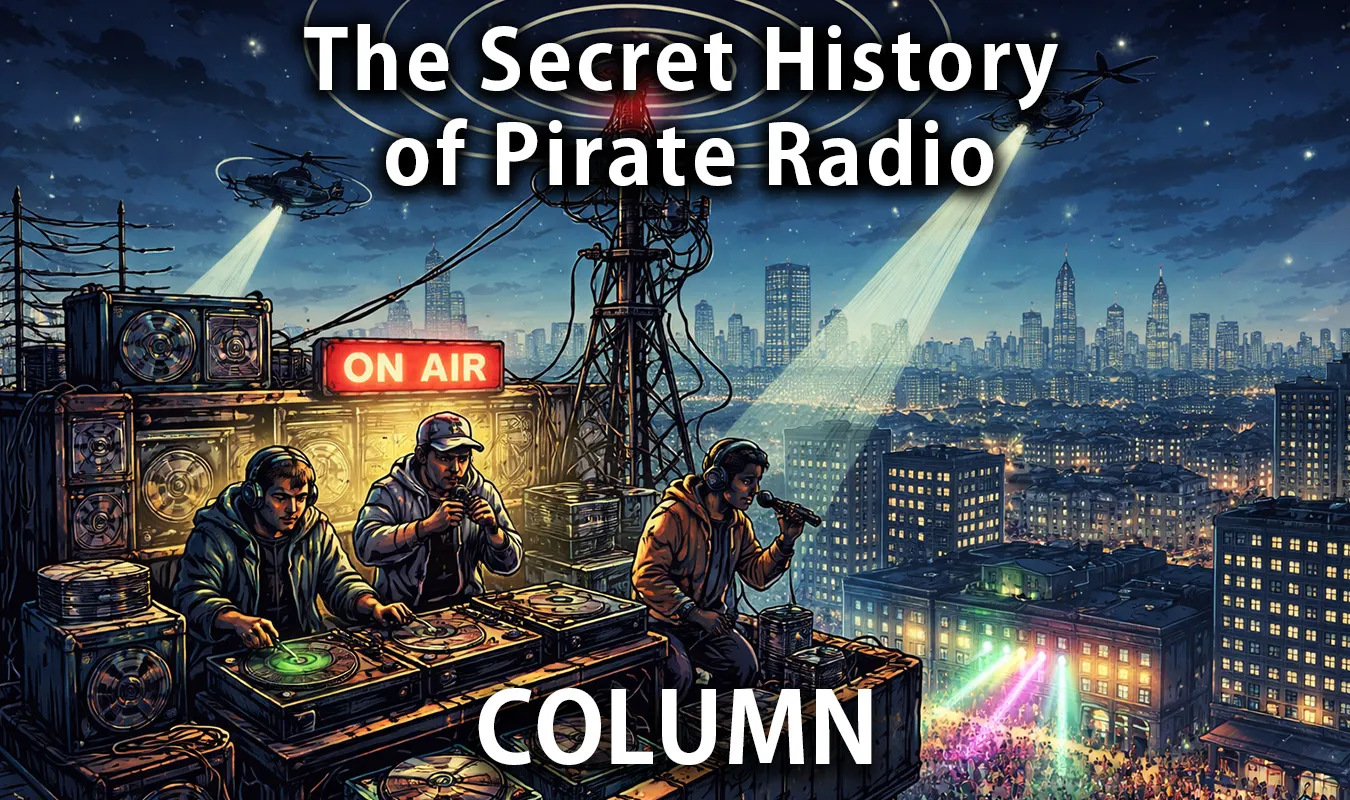
The roofs of buildings, the roofs of housing complexes, and cars loaded with broadcasting equipment. Radio waves emitted from illegal transmitters spread across the city skyline, engulfing London at night.

The music played there would eventually become the center of club culture.

UK rave, jungle, drum and bass, garage and grime.

Many of these genres were popularized through pirate radio rather than formal media.

Before the Internet, radio waves were the fastest network connecting urban subcultures.

Pirate radio was the “underground internet” before music became mainstream.


Origin of Pirate Radio

The history of pirate radio dates back to Europe in the 1960s.

At the time, the BBC had a near monopoly on British broadcasting. Pop music was only played for a limited time, and youth culture was not the focus of broadcasts.

Then came the maritime broadcasting station.

A ship is anchored on the high seas of the North Sea and radio is transmitted from there.

This is how the earliest form of pirate radio was born.

Their style of playing rock and pop music all day long was extremely popular among young people.

However, in 1967 the government enacted a law prohibiting pirate broadcasting, and many stations were shut down.

But culture did not disappear.

From sea to land.

From the 1970s onward, pirate radio began broadcasting from the rooftops of city buildings.

London was a multi-ethnic city.

Local stations playing reggae and dub have sprung up in Caribbean immigrant communities.

Eventually, that culture would become the soil for the next generation of club music.

From maritime broadcasting to city rooftops. Pirate radio survived as an underground culture.


Rave culture and radio waves

In the late 1980s, a major musical revolution occurred in England.

It’s acid house.

Club music from Chicago and Detroit was brought to Britain, and huge rave parties began to be held all over the country.

However, this culture was also not accepted by the media.

The club was shut down by police and the rave was treated as an illegal event.

Pirate Radio played an important role in this.

DJs played new records, shared party information, and formed a community here.

Especially in London, the number of pirate stations specializing in dance music is rapidly increasing.

The city’s nights were filled with illegal radio waves.

Rave culture spread not through clubs but over the airwaves.


Jungle Birth Media

In the early 1990s, a new sound emerged from UK rave.

It’s a jungle.

This music, which sped up breakbeats and layered reggae and dub bass, was rarely played on the BBC at the time.

But Pirate Radio was different.

DJs will bring in the latest dubplates and broadcast unreleased tracks.

Radio was not just an advertising medium, it was a musical laboratory.

The MC grabs the microphone and improvises words to the DJ’s play.

This style also took hold in clubs and became an important element of jungle culture.

Jungle grew out of radio booths, not clubs.


graph TD A[Acid House] B[Breakbeat Hardcore] C[Jungle] D[Drum and Bass] A --> B B --> C C --> D

London Rooftop Network

In the 1990s, there were said to be hundreds of pirate stations in London.

The transmitter was installed on the roof of a high-rise apartment complex.

The reason is simple.

This is because radio waves can reach long distances.

Some stations covered large areas of the city.

Equipment is often confiscated by police, but broadcasting is quickly restored.

Install a new transmitter and change the frequency.

The Pirate Bureau was always on the move.

DJ, MC, technician, promoter.

Many young people were involved in this culture.

The station became the center of the club scene and formed a musical community.

Rooftop antennas were infrastructure that connected the city’s underground culture.


Garage and urban sounds

In the late 1990s, UK garage became popular.

This house-based music quickly spread through London’s clubs and pirate radio.

Many of the garage DJs and MCs came from pirate stations.

Play on the radio and appear in clubs.

This cycle created the music scene.

Listeners listen to a DJ play on their radio at home and then go to a club that weekend.

Radio was directly connected to the city’s nightlife.

Pirate Radio was an advertising device for club culture.


Birth of Grime

In the early 2000s, a new genre was born in East London.

It’s grime.

It was a style that made the garage beat even more minimal and brought rap to the fore.

This music also spread from pirate radio.

Young MCs gather in the studio and perform impromptu raps.

The atmosphere of the broadcast was like a live battle.

Listeners send their responses by phone or text.

Radio became the center of the community.

Grime was born on the airwaves, not in clubs.


graph TD A[UK Garage] B[2-Step] C[Grime] D[UK Drill] A --> B B --> C C --> D

Regulation and enforcement

The government has been cracking down on pirate radio for years.

Confiscation of transmitters, fines, and interference with broadcasting.

However, it could not be completely erased.

The reason is simple.

This is because this culture was deeply rooted in urban communities.

A place to play music that mainstream stations don’t cover.

Where new artists first get noticed.

That was Pirate Radio.

The stronger the regulations, the more active the underground culture became.


Internet era

In the late 2000s, things changed.

This is the advent of streaming and internet radio.

Broadcasting will shift to online rather than radio waves.

Many pirate stations were relaunched as web radios.

The battle over frequencies is over.

But the culture continues.

Online radio and streaming platforms continue the spirit of pirate culture.

The Internet didn’t end pirate radio, it evolved it.


Chronology: Pirate Radio and UK Music

timeline 1960 : 海上パイレートラジオの登場 1967 : 英国で海賊放送禁止法 1970 : 都市型パイレート局が登場 1988 : アシッドハウスとレイヴ拡大 1991 : ジャングル誕生 1995 : ドラムンベース確立 1998 : UKガラージ人気 2002 : グライム誕生 2010 : インターネットラジオ普及

Music history created by radio waves

Pirate Radio is not just illegal broadcasting.

It was a cultural infrastructure.

A place where new music is born, spreads, and communities are formed.

If this underground network didn’t exist, UK rave, jungle and grime would all be different.

Music history is often told by record companies and star artists.

But small transmitters placed on city rooftops were just as important.

The radio waves that flowed from there created a new musical future.

The musical revolution began not in a studio, but from a rooftop antenna.


Monumental Movement Records

Monumental Movement Records