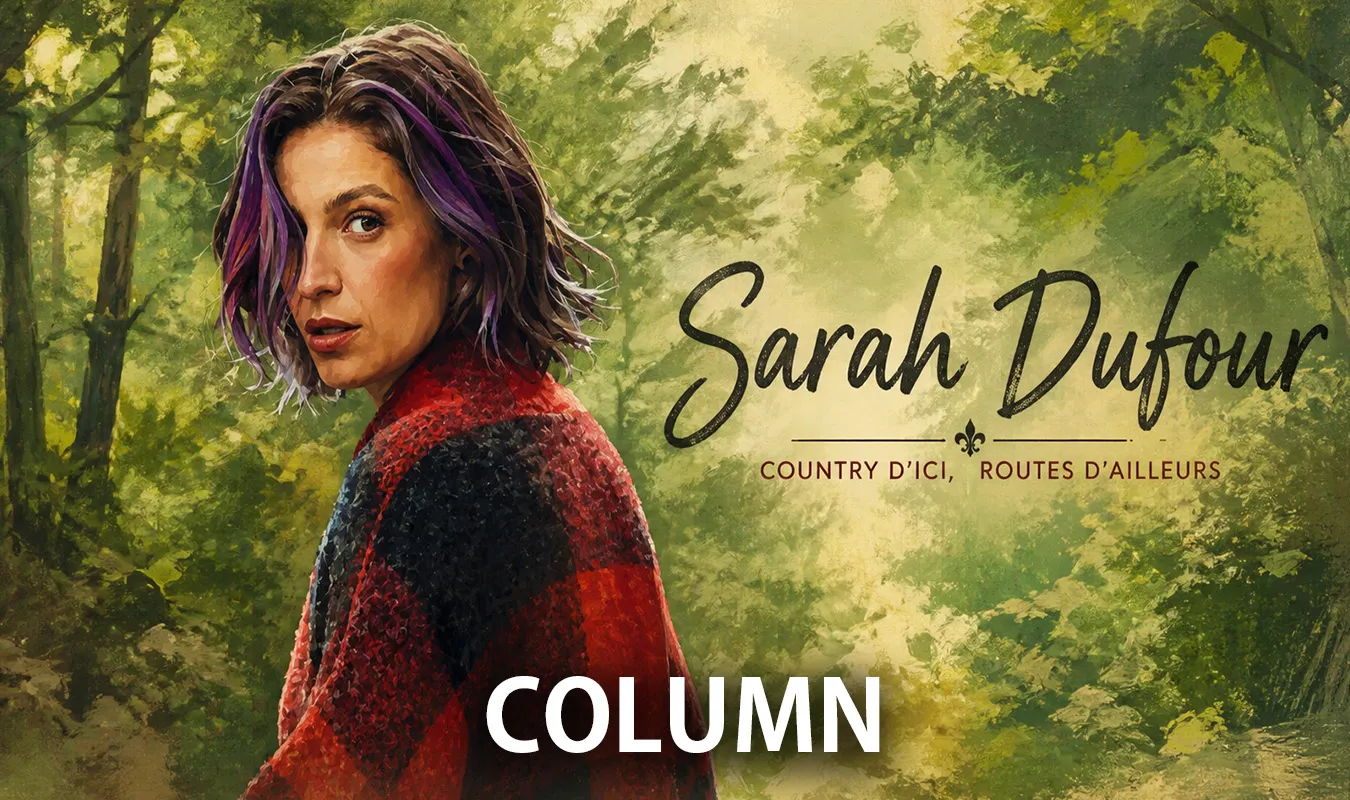
[Column] Sarah Dufour - The intersection of Quebec dust and modern country

Column en Country Folk Québec
[Column] Sarah Dufour - The intersection of Quebec dust and modern country

Road music in Quebec’s language

Text: mmr Theme: Sarah Dufour, who connects Quebec language culture and North American roots music. Through its history, we trace the changes in modern French-speaking countries.

A unique country image emerging from French-speaking Canada

North American country music has long been described as an extension of southern American culture. However, in the 21st century, its outline gradually changed. As the boundaries between genres became blurred and rock, folk, blues, alternative, and even indie culture mixed together, country became less of a regional music and more of a way to talk about a sense of life.

Amidst this change, Quebec singer-songwriter Sarah Dufour emerged as a unique presence.

Her music is not an imitation of southern country. Rather, it is a musical version of Quebec’s language, accent, working culture, nomadic culture, and atmosphere of the provincial city. The influence of Anglophone Americana is certainly present there. However, at the same time, it retains a strong sense of language and lifestyle that is unique to the French speaking world.

Sarah Dufour’s work is interesting because it is not a “globalized country,” but a “modernized country that retains its regional characteristics.”

Her songs have the smell of mud.

The vibrations of trucks, bars in local cities, paved roads after the snow melts, long-distance travel, field work, and road culture. These images are not just a performance, but are engraved within the song as a sense of daily life.

This is different from urban pop music.

The song is not about a consumed lifestyle, but about the scenery that actually passes through the body.

graph TD A[quebec culture] --> B[French] A --> C[Local city culture] A --> D[sense of work] B --> E[Sarah Dufour] C --> E D --> E E --> F[modern country] E --> G[Americana] E --> H[rock]

Sarah Dufour’s importance lies in her reconstruction of North American roots music in the “language of Quebec life.”


The Saguenay region and its musical landscape

A sense shaped by Quebec culture

Sarah Dufour is originally from the Saguenay region of Quebec.

Unlike a metropolitan cultural area like Montreal, Saguenay is a region closely connected to forestry, local industry, and harsh winter environments. When discussing Quebec culture, the focus is often on Montreal”s art scene. In reality, however, Quebec”s cultural diversity has been supported by its regional cities.

In this sense, Sarah Dufour belongs to a different lineage from the “urban francophone culture.”

In her music, “on-site sensibilities” come to the fore rather than urban sophistication.

Guitar sounds, for example, tend to be very direct and avoid too much embellishment. The same goes for vocals, where the emphasis is on the force of the words rather than technique. This is influenced by North American roots music, but it is also connected to the “honesty” seen in Quebec culture.

Also, her French is different from Parisian French.

It is extremely important that he does not hide his Quebec accent and reflects it in the lyrics.

This is not just localism.

Rather, their attitude is closer to ““singing the world in their own words.’’

Since the late 20th century, Quebec music has actively differentiated itself from France. After Robert Charlebois, Quebec’s unique pop culture was gradually established. And Sarah Dufour can be said to be the one who connected this flow to the modern country/Americana context.

timeline title ケベック音楽文化の流れ 1960 : Quiet Revolution 1970 : ケベック独自ポップ文化の形成 1980 : ローカルロックの拡大 1990 : フランコフォン・オルタナティブ 2000 : Americana影響の浸透 2010 : Sarah Dufour登場

Sarah Dufour’s music exists at the intersection of the physical sensations of Quebec culture and North American roots music.


Les Poules à Colin Era

Foundation gained from group activities

Before Sarah Dufour’s solo career, she was best known as a member of Les Poules à Colin.

This group was a Quebecois folk group based on traditional music, but with a modern sense of arrangement. Here she becomes more than just a vocalist, learning how to connect tradition and modernity.

Quebec’s traditional music has a unique history, blending Irish music, French folk music, and North American folk culture. Elements such as the fiddle, rhythmic culture, and collective singing are also tied to the memory of local communities.

Les Poules à Colin did not treat them simply as objects of preservation.

Rather, they were reconfiguring it as ““current music.’’

This experience was very important to Sarah Dufour.

Even in her later solo works, she does not treat traditional music like a museum. Rather than simply reproducing old forms, he takes the attitude of ““transplanting them to modern living sensibilities.’’

This is consistent with an important ethos of North American Americana.

In other words, the idea is not to ““preserve the past,” but to ““inject the past into the present.”

graph TD A[quebec traditional music] --> B[Les Poules à Colin] B --> C[Group performance feeling] B --> D[local culture] B --> E[modern arrangement] C --> F[Sarah Dufour Solo] D --> F E --> F

The group’s period was an important time for Sarah Dufour to learn how to bring tradition into the present.


Going solo and establishing your style

Fusion of Americana and Quebec culture

Sarah Dufour, who has transitioned to a solo career, has become more rock and road-oriented.

What is noteworthy here is that she completely avoided leaning toward “American country.”

It’s true that the sound is influenced by Americana and Roots Rock. However, the world of lyrics, pronunciation, and depictions of life are strongly influenced by Quebec culture.

This sense of balance is her greatest characteristic.

There are many cases in which French-speaking musicians in North America weaken their local identity in the process of approaching the English-speaking market. But Sarah Dufour was the opposite.

It connected to a broader North American sound while maintaining its regional character.

Additionally, the word “movement” often appears in her songs.

Roads, vehicles, bars, late nights, the after-work atmosphere.

This is not just a wanderlust.

In North American regional culture, migration is closely tied to work and survival. Especially in Canada’s vast geography, long-distance travel was a way of life.

Sarah Dufour doesn’t over-romanticize that feeling.

Rather, it depicts a sense of fatigue and reality.

As a result, her music has a weight that “tourist country” doesn’t have.

graph TD A[Americana] --> D[Sarah Dufour] B[Roots Rock] --> D C[quebec culture] --> D D --> E[road feeling] D --> F[sense of work] D --> G[reality of local cities]

Sarah Dufour is one of the few contemporary artists who connects to North American roots music without losing regional culture.


Presence after “Sarah Dufour”

Creating works that emphasize a live feeling

Her works always have a “live feel” to them.

This is in contrast to the over-edited culture of contemporary pop music.

The sway of the rhythm, the roughness of the guitar, the force of the vocals. These elements are not completely homogenized. Rather, the ““body performing’’ remains.

This attitude is also an important characteristic of North American roots music.

Especially in the Americana scene in recent years, there is a strong tendency to emphasize “realism” rather than “perfection.” Sarah Dufour is also in this vein.

Also, her staging is very energetic.

It has rock-like propulsion and country-like storytelling at the same time, and is close to the audience. This may also be due to the influence of local live culture.

In urban indie culture, “distance” is often aestheticized. But for Sarah Dufour, live performances function as communal spaces.

Interaction with the audience, bar atmosphere, and a sense of sharing.

These are also deeply connected to Quebec regional culture.

graph TD A[Live feeling] --> B[physicality] A --> C[sense of community] A --> D[immediacy] B --> E[Sarah Dufour's stage] C --> E D --> E

Before her music is a “recorded work,” it is established as “physical music that plays on the spot.”


Position as a Quebec woman artist

Intervening in a genre with a strong masculine image

Country and Roots Rock have long been genres that have a strong male-centric image.

In particular, themes such as “roads,” “bars,” and “labor” have often been talked about from a male perspective. But Sarah Dufour naturally slots into that space.

Importantly, she does not exist solely as a “counterfeminist expression”.

Rather, she acts like a ““resident of that world.’’

This is huge.

In her lyrics and stage performances, a ““sense of the field’’ is given priority over self-directed emphasis. As a result, the landscape within the traditionally male-dominated genre appears to be changing.

Additionally, there is a history of female singer-songwriters having a relatively strong presence in the Quebec cultural area. Sarah Dufour is also an extension of that trend.

However, she updated the tradition not from the chanson lineage but from the North American roots music side.

This is an interesting position in the history of Quebec music.

graph TD A[Quebec Women's SSW Culture] --> D[Sarah Dufour] B[Roots Rock] --> D C[CountryCulture] --> D D --> E[Genre update] D --> F[local culture expression]

Sarah Dufour has quietly updated the very perspective within North American roots music.


Possibilities of French Country

Unique rhythm created by language

When talking about Sarah Dufour, the most important thing is that she sings country in French.

This is not just a translation.

The accents and rhythms unique to English country are deeply connected to the linguistic structure of English. Therefore, reproducing the same form in French often results in unnaturalness.

But Sarah Dufour is taking advantage of that discomfort.

The sharp pronunciation, rapid rhythm, and colloquialism of a Quebecois accent. By actively incorporating these elements into their music, they have created a ““uniquely French country groove.’’

This is a very original attempt.

Her music is not a “substitute for English country.”

Rather, it is a new North American roots music that has been transformed into a different language.

graph TD A[english country] --> C[rhythm culture] B[Quebec French] --> D[unique accent] C --> E[Sarah Dufour] D --> E E --> F[new francophone country]

Sarah Dufour has expanded the possibilities of “North American roots music in French.”


Discography and chronology of activities

Year Events
Early 2010s Active at Les Poules à Colin
Late 2010s Full-scale solo activities
2019 Increasing attention with solo works
2020s Expanding presence in the Quebec francophone scene
Mid-2020s Expanding festival appearances and live activities
timeline title Sarah Dufour 年表 2010 : Les Poules à Colin 2015 : ソロ方向性を模索 2019 : ソロ作品で注目 2020 : Americana色を強化 2023 : ライブ活動拡大 2025 : ケベック現代カントリーの代表的存在へ

Her career shows the image of a contemporary artist who ““spreads while maintaining local culture.’’


Meaning in contemporary North American music

Local culture did not disappear

Due to globalization, much music has become homogenized.

Pronunciation has been refined, regional differences have diminished, and algorithmic sounds have increased. However, the presence of Sarah Dufour shows value in the opposite direction.

Locality is not a weakness.

In fact, it can be a source of uniqueness.

The Quebec accent, the local culture, the work ethic, and the road feel unique to snowy countries. By bringing these things into her music without hiding them, her works have acquired a strong sense of reality.

It has an appeal different from that of “world-standardized pop.”

Her work also shows that North American francophone culture still has a vitality of its own.

Within the huge English-speaking market, Quebec culture has long formed its own sphere of expression. Sarah Dufour is one of its modern successors.

graph TD A[globalization] --> B[homogenization] C[Sarah Dufour] --> D[Maintaining locality] D --> E[uniqueness] D --> F[sense of reality] D --> G[Quebec culture inheritance]

Sarah Dufour’s music is a powerful testament to the fact that local culture can be renewed even in modern times.


Monumental Movement Records

Monumental Movement Records