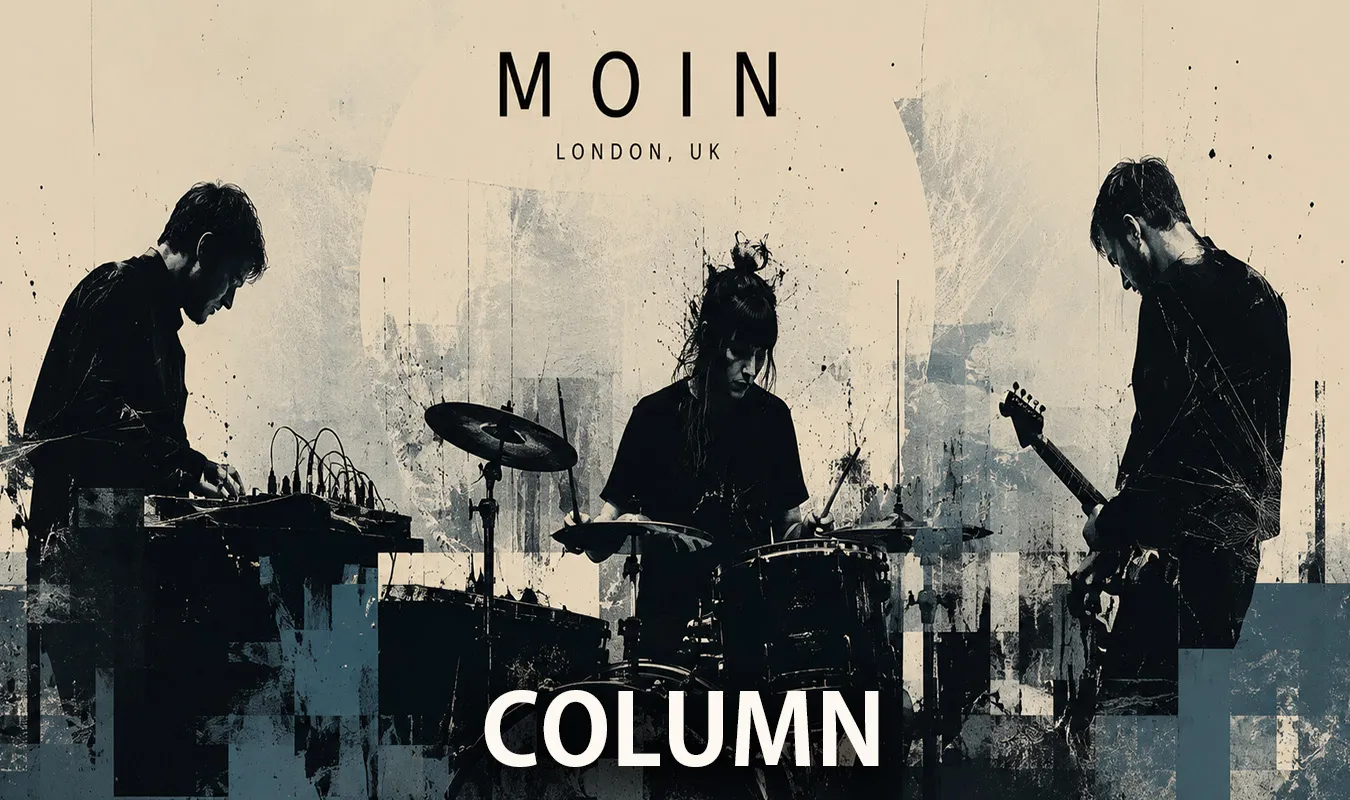

[Column] Maruja depicts the "critical point of modern UK noise jazz" – the current location of a new generation of bands oscillating between violence and poetry
Column en NoiseRock PostPunk UK
What is Maruja?
Text: mmr|Theme: About Maruja, who is beginning to be talked about as “a presence that shakes the boundaries of genres” in the contemporary British underground music scene.
Maruja’s sound, which intersects post-punk, noise rock, jazz improvisation, and spiritual tension, is not just a fusion of genres, but rather a redefinition of music itself.
New impulses rising from Manchester underground scene
Historically, Manchester, England is a city with a multi-layered musical history, including the development of post-punk and house after Joy Division, and the surrounding culture of Britpop. Among them, Maruja appears in a form that cannot simply be recovered into the existing genealogy.
Their characteristic is that, although they have a rock band-like composition, their song structure does not rely on the traditional ““A melody, B melody, chorus’’. Instead, the emphasis is on repetition, accumulation, explosion, and arrangement of silence, which is more similar to the grammar of contemporary jazz and improvisational music.
Therefore, their music appears in its most complete form in the live space.
The starting point of Maruja lies not in the history of the city, but in the “fluctuations” of the city itself.
Structure of sound: between collapse and order
What characterizes Maruja’s music is a structure that could be called “controlled chaos.” The saxophone often comes to the fore, an unusual choice for a rock band, but a natural component for them.
The guitar forms a texture rather than a riff, the bass fixes the sense of time through repetition, and the drums simultaneously carry the freedom of jazz and the structure of post-rock. The saxophone then enters like a “cleft” and temporarily collapses the entire music.
This collapse is not destruction, but rather functions as a device for reconstruction.
Maruja’s sound is always presented as a “state of creation” rather than a finished product.
Initial impulse and direction seen in the EP “Knocknarea”
The EP Knocknarea, released in 2023, is an important record in understanding Maruja’s early impulses. Although this work is composed of a compact group of songs, their essential direction is already clearly visible within it.
The political and social tensions, the pressures of urban life, and the instability that has accumulated within the individual are contained in this work as a “density of sound” rather than a direct message.
What is particularly impressive is that the development of the sounds does not aim for a “solution.” While most rock music tends toward catharsis, Maruja instead chooses to “remain unresolved.”
"”Knocknarea’’ is not an end, but rather a record that fixes the instability of the beginning.
The device of a live show – the moment when music becomes an “incident”
The biggest factor that determines Maruja’s reputation is not her studio work, but her live performances. Their performance is not a reproduction, but an event generated on the spot.
During live performances, the tempo and structure change flexibly, and the songs enter a unique state in which they “collapse while maintaining their shape.” Therefore, rather than listening to the music, the audience witnesses the process of the music changing.
In particular, the interplay between the saxophone and drums is highly improvisational, at times jazz-like, but at the same time tinged with noise-like violence.
Maruja’s live performance is not a performance, but an observation of the process by which sound self-destructs.
Position in the UK postgenre context
The contemporary UK scene is a complex one, with post-punk revival, grime, jazz revival and experimental rock all happening at the same time. Among them, Maruja is located in a ““gap’’ that does not completely belong to any genre.
Although they have the freedom of jazz, they are not jazz, and although they have the structure of post-rock, they are not post-rock. Rather, he musicalizes those boundaries themselves.
This kind of positioning is not a mere fusion, but rather a ““rewiring of genres.’’
Rather than crossing genres, Maruja challenges the very assumptions of genres.
Musical physicality and political nuance
Maruja’s music does not feature politics in the form of clear slogans. However, in its place, there is a strong physical tension.
Repetitive rhythms, intermittent phrases, and sudden sonic breakdowns function to symbolize the stress and instability of modern society. It is not a verbal assertion, but is conveyed as a sensory pressure.
This approach focuses on eliciting a response at a physical level, rather than leaving interpretation up to the listener.
Maruja’s music is in the realm of being understood not as a meaning, but as a bodily response.
The future shown by Maruja ─ Aesthetics of unfinishedness
If I had to describe Maruja’s current position in one word, it would be the “aesthetics of unfinishedness.” Rather than being presented as a completed work, the fact that it is always in a state of being in the process of creation becomes an expression in itself.
This attitude contrasts with the immediacy of music consumption in the digital age, and rather suggests the value of not being finished.
Their music exists not to end, but to continue.
Maruja releases music into time by refusing to complete it.