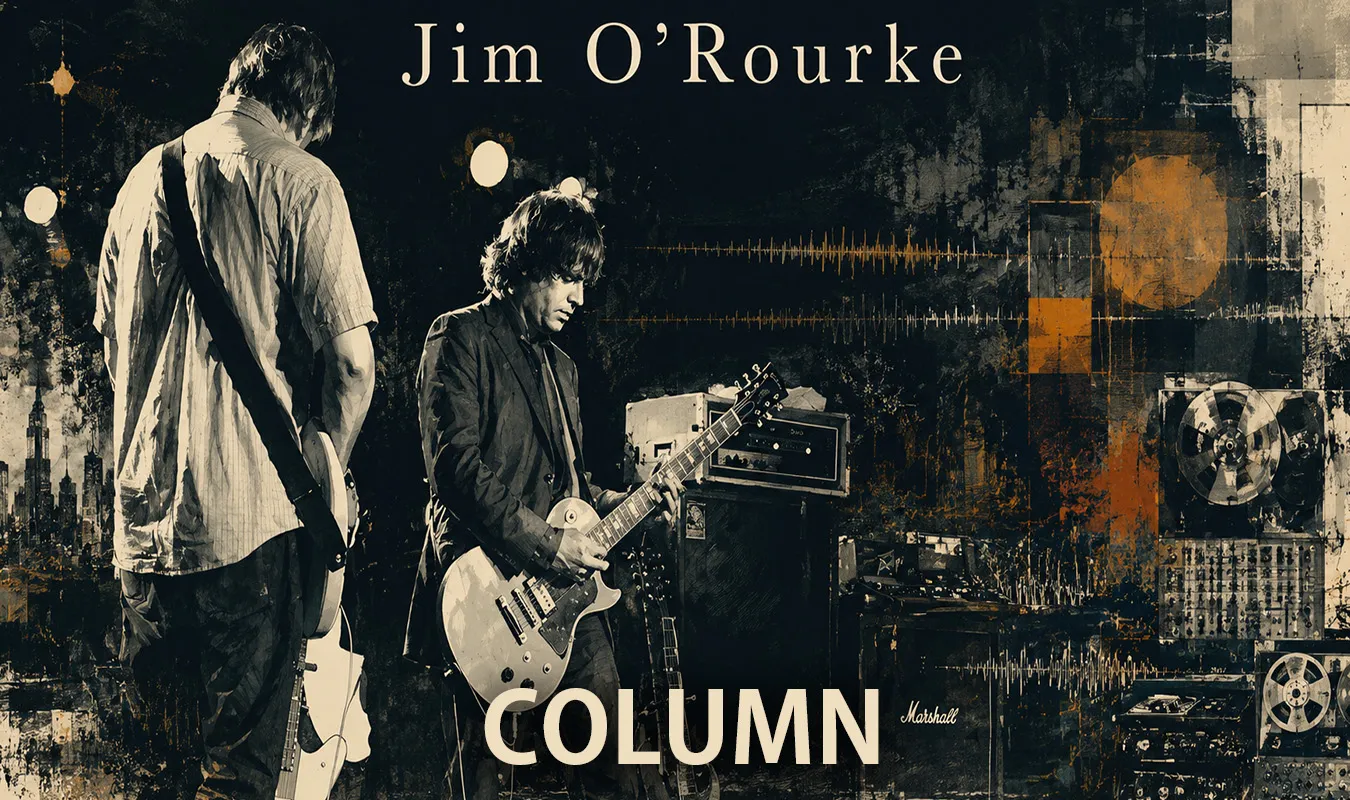
[Column] Jim O'Rourke - A musician who melted boundaries

Column en Experimental Post Rock
[Column] Jim O'Rourke - A musician who melted boundaries

A musician who continued to defy boundaries

Text: mmr|Theme: Noise, folk, electronic acoustics, pop. Follow the path of Jim O’Rourke, who traversed all of them while charting his own musical map.

Looking back at the history of experimental music since the 1980s, there have been many musicians who have transcended genres. However, among them, there are few who have made the concept of musical genre as ambiguous as Jim O’Rourke.

People who hear his work for the first time are confused.

One album has beautiful acoustic pop music. In the next piece, metallic sounds and feedback continue for several minutes. In other works, a repetitive structure similar to minimal music appears, and in other works, improvised noise explodes.

Yet, strangely, there is a Jim O’Rourke-like quality to each of his works.

His career has been built not on a sense of unity but on transversality. Rock, electroacoustic, improvisation, contemporary music, folk, jazz, minimal, noise. Musical cultures that would normally be divided existed simultaneously for him.

Born in Chicago, USA in 1969, Jim O’Rourke had a strong interest in experimental music from a young age. He was particularly interested in free improvisation and 20th century contemporary music, and had a different sensibility than just a rock boy.

His areas of influence are extremely wide.


Main sources of influence

  • free jazz
  • musique concrète
  • contemporary music
  • 1970s singer-songwriter
  • noise
  • Krautrock
  • American Primitive Guitar
  • Chicago Acoustic School
  • movie music
  • electronic sound
graph TD A[contemporary music] --> D[Jim O'Rourke] B[noise] --> D C[fork] --> D E[improvised music] --> D F[electronic sound] --> D G[pop] --> D H[minimal music] --> D

From the beginning, he showed no interest in “being faithful to the genre.” Rather, he was fascinated by the sense of discomfort that arises the moment musical cultures come into contact with each other.

From the late 1980s to the early 1990s, the American underground music scene was experiencing an expanding spirit of experimentation beyond hardcore. This was also the time when the term post-rock began to appear.

In this atmosphere, Jim O’Rourke became more than just a guitarist or producer, he became something like an ““editor’’.

He doesn’t just play music.

Music history itself was being rearranged.

Jim O”Rourke”s greatest characteristic was his attitude of creating music based on connections rather than genres.


Chicago underground music and early activities

Chicago in the 1990s was a pivotal point in the history of American experimental music.

A unique cultural zone was forming, different from New York no-wave and West Coast noise. There, rock and contemporary music, improvisation, and electronic sound mixed naturally.

Jim O’Rourke was at the center of it all.

Particularly important were the activities at Gastr del Sol.

Gastr del Sol, known as the unit with David Grubbs, was extremely different from the alternative rock context of the time.

The song suddenly stops.

The melody falls apart in the middle.

The silence continues for a long time.

Acoustic instruments and noise coexist.

They intentionally incorporated structures into their work that normal rock bands would avoid.

timeline title Jim O'Rourke 初期活動 1980s : 実験音楽へ傾倒 1991 : Gastr del Sol参加 1993 : ソロ活動拡大 1995 : プロデュース活動増加 1997 : Drag City作品群で注目

At the time, Jim O’Rourke was more than just an “avant-garde musician.”

He also had a very good pop sensibility.

While creating noise music, he also loved 1970s soft rock. He understood the arrangement sensibilities of Van Dyke Parks and Burt Bacharach, and treated them in the same light as experimental music.

This feeling was directly connected to his later masterpieces.

He was also a very good recording engineer.

In the 1990s, lo-fi recording became a popular aesthetic in indie music. However, Jim O’Rourke placed more emphasis on “sound placement” than mere roughness.

small noise.

The room rang.

Spatial reverberation.

microphone distance.

silence.

He thought of music not as a “performance” but as a “space design.”

This feeling greatly influenced his later production work.

Jim O”Rourke wasn”t just composing music, he was composing the sonic space itself.


The image of “experimental music” changed by solo works

In the late 1990s, Jim O’Rourke achieved great acclaim for his solo work.

In particular, ““Bad Timing,” ““Eureka,” and ““Insignificance’’ are often talked about as his masterpieces.

The reason these works were groundbreaking was that they were ““experimental music, but easy to listen to.’’

Traditionally, avant-garde music has tended to be associated with esotericism. However, Jim O’Rourke created beautiful melodies and complex structures at the same time.

Representative solo works

Year Works Features
1997 Bad Timing Guitar-based feature
1999 Eureka Chamber music pop
2001 Insignificance A masterpiece with a strong rock flavor
2009 The Visitor A traveling work composed of one song

"”Bad Timing’’ inherits the flow of American primitive guitar, but develops like film music.

In ““Eureka,’’ he used strings and woodwind instruments to create an acoustic world that could be considered the pinnacle of chamber music pop.

"”Insignificance’’ has a stronger rock tone and is highly popular as his song work.

graph TD A[Bad Timing] --> B[fork] A --> C[minimal] A --> D[movie music] E[Eureka] --> F[chamber music] E --> G[soft lock] E --> H[experimental acoustics] I[Insignificance] --> J[Alternative] I --> K[pop] I --> L[noise]

His solo works have something in common.

It is “beauty on the verge of collapse.”

It’s not perfect pop music.

Noise gets in.

The development suddenly changes.

There was a long silence.

However, this instability creates strong emotions.

Jim O’Rourke proves that “experimentation” and “emotion” are not at odds.

This had a huge influence on later indie music.

Since the 2000s, many artists have begun to engage in “quiet experimentation,” and Jim O’Rourke is certainly at the root of this.

His music was not difficult to understand, but “complex yet emotional.”


Joining up with Sonic Youth

In 1999, Jim O’Rourke officially joined Sonic Youth.

This surprised many music fans at the time.

Because Sonic Youth was already a complete and legendary band.

But in reality, the feelings between the two were very close.

Sonic Youth brought noise and rock together, and Jim O’Rourke was another boundary-breaking musician.

He functioned more as a “structural coordinator” than a guitarist.

After joining Sonic Youth, the sound organization and composition sense of the songs changed significantly.

Main works during the participation period

  • NYC Ghosts & Flowers
  • Murray Street -Sonic Nurse -Rather Ripped

"”Murray Street’’ in particular received high praise.

While retaining the violence of a noise band, the space became more expansive and quiet.

flowchart TD A[noise] --> D[Murray Street] B[improvisational nature] --> D C[空間設計] --> D E[melody] --> D

Sonic Youth, when Jim O’Rourke joined the band, is said to have achieved not only “destruction” but also “white space.”

He was also the acoustic translator between members.

He had an extremely high ability to create a recorded work without sacrificing the band’s improvisational nature.

Therefore, his presence was more than just an additional member.

Jim O’Rourke gave Sonic Youth “breathing” rather than “organization”.


Unusual flexibility as a producer

When talking about Jim O’Rourke, the production industry cannot be avoided.

He is involved in a wide range of works.

Moreover, none of them sound the same.

Producers with strong individuality usually dye their works in their own unique colors. But Jim O’Rourke was the opposite.

He brings out the artist’s unique texture.

Main artists involved

Artist Main Features
Sonic Youth Noise Rock
Wilco Alternative Country
Stereolab Experimental Pop
Smog Lo-fi folk
Joanna Newsom Chamber Folk

In particular, Wilco’s involvement around Yankee Hotel Foxtrot was important.

Since the 2000s, indie rock has evolved in a more acoustic direction than before. One of the turning points was the Jim O’Rourke-esque sensibility.

He doesn’t make “beautiful recordings” but rather “arranges sounds with meaning.”

Even noise has meaning.

Even the blank spaces have meaning.

Localization also has meaning.

Even silence has meaning.

This felt similar to film editing.

graph TD A[recording] --> E[space] B[silence] --> E C[noise] --> E D[Localization] --> E E --> F[emotion design]

As a result, his production work is not flashy.

However, if you listen to it repeatedly, it has an unusual depth to it.

Jim O”Rourke didn”t just “add sounds,” he placed the “meanings of the sounds.”


Immigration to Japan and quiet later activities

Since the late 2000s, Jim O’Rourke has moved to Japan.

Since then, his activities have become quieter and more introspective.

Although large-scale media exposure has decreased, the amount of creation has actually increased.

Improvisation.

electronic sound.

collaboration.

movie music.

Archive work.

Supervision of recurrence.

He became more of an ““acoustic researcher’’ than a star on the public stage.

His works after moving to Japan have a unique tranquility to them.

urban noise.

A feeling of air.

Time has passed.

Microscopic repetition.

These things are appearing more strongly than before.

mindmap root((After moving to Japan)) 即興 電子音響 静寂 映画音楽 長時間構成 コラボレーション

Also important was the connection with Japan’s experimental music culture.

Japan has long had a unique culture of improvisation, noise, and electronic sound. Jim O’Rourke is deeply integrated into it.

His activities were more like participating in a transnational acoustic community than ““American musicians coming to Japan.’’

After immigrating to Japan, Jim O’Rourke moved from “focusing on the work” to “centering on the sound itself.”


Jim O”Rourke”s legacy

It is difficult to simply summarize Jim O”Rourke”s accomplishments.

He’s not a hero of any particular genre.

I’m not a rock person either.

I’m not a noise person either.

I’m not even a pop writer.

But at the same time, it’s all of those things.

His greatest achievement was that he did not end up ““crossing genres’’ with mere omnivorousness.

多くの音楽家が複数ジャンルを聴く。

But Jim O’Rourke treated them in the same light.

Noise and pop were equal.

Improvisation and melody were equal.

Both electronic and acoustic sounds were equal.

That feeling is extremely compatible with the current music environment.

Nowadays, thanks to Spotify and YouTube, genre boundaries are blurring more than ever before. In playlist culture, different types of music naturally line up.

But Jim O’Rourke has been practicing that sensibility since the 1990s.

graph TD A[rock] --> E[Crossing genres] B[noise] --> E C[fork] --> E D[electronic sound] --> E E --> F[modern listening sense]

That”s why his works still don”t get old.

This is because the book deals not with trends, but with the possibilities of hearing itself.

Jim O’Rourke was a musician, editor, recordist, and critic.

Above all, he was a person who continued to doubt the walls of ““music genres’’.

Jim O”Rourke”s body of work continues to prove that “music is about connection, not classification.”


Chronology

Year Events
1969 Born in Chicago, USA
1980s Start of experimental music activities
1991 Gastr del Sol participation
1995 Full-scale production activities
1997 “Bad Timing” announced
1999 “Eureka” announced
1999 Joined Sonic Youth
2001 “Insignificance” announced
Late 2000s Moved to Japan
2009 “The Visitor” announced
After 2010s Shift to improvisation and electronic acoustics

Discography notable works

Works Publication year Features
Disengage 1992 Early experimental acoustics
Bad Timing 1997 Long guitar work
Eureka 1999 Chamber Music Pop
Insignificance 2001 A masterpiece with a strong rock flavor
The Visitor 2009 A traveling piece composed of one song

-David Grubbs -Sonic Youth

  • Wilco
  • Chicago Underground
  • post lock
  • electronic sound
  • improvisational music
  • minimal music
  • No Wave
  • Krautrock

To understand Jim O’Rourke is to decipher the entire map of experimental music since the 1980s.


Monumental Movement Records

Monumental Movement Records