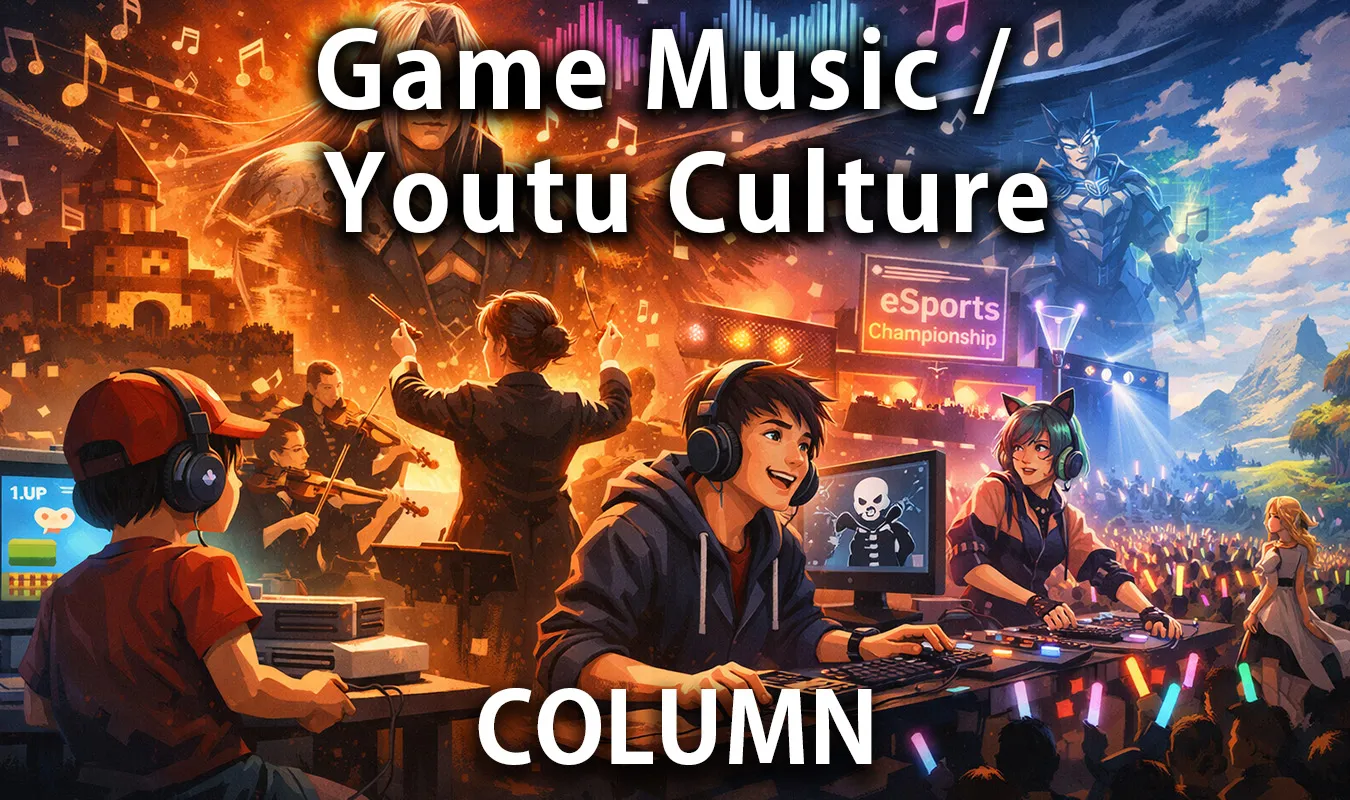
[Column] The moment when game music becomes mainstream among young people
Column en Culture Game Music Streaming
What is game music?
| Text: mmr | Theme: Where have the ears of the digital generation gone? - The structural shift in which game music has become the core culture of young people |
Game music refers to a group of musical works created for video games. It is a broad genre that includes everything from chip sound sources under hardware constraints to full orchestral recordings, electronic music, pop music, and folk music.
Traditionally, it was positioned as background music that supplemented the game experience, but now it has formed an independent viewing target, distributed content, and live market.
Points covered in this article
- The strength of the melody created by technical constraints
- Composer visibility and branding
- Explosion of derivative works due to internet culture
- Streaming and playlist generation
- E-sports and large-scale production *Changes in music exposure time among young people
- Decisive phase of mainstreaming
History
1. Establishment of 8bit and melodicism (1980s)
Home game consoles in the 1980s had a limited number of simultaneous polyphony, and restrictions on chords and sustained notes. Therefore, composers emphasized clear rhythms and melodies that were easy to remember.
Super Mario Bros Music: Koji Kondo
The terrestrial BGM is designed with a loop structure of about 2 minutes, and has a light and jumping feel with a tempo of about 100 to 110 BPM. The simple triad progression and the driving force of the bass line were strongly connected to the playing experience.
At the same time, Dragon Quest Music: Koichi Sugiyama
“Overture” has a classical fanfare structure and is designed to create a ritualistic uplift as the game begins.
These were not just background music, but music that symbolized the brand of the work itself.
Restrictions have forged melodies and created themes that will remain in the memories of generations.
2. The CD-ROM era and the expansion of sound (1990s)
In the late 1990s, with the spread of CD-ROMs, the capacity of sound sources expanded dramatically. Strings, chorus, and rock band formations are introduced.
Final Fantasy VII Music: Nobuo Uematsu
”“One-Winged Angel’’ introduced a Latin chorus and expanded the boss fight music into a religious and theatrical space. The song was later performed by orchestra around the world.
Started in 2002 Distant Worlds: music from FINAL FANTASY has performed repeatedly in North America, Europe, and Japan, and established game music in classical halls.
At this stage, game music transitioned from a ““domestic experience” to a ““performance art in public spaces.”
Game music has left the home and entered the concert hall.
3. Explosion of derivative works and internet culture (2000s)
With the spread of video sharing sites, the culture of performance videos and remixes is rapidly expanding.
especially Touhou Project created a culture of arranging thousands of songs and formed a doujin music market.
Young people not only listen to the original songs, but also
- guitar cover
- Piano performance *EDM remix
- Chiptune reconstruction
Through such reinterpretation, participants come to participate.
During this era, game music transformed into “shared material.”
Players have changed from listeners to co-writers.
4. Indie revolution and SNS spread (2010s)
appeared in 2015 Undertale Music: Toby Fox
“Megalovania” has been widely quoted on YouTube and TikTok, and has spread in multiple ways, including rhythm games, meme videos, and brass band performances.
At the same time, Minecraft Music: C418
The environmental music approach has become part of the daily lives of young people as background music for work.
Game music will be incorporated into playlists for “concentration,” “study,” and “sleep,” redefining it as background music for daily life.
Game music has changed to a sound that encapsulates everyday life.
5. Global distribution and orchestration (2020s)
Distribution starts in 2020 Genshin was recorded with a full orchestra in London, Shanghai, and other locations. The official concert video was simultaneously distributed worldwide and viewed by millions of viewers.
At e-sports tournaments, large-scale productions are included in the opening ceremonies. League of Legends is developing virtual artist productions and live performances.
Game music is no longer just “in-game music” but has become a core element of global entertainment.
For young people, it was the most natural mainstream.
Chronology
Mainstreaming model
Key Artists
- Koji Kondo
- Koichi Sugiyama
- Nobuo Uematsu
- Toby Fox *C418
Essential Tracks
- Ground BGM (Super Mario Bros.)
- Overture (Dragon Quest)
- One-Winged Angel
- Megalovania
- Minecraft – Sweden
Cultural Impact
Changes in music exposure among young people:
- Decrease in TV viewing time
- Increased YouTube viewing time
- Increased gameplay time
- Establishment of streaming usage
The game music is “operation” “Successful experience” “Story immersion” Because it is inseparably linked to emotional memory, it has a high retention rate in emotional memory.
Also, for Generation Z In many cases, people come into contact with game music more frequently than anime theme songs.
For young people, game music is not a background sound, but a main melody that is assimilated into the experience.
FAQ
Q1. Why did it become mainstream so quickly?
With the lifting of the streaming ban, the structure has become available to people who don’t know about games.
Q2. What is your relationship with classical music?
With the expansion of orchestral performances, it is also valued as a performance art.
Q3. What are your future prospects?
It is predicted that real-time music experiences in VR spaces and Metaverse events will expand.
The moment when game music becomes mainstream among young people is not a single incident, but the result of a 40-year accumulation of technology and culture.