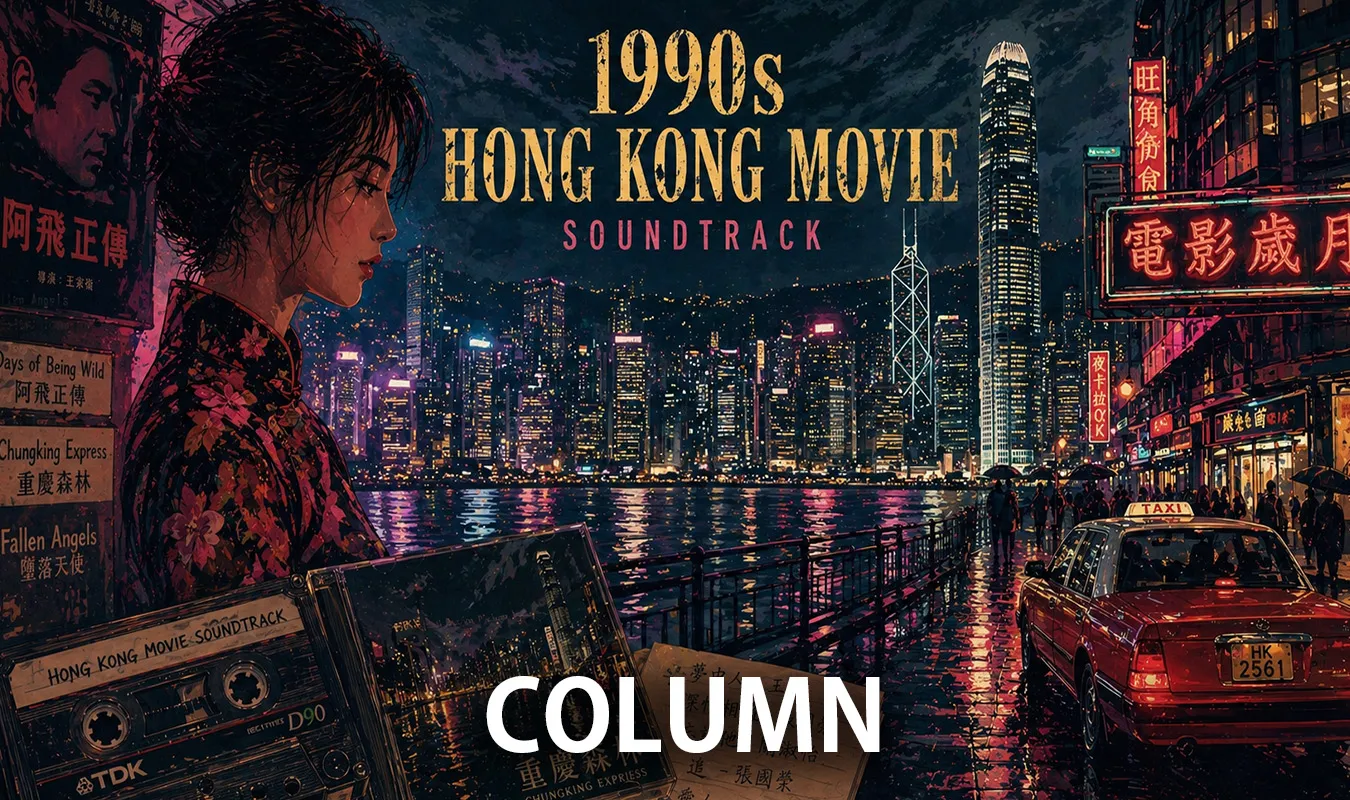
[Column] The Golden Age of Hong Kong Movie Soundtracks: The Heartbeat and Memories of the 90s City

Column en 90s Film Movie Soundtrack
[Column] The Golden Age of Hong Kong Movie Soundtracks: The Heartbeat and Memories of the 90s City

Prologue: An era when sound recorded cities

Text: mmr|Theme: Soundtrack innovation and urban culture resonance in 1990s Hong Kong films

Hong Kong cinema in the 1990s was an era in which the contours of the city were engraved not only through images but also through sound. The reflections of neon lights, the damp night air, the speed and impatience, all of which flow into the audience’s bodies along with the music. In particular, the soundtrack was not just a background, but functioned as another narrator running alongside the story.

At this time, Hong Kong’s handover in 1997 was just around the corner, and there was a unique sense of tension and floating in the society as a whole. Film music directly reflected this atmosphere, sometimes expressing the heartbeat of the city with pop and lightness, and other times with urgent rhythms.

In Koisuru Planet, for example, repeated pop songs emphasize the characters’ loneliness and the dislocation of time, and the music itself is integrated into the structure of the story. Here, ““music selection’’ began to have the same meaning as composition.

The music of Hong Kong movies in the 1990s was a device for reproducing the city’s time itself.


Close relationship between Hong Kong pop music and film music

Cantopop Penetration

Cantopop is essential when discussing Hong Kong movie soundtracks. In the 1980s and 1990s, Cantopop was strongly connected to the film industry, and a structure was established in which theme songs and star actors mutually increased popularity.

Stars such as Zhang Guorong, Liu Dehua, and Wang Fei were both actors and singers, and often sang their own movie theme songs.

Representative artists and characteristics

  • Wang Fei Symbolizes urban loneliness with a floating voice and alternative-oriented songs

  • Zhang Guorong Wide range of emotional expressions, suitable for everything from love stories to dramas.

  • Liu Dehua The classic Cantopop that combines star quality and popularity

  • Hayashi Zixiang Providing many dramatic songs with powerful vocals

Drama of the theme song

The theme song was not just an ending, but also served to reinforce the emotional core of the story. Especially in romantic movies and noir films, the melody of the theme song remains strongly in the memory of the audience.

In Angel’s Tears, music also functions as a device to visualize the psychological distance between the characters.

Cantopop extended outside of cinema and perpetuated the story in the lives of audiences.


Representative soundtrack and track list

Planet in Love (1994)

It is characterized by a structure that connects fragments of the city through sound. The repetition of pop songs links to the temporal structure of the story.

Main track examples:

  • crazy person *California Dreamin’
  • Instrumental score (mainly electronic sound)

Angel’s Tears (1995)

Sound with the theme of night city and loneliness. Jazz and electronic sounds intertwine.

Main track examples:

  • Karmacoma
  • Instrumental theme (score by Shigeru Umebayashi)

Men’s Elegy Series

A sound that symbolizes the fusion of action and lyricism.

Main track examples:

  • Ballad theme song (Cantopop style)
  • Synth-based action score

Flowers (Reference: 2000)

It is important as a musical aesthetic that is an extension of the 90’s.

Main track examples:

  • Yumeji’s Theme *Latin music insert

Soundtracks have become established as standalone works, forming a culture where they are listened to outside of movies.


Experimentation and internationalism of composers

Multicultural musical language

Hong Kong film music in the 1990s was extremely multicultural. There was a mix of jazz, electronica, classical, rock, and even traditional Chinese music.

Shigeru Umebayashi, a representative composer, fuses Japanese melodies with Western arrangements.

Gu Ka-hui also worked in both television and film, and laid the foundation for Hong Kong music.

Introduction to electronic music

Around the same time, the influence of electronic music was also noticeable, with trip-hop music such as Massive Attack becoming the signature sound of the city night.

Crossing genres, the composers used sound to reconstruct the complexities of Hong Kong.


Action movies and rhythm innovation

Music of speed and tension

In John Woo’s work, music was the very rhythmic element of the action.

Contrast with slow motion

After Men’s Elegy, the combination of slow motion and lyrical music became established.

In action movies, music plays the role of directing time rather than movement.


Wong Kar-wai and the Poetics of Sound

Recontextualization of existing songs

Wong Kar-wai restructured existing songs and gave them new meaning.

Relationship between sound and memory

Music acts as a memory trigger, making the film stay with the audience for a long time.

Music existed not to explain the story, but to make it stick in memory.


Chronology: 90s Hong Kong movie soundtrack flow

timeline 1990 : Cantopopと映画の融合が完成 1992 : 電子音楽の導入が加速 1994 : 恋する惑星で選曲の重要性が顕在化 1995 : 天使の涙で都市的孤独の音響化 1997 : 香港返還とともに映画産業の転換期 1999 : 国際市場を意識した音楽制作が主流化

In the late 1990s, music became increasingly international, and Hong Kong cinema entered a new phase.


Diagram: Relationship structure between music and movie elements

graph TD A[urban environment] --> B[movie footage] A --> C[soundtrack] C --> D[emotional expression] B --> D D --> E[audience experience] C --> E

Though independent, images and music intersected, creating a multilayered audience experience.


Final Chapter: Memories of Hong Kong left behind by sound

Hong Kong movie soundtracks in the 1990s went beyond mere film music and functioned as memories of the city itself. It is imprinted with the atmosphere of a political transition, the waves of globalization, and the loneliness of the individual.

When we listen back to that music today, we are not just remembering a movie, but reliving the texture of an era.

The soundtracks of Hong Kong movies continue to beat as the heartbeat of the city even after the images have disappeared.

Music has surpassed movies and has become a medium that preserves the era itself.


Monumental Movement Records

Monumental Movement Records