[Column] Comprehensively elucidating the myth, history, science, and cultural influence of 432Hz music - What psychological effects does frequency have on music?
Column en Ambient Frequency Healing History![[Column] Comprehensively elucidating the myth, history, science, and cultural influence of 432Hz music - What psychological effects does frequency have on music?](/../assets/images/column-432hz.webp)
Prologue: Why is 432Hz treated as “special”?
Text: mmr|Theme: About 432Hz, a mysterious and fascinating cultural phenomenon
A representative example of the theory of alternative frequencies in music that is being talked about on the Internet is 432Hz. Millions of ““432Hz Music” have been uploaded to YouTube, with everyone from the spiritual realm to electronica creators talking about this frequency using words such as ““healing,” ““cosmic harmony,” ““golden ratio,” ““ancient civilization,” and ““natural frequency.”
However, the debate surrounding 432Hz is complicated by facts, misconceptions, and spiritual symbols. It’s hard to tell where history begins and modern mythology begins.
In this paper,
- Music history (history of tuning)
- Scientific verification (psychological/physiological data)
- Cultural History (Mysticism/1960s New Age)
- Media spread (YouTube/healing boom)
We will comprehensively analyze why 432Hz attracts so many people.
Chapter 1: History of tuning - until 440Hz was standardized
1-1. Pre-modern times: completely different pitches depending on region and era
From the 18th to the 19th century, the standard pitch of music (A frequency = A frequency) varied by region, instrument, and era. A fluctuated in the range of 380Hz to 470Hz.
- Baroque Europe: Frequently around 415Hz (modern “Baroque pitch”)
- Northern Italy (18C): Approx. 430Hz
- French court (18C): approx. 392Hz (“Tonneau Bass”)
In this way, “432Hz” is not the “correct pitch” in history, but A region around 430-435Hz actually existed, so it can be said that misunderstandings were likely to occur in future generations.
1-2. Industrialization and internationalization required a “unified pitch”
In the latter half of the 19th century, as orchestras became huge and exchanges between European cities increased, Differences in pitch in various locations began to cause confusion at concerts.
Following this trend, France established A=435Hz (=commonly known as the diapason norm) (1859). This value also contributed to the misunderstanding that 432Hz was the classical orthodox pitch.
1-3. 20th century: International standardization of A=440Hz
- 1939: A=440Hz proposed at the London Conference
- 1955: Officially adopted as an ISO standard
- 1975: Revised as ISO 16, current
In other words, 440Hz is a “convenient standard created by modern internationalization”, The decision was not made based on musical or spiritual superiority.
Chapter 2: Is 432Hz really a “natural frequency”?
The claims made on the internet about 432Hz are as follows.
- Universal Harmonic Frequency
- Compatible with earth vibration (Schumann resonance)
- Relationship with golden ratio φ
- Has health and healing effects
However, from a scientific perspective, most of these claims have no direct causal relationship.
2-1. Unrelated to Schumann resonance (7.83Hz)
The fundamental tone of the Schumann resonance that exists in the earth’s electromagnetic environment is “7.83Hz”.
- 7.83Hz × 55 ≒ 430.65Hz
- 7.83Hz × 56 ≒ 438.5Hz
**Even integer multiples do not match 432Hz. **
2-2. The relationship with the golden ratio φ (1.618…) is also “number matching”
It is true that the number 432 has been used in various mystical systems; The relationship between 432Hz as a frequency and φ is not mathematically inevitable.
2-3. Only “timbre change” can be confirmed scientifically
If you convert the same song to 432Hz and 440Hz, Subtle differences in tone and tension occur due to the 8Hz difference.
- 432Hz → Slightly soft, impression of less sound pressure
- 440Hz → Modern music, clear, and easy to edge
People’s impressions are easily influenced by this, but Research data showing clear physiological advantages are currently limited.
Chapter 3: 432Hz from psychological and physiological data
Often cited in the following studies:
- 432Hz music is slightly more likely to lower your heart rate
- Tendency for subjects to report feeling “calming” and “warm”
However, the difference in effectiveness is small;
- 432Hz → Easy to relax
- 440Hz → Easy to concentrate
No clear superiority difference beyond this “tendency” has been proven.
Rather, if you have an expectation that “432Hz is a soothing sound”, It is quite possible that you feel comfortable due to the placebo effect.
Chapter 4: Why has the “432Hz myth” spread rapidly in modern times?
4-1. Originated in 1970s New Age culture
- Sound therapy
- Connection between chakras and musical scales
- Mystical numerology (432, 108, 144…)
In this culture, number symbolism and music were associated.
4-2. After 2000s: Explosive spread on the Internet
YouTube was a platform where you could easily share ““famous songs converted to 432Hz’’.
-EDM
- Lofi
- Ambient
- sleep music
- 1/f fluctuation BGM
Both creators and listeners praised the “soft sound” 432Hz has penetrated across genres.
4-3. The “narrative” of numbers gained support
Many of the people who support 432Hz I’m more attracted to the “storytelling” than the numbers themselves.
- Mysteries of ancient civilizations
- Harmony with nature and the universe
- Elevation of spirituality
- The healing power of music
This is a different level of attraction than whether it is true or not. This is a major reason why 432Hz as a cultural phenomenon was established.
Chapter 5: Music Production Perspectives - What actually changes with 432Hz conversion?
5-1. Conversion in DAW
- Decrease 440Hz recording by –31.766% cents
- Or create a new project with A4=432Hz
5-2. Differences in tone
- The “hardness” of the high range is slightly softened.
- Sounds more atmospheric
- Singing voice sounds slightly rounder
Many producers say that it has a particularly positive effect on vocals.
5-3. Most important: The key of the song changes
432Hz lowers the entire pitch, so Please note that if you match it with a 440Hz performer, it will be out of sync.
Although it is unrealistic for classical music or band performances, This is not a problem with YouTube’s background music.
Illustration: 440Hz → 432Hz conversion
Chronology: Music standard pitch and the establishment of the “432Hz myth”
Chapter 6: “Belief” and “musical reality” surrounding 432Hz
The important point is that the experience of listeners who prefer 432Hz is not a lie.
- Impression of “calming” and “soft”
- How addictive the creator feels
- Emotional value created by the symbolism of numbers
This exists as a cultural/psychological reality that is separate from scientific proof.
Music is originally It is a field where science, sensation, and storytelling coexist, and 432Hz can be said to be a symbolic phenomenon.
Summary: 432Hz is a “mysterious and fascinating cultural phenomenon”
- There is no special historical basis
- Not scientifically better than 440Hz
- However, as a cultural phenomenon it is very interesting. Has the power to enrich the listener’s experience
In other words, 432Hz is
More than “music as fact” Area where “music as a story” shines
attracts people.
This is also one of the most fundamental values that music provides to humans.
YouTube Podcast
*This podcast is in English, but you can watch it with automatic subtitles and translation.
Appendix: Reference keywords
- A=432Hz / A=440Hz
- Music therapy *Frequency effect
- Mysticism/New Age
- Tuning history
- Baroque pitch
- Music psychology
Explore more like this
![[Column] Complete history of vaporwave culture — label history, acoustic analysis, sociocultural theory, illustrations, chronology](/../assets/images/column-vaporwave.webp)
[Column] Complete history of vaporwave culture — label history, acoustic analysis, sociocultural theory, illustrations, chronology
Introduction: What is Vaporwave?
![[Column] Religious music around the world and its psychological and social effects - The history of music and prayer as explained through illustrations and timelines -](/../assets/images/column-religious-music-worldmap.webp)
[Column] Religious music around the world and its psychological and social effects - The history of music and prayer as explained through illustrations and timelines -
Prologue: The universality of music and religion
![[Column] Fusion of Yoga and Music: History, Science, and Practical Guide](/../assets/images/column-yoga-music.webp)
[Column] Fusion of Yoga and Music: History, Science, and Practical Guide
Introduction: Yoga meets music
![[Column] The miracle of listening: the future of](/../assets/images/column-hearing-health.webp)
[Column] The miracle of listening: the future of "sound" envisioned by the Hearing Health Foundation
Introduction: Poetics of the sense of hearing
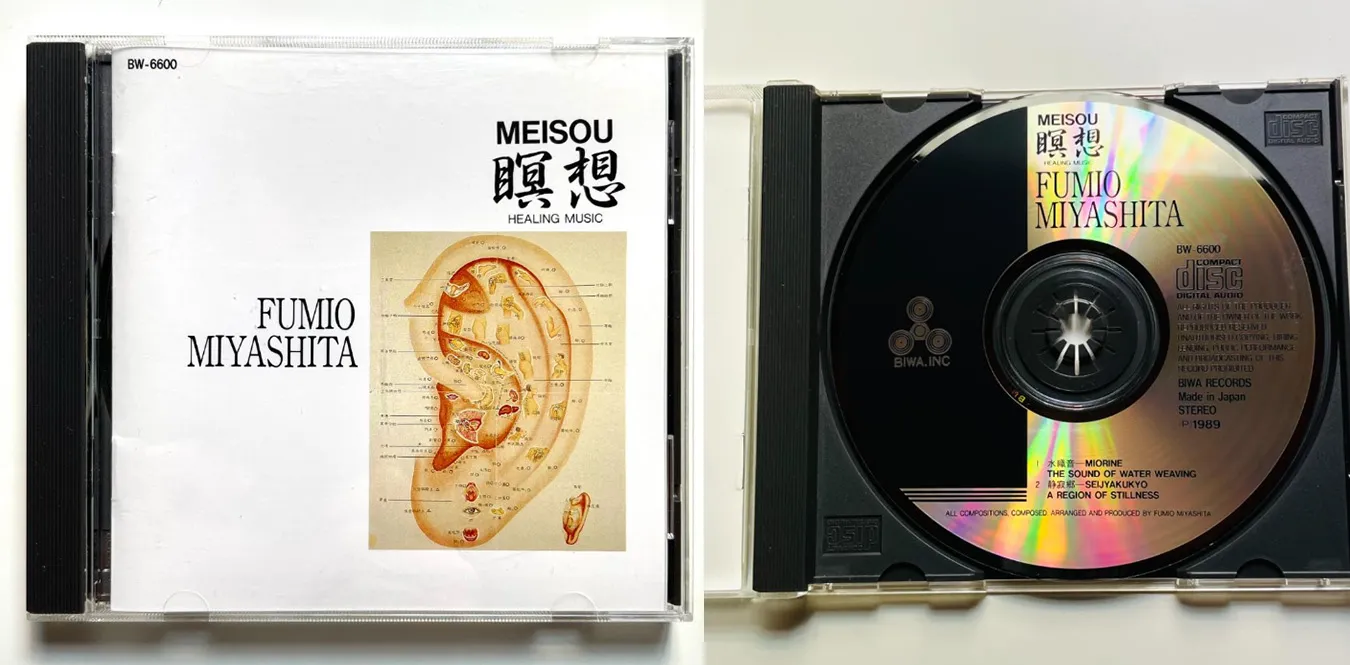
Fumio Miyashita - Meisou
Tomio Miyashita is a musician, music therapist, and synthesizer player from Nagano Prefecture.