[Column] Yann Tomita: A sound explorer who expanded the horizons of sound collage and electronic music.
Column en Experimental Modular Sampling
Prologue: An entity that redefined music as a “material”
Text: mmr|Theme: The trajectory of an explorer who updated the concept of sound by crossing sampling and modular synths
A perspective from outside music
In the history of Japanese music, Yan Tomita is more than just a musician. His activities are not limited to performance and composition, but are full of attempts to update the way we perceive sound itself. He has played an extremely important role in the introduction and development of sampling culture in Japan, especially since the 1980s.
A characteristic of Yan Tomita is that he does not rely on existing genres. His attitude of traversing different fields such as pop, dub, electronic music, ethnic music, and environmental sounds while reconstructing them as “materials” was unprecedented at the time. The idea of viewing music not as a completed work but as a collection of editable fragments overlaps with the foundation of later digital music production.
His approach is to redefine music production as a process of ““recording” and ““relocation.” Recorded sounds are no longer fixed records, but become materials that must be rearranged. Although this idea resonates with the trends of hip-hop, dub, and musique concrète, it is important that it was developed uniquely in Japan.
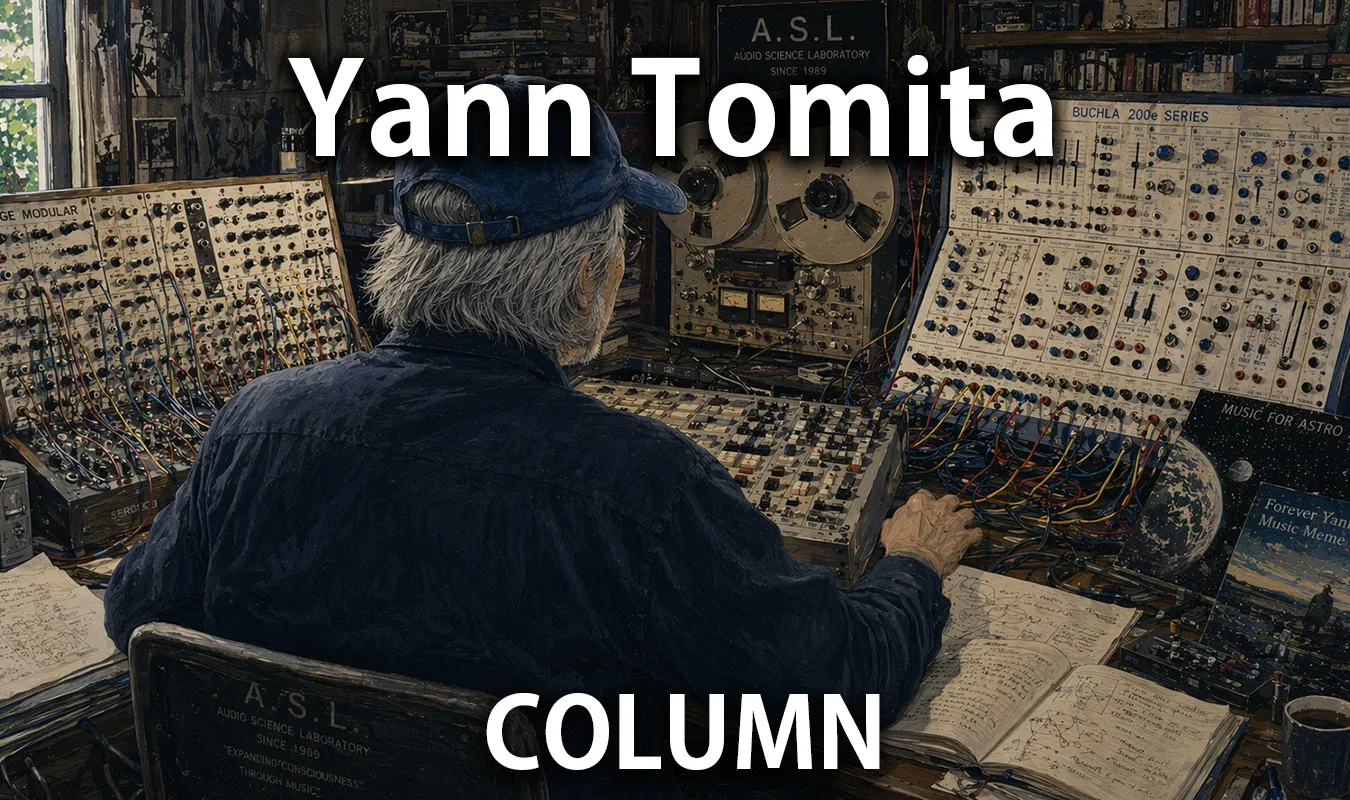
Furthermore, he has a strong interest in electronic audio equipment itself, and has made modular synthesizers the center of his acoustic experiments. In particular, the fact that he owned systems such as Serge and Buchla and used them as experimental sound generation devices is essential to understanding his musical outlook.
A unique sonic world was formed by combining the perspective of treating music as a material with an inquisitive mind towards electronic equipment.
Initial activities: Starting out as a percussionist
Interest in rhythm and physicality
Jan Tomita was born in 1952 and began his musical career as a percussionist. The choice of percussion instruments is important in understanding his later views on music. Rhythm is the most primitive element of music and is closely tied to physicality.
From the 1970s to the 1980s, while having contact with various music scenes in Japan and abroad, he came to treat rhythm not as mere accompaniment, but as the structure of music itself. It is thought that at this stage, the idea of decomposing and reconstructing sound had already begun to emerge.
Also, since the field of percussion emphasizes timbre and texture rather than pitch, his interest naturally turns to the texture of sounds. This is an important foreshadowing that would lead to his later interest in field recording and sampling.
By starting with percussion instruments, I developed a perspective that sees sound as texture rather than structure.
Encounter with sampling: The invention of sound reconstruction
Transformation brought about by digital devices
In the 1980s, the appearance of samplers brought about major changes in music production. Yan Tomita was one of the first to notice this new technology, and saw it not as a mere tool, but as a device that could change the concept of music.
Sampling is the act of recording existing sound and reusing it in a different context. This technology shifts the focus of music from ““performance” to ““editing.” Yan Tomita actively accepted this change and deepened his technique of sound collage.
His method is unique in that it transforms the meaning of sounds, rather than simply quoting them. For example, by taking in environmental sounds and everyday sounds and placing them within a musical structure, he shakes up the listener’s perception. This approach goes beyond mere music production and questions the very perception of sound.
At the same time, he established his own methodology of manipulating “recorded sound” and “generated sound” in the same layer by handling sampling and modular synthesizers in parallel. Systems like Serge”s and Buchla”s did not have a fixed timbre, but were infinitely variable through patching, making them extremely compatible with his philosophy.
Sound generation and reconstruction are integrated through the combined use of sampling and modular synths.
Audio Science Laboratory (A.S.L.)
The theme is “Expanding consciousness through music”
In 1989, Jan Tomita heads up the Audio Science Laboratory (A.S.L.). This activity was not just a production project, but a venue for acoustic research developed under the theme of ““expanding consciousness through music.’’
In A.S.L., it becomes clear that sound is viewed not as mere entertainment, but as a phenomenon that affects perception and consciousness. It explores how elements such as acoustic placement, frequency, and spatiality affect human sensation.
His activities during this period were closely linked to sonic experiments using sampling and modular synths. Sound is treated as both a ““thing that is composed” and a ““phenomenon that is experienced,” and approaches from both perspectives are being attempted.
Moreover, this idea would appear more clearly in his later works. Music is not simply an expression, but is positioned as a device for transforming perception.
The perspective of treating music as a phenomenon that affects consciousness was clarified in A.S.L.
Doopees and the Reconstruction of Pop
Fusion of fictional story and sampling
In the 1990s, Dopeees occupied a unique position among Yan Tomita’s activities. Although this project was a pop unit centered around vocalists, its internal structure was extremely experimental.
Doopees’ works combine radio drama-like narratives, fragmented sounds, and sampled audio sources, and are structured as sonic stories rather than songs. In particular, the structure seen in the album ““Doopee Time’’ is a series of songs, talk, and sound effects, forming a kind of imaginary broadcast space.
This method is directly connected to Yang Tomita’s sampling philosophy. Sound is not simply arranged as a musical element, but is treated as an element that composes a story or situation. In other words, music and storytelling are integrated on the same level.
Also, the pop surface of Dopeees does not hide his experimentalism, but rather serves as a device to highlight it. The project’s uniqueness lies in the precise placement of sound fragments behind familiar melodies and voices.
Doopees was an attempt to reconstruct the sound and story while borrowing from pop formats.
Expansion of works: embodiment of acoustic philosophy
“Music for Astro Age” and cosmic sensations
"”Music for Astro Age”’ is one of the works in which Jan Tomita”s acoustic philosophy is further expanded. This work emphasizes the spatiality and expanse of sound, presenting a structure that seems to be freed from an earthly sense of time.
As the title suggests, this album evokes a sense of cosmic scale. Rather than proceeding in a straight line, the sounds are arranged to float in space, guiding the listener’s perception in a direction that expands.
Sampling and sound production are once again closely intertwined, with sound functioning both as a record of reality and as an element for constructing an abstract space.
By expanding the spatial nature of sound to the utmost limit, the auditory experience itself is transformed.
“Forever Yann Music Meme 2” and the structure of repetition and memory
"”Forever Yann Music Meme 2”’ is a work that is strongly conscious of the themes of sound repetition and memory. In this work, fragmentary sounds and phrases are repeated, creating a unique sense of time in the listener”s mind.
What is important here is the concept of ““meme.’’ Sound is not just a physical phenomenon; it is replicated in memory and culture, and propagates while transforming. This perspective is also deeply connected to sampling culture.
Repeated sounds are not just repetitions, but continue with subtle changes. As a result, listeners get different experiences even though they are supposed to be hearing the same sound. This feeling makes us reconsider the relationship between time and memory.
Memory and the sense of time are reconstructed through the repetition and change of sound.
Modular synths and acoustic experiments
Ideological resonance between Serge and Buchla
Jan Tomita’s Serge and Buchla modular synthesizers are more than instruments, they serve as a platform for sonic experimentation.
The Serge system is relatively compact and flexible, allowing complex signal processing. On the other hand, Buchla has a design philosophy that does not assume a keyboard, and has a direction of liberating music from performance. Both of these systems are designed to deviate from the traditional Western musical framework.
Yan Tomita used these instruments to focus on ““generating” sounds rather than ““playing” them. Characteristics of his work, such as changes in sound through voltage control, random patching, and acoustic structures that continually change over time, are closely tied to these devices.
Furthermore, this sonic approach functions as the foundation for his activities with Doopees and A.S.L. It is distinctive in that the different fields of pop, experimentation, and research are unified by the same sonic philosophy.
Modular synths function as the foundation that supports all activities.
Chronology: Trajectory of Yan Tomita’s activities
Organizing major events
It is distinctive in that research, pop culture, and experimentation are developed in parallel.
Model diagram of musical structure
Cycle of sampling and sound generation
Music production, pop expression, and acoustic research are integrated into one circular structure.
Impact and evaluation
Spread into the Japanese music scene
Yan Tomita’s activities have influenced many aspects of the Japanese music scene. His presence was a pioneer, especially in the spread of sampling culture. Later electronic, hip-hop, and experimental music artists learned much from his methods.
His influence was also important in terms of the philosophical introduction of modular synths. The idea of treating sound not as a fixed timbre but as a process of continuous generation resonates with the modern modular scene.
Furthermore, the perspective of ““expanding consciousness through music”’ presented through A.S.L.”s activities is evaluated as an attempt to expand music from mere entertainment and connect it to the realm of perception and experience.
The influence that spans the three layers of music, research, and pop continues even today.
Conclusion: Updated thoughts on sound
Music that continues to transcend boundaries
Looking back on Yan Tomita’s activities, he has consistently pursued the question ““What is sound?’’ Through the series of processes of performance, recording, generation, editing, and playback, sound is shown to be an ever-changing entity.
Although his different activities, such as A.S.L., Dopeees, and his solo works, have different forms, they are all rooted in the same philosophy. Sound is a material, a phenomenon, a memory, and an experience.
The fusion of modular synths and sampling, and the perspective of their effects on consciousness, continue to be an important foundation in current music production and sound art.
The core of his activities is an attempt to renew perception itself through sound.