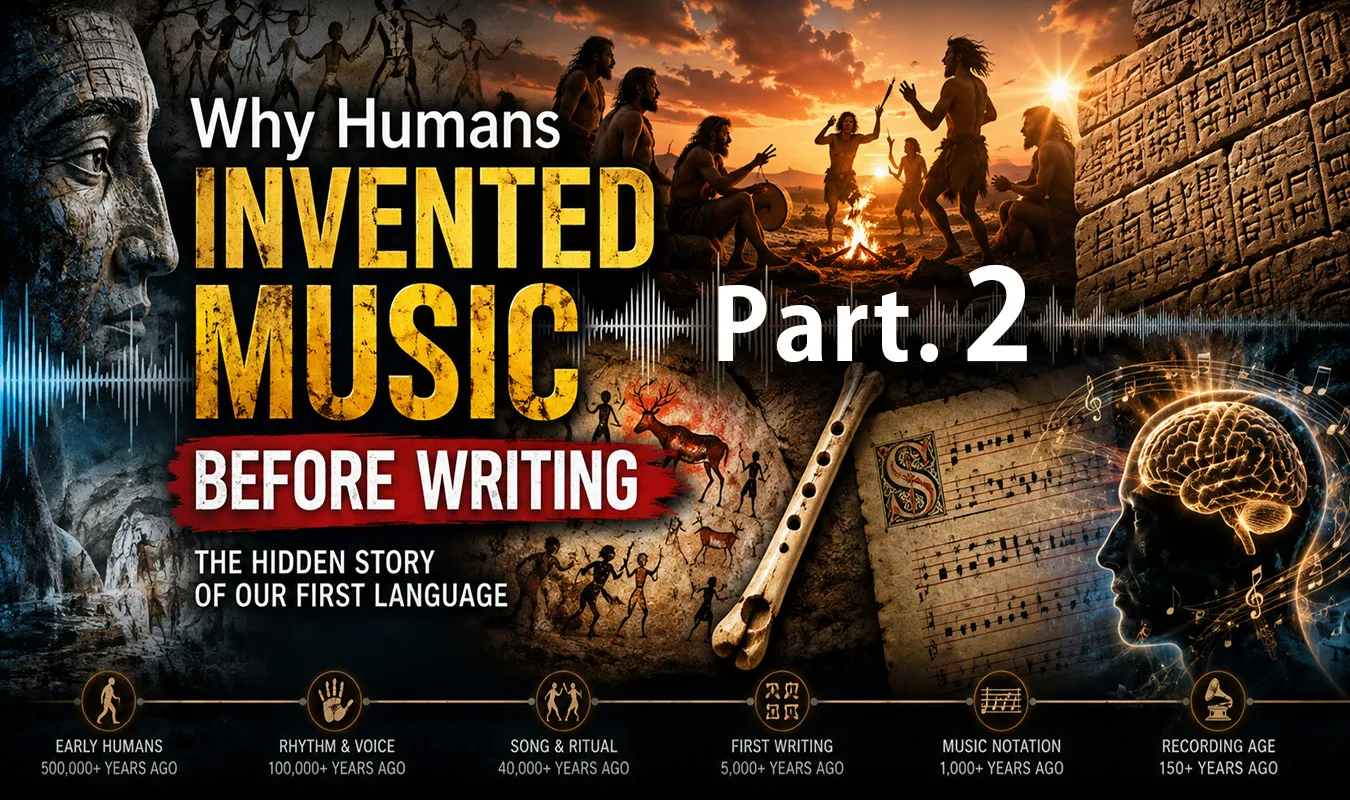
![[Column] Why Humans Invented Music Before Writing - Part1](/../assets/images/column-why-humans-invented-music-before-writing-part1.webp)
What were humans listening to before writing?
文:mmr|テーマ:「音楽は文字より前に存在したのか?」という問いを、人類の時間軸そのものから掘り下げます
人類の歴史を考えるとき、私たちはつい「記録されたもの」から始めてしまう。
文字が登場すると、王の名前が残る。法律が残る。宗教が残る。戦争の記録が残る。交易の記録も残る。
しかし、文字が存在しなかった時代にも、人間は生きていた。
狩りをし、食料を分け、子どもを育て、死者を弔い、仲間と移動し、危険を知らせ、知らない土地へ進んでいった。
そして、そのすべての背景には音があった。
人間は生まれた瞬間から音の世界にいる。
Mother’s voice.
足音。
風。
雨。
動物の鳴き声。
呼吸。
泣き声。
laughter.
叫び声。
身体を叩く音。
石と石がぶつかる音。
The sound of hitting wood.
人間が文字を書くようになるよりはるか以前から、こうした音は人間の生活の一部だった。
ただし、ここで重要なのは、「音が古い」ということと、「音楽が文字より先に存在した」と完全に証明できることは同じではないという点だ。
先史時代の音楽は、ほとんど直接的な記録を残していない。
楽譜はない。
録音もない。
演奏そのものを記録した映像もない。
したがって、私たちは現代の音楽をそのまま過去へ投影することはできない。
それでも、考古学、人類学、言語学、認知科学、比較研究などを組み合わせると、一つの非常に強い可能性が見えてくる。
Even before humans learned to write, humans were using sounds intentionally.
そして、その一部は現代の私たちが音楽と呼ぶものに近い性質を持っていた可能性が高い。
人類の歴史で最初に残ったメディアは、文字ではなく身体と音だったのかもしれない。
1. Writing appeared much later in human history
文明の始まりを文字から考えると見えなくなるもの
現在知られている最古級の文字体系は、紀元前4千年紀後半のメソポタミアで成立した楔形文字や、古代エジプトの文字体系などである。
これは人類史全体から見ると非常に新しい。
Modern humans, or Homo sapiens, are thought to have existed at least 300,000 years ago.
文字の登場までには、非常に長い時間がある。
単純化すると、
約30万年前
│
│  ホモ・サピエンスの歴史
│
│  言語・社会・道具・儀礼・音声文化
│
│  ─────────────────────
│
約5千年前
│
│  初期の文字体系
│
└── 現在
つまり、人類の歴史の大部分は「文字のない歴史」だった。
これは重要なポイントだ。
私たちは歴史を文字資料から学ぶことが多いため、無意識のうちに「記録されたもの=人類の文化」と考えてしまう。
However, this does not mean that there was no culture in the era when there was no written language.
むしろ逆だ。
人間は文字を発明するよりはるか以前から、複雑な社会生活を営んでいた。
道具を作り、環境に適応し、他者と協力し、知識を伝えていた。
その知識を保存する方法として、文字以外の仕組みが存在していた。
記憶。
Imitation.
反復。
body movement.
声。
story.
儀礼。
そして音である。
“Not recorded” and “did not exist” are different
先史時代の文化を研究するとき、最大の問題になるのが証拠の偏りだ。
石器は残る。
骨も条件が良ければ残る。
洞窟壁画も残る。
しかし、人間の声は残らない。
拍手も残らない。
踊りも残らない。
歌も、通常は残らない。
ここには、現代人には非常に分かりにくい問題がある。
We can now record music.
You can save it to your smartphone in just a few seconds.
だから「音楽」というものを、物体のように保存できると感じている。
しかし、人類のほとんどの歴史において、音楽は保存できなかった。
演奏された瞬間に消えていった。
残ったのは、演奏する人間の記憶と、それを聴いた人間の記憶だった。
Therefore, when researching prehistoric music, it is difficult to discover ““the music itself.’’
Instead, clues include tools that may have been used to create the sound, physical activity, and social behavior.
文字以前の文化を理解するには、残った物だけでなく、残らなかったものについて考える必要がある。
2. Humans used “voice” before writing.
最初のコミュニケーションは書かれたものではない
The relationship between “music” and “language” becomes important here.
現代社会では、言語を文字で考えることが多い。
「言葉」と言われると、文章を思い浮かべる。
However, writing is not language itself.
文字は、言語を記録するための後発の技術だ。
人間の言語能力は、文字よりはるか以前に存在していたと考えられている。
Therefore, it is natural to think that in early human societies, much of the information was transmitted through voice and the body.
Someone warns of danger.
仲間を呼ぶ。
Get the child’s attention.
感情を伝える。
相手を安心させる。
敵意を示す。
Ask for cooperation.
こうした行為では、単純な「意味」だけでなく、声の高さ、強さ、長さ、リズムなども重要になる。
例えば、同じ言葉でも声の高さが変われば印象は変わる。
There’s a difference between saying something short and strong and saying it long and elongated.
An angry voice and a reassuring voice convey the same message in completely different ways.
つまり、人間のコミュニケーションには、言葉の意味だけでは説明できない音響的な情報が最初から含まれていた。
Music and speech are not completely different things
現代の音楽では、歌詞とメロディーを分けて考えることができる。
しかし、人類の初期の音声文化について考えると、この区別がそれほど明確だったとは限らない。
talk.
叫ぶ。
call out.
泣く。
笑う。
歌う。
これらはすべて、人間の声を使った行動だ。
Of course, all of this cannot be called “music.”
しかし、人間の声が音程、リズム、反復、強弱、時間的パターンを持つことは明らかだ。
この意味で、音楽と発話は完全に別々の領域として最初から存在したというより、共通する能力から分化した可能性を考えることができる。
However, there is no single scientifically settled explanation as to whether ““language came first and then music” or ““musical and linguistic vocalizations developed in parallel.”
There are multiple theories regarding the origin of music.
The important thing here is not to force the parts you don’t understand into a single story.
それでも「音楽的な能力」は非常に古い可能性がある
Humans can distinguish between sounds.
声の高さを区別できる。
Able to recognize temporal patterns.
反復を認識できる。
同期できる。
Predictable.
These abilities are not only necessary for understanding contemporary music.
言語の理解や社会的コミュニケーションにも関係している。
Humans, in particular, read a tremendous amount of information from other people’s voices.
誰が話しているのか。
Are you angry?
Are you feeling safe?
興奮しているのか。
Are you far away?
近くにいるのか。
Some of this information comes from the acoustic characteristics of the voice rather than the meaning of the words.
In other words, sound is not just a ““background’’ for humans.
It was the very information needed to understand society.
Thinking about the origins of music is also thinking about the era when humans began to understand others through sound.
3. Babies respond to rhythm even before they are taught music.
The human body itself was the first rhythm
When thinking about music, you don’t have to start with instruments.
The first musical instrument may have been the human body.
Clap your hands.
Step on your foot.
Shake your body.
Speak out.
呼吸する。
repeat.
There is a rhythm to these actions.
And human life itself includes cyclical movements.
walk.
run.
bite.
Breathe.
心臓が拍動する。
sleep.
起きる。
Collaborate.
There are temporal patterns in these physical activities.
Of course, there is no evidence that heartbeats or walking directly produce music.
However, the ability of humans to recognize temporal patterns and move their bodies in accordance with them is important for understanding music.
What infant research shows
発達研究では、乳児が音の高さや強さ、時間的な変化に敏感であることが知られている。
Furthermore, interactions between infants and caregivers frequently involve the use of vocal pitch, rhythm, and timing.
When adults talk to babies, they often use different pitches, intonations, and rhythms than in normal conversation.
This does not mean that it is exactly the same in all cultures around the world.
However, it has been widely studied that speech to infants has musical characteristics that are different from mere information transmission.
What”s interesting here is that a baby”s first ““musical environment’’ is not an instrument or a recorded work.
It’s a human voice.
母親や父親、養育者の声。
繰り返されるフレーズ。
抑揚。
呼びかけ。
Laughter.
泣き声。
This exchange of sounds exists at the very beginning of human social life.
Are lullabies the origin of music?
ここから、よく知られた仮説が登場する。
“Music may have started with lullabies.”
子守歌は、声の高さ、反復、リズム、メロディーを利用する。
また、乳児を落ち着かせるという社会的機能も持つ。
しかし、これをそのまま「音楽の起源」と断定することはできない。
One thing is that lullabies are an old form; the other is that they were the first music.
同じように、狩猟、求愛、儀礼、踊り、労働なども音楽の起源として提案されてきた。
Each has a certain rationality.
しかし、現時点で「音楽はこの一つの目的のために生まれた」と断定できる証拠はない。
In fact, it is possible that humans did not use sound for just one purpose from the beginning.
音楽は一つの発明品ではなく、さまざまな人間活動の中で徐々に形成された可能性がある。
4. Was the first music not a “song” but an action?
Don’t bring modern musical concepts into prehistoric times
「最初の音楽」と聞くと、私たちは曲を想像する。
It has a melody, a rhythm, a beginning and an end.
However, that is an idea based on modern music culture.
There is no evidence that prehistoric humans created ““songs’’ in the same sense as modern humans.
そもそも「音楽」という概念そのものが文化によって異なる。
ある社会では、儀礼と音楽、踊り、物語、宗教的行為が明確に分離されていない場合がある。
In other words, what we now call “music” is not necessarily an independent category for humans in the past.
そこで、別の考え方ができる。
What existed in the beginning may not have been a ““musical work” but an ““action that organizes sounds.”
There is power in repetition
人間は繰り返しを好む。
Repeat the same action.
同じ言葉を繰り返す。
同じリズムを繰り返す。
同じメロディーを繰り返す。
Repetition allows you to predict what will happen next.
And being able to predict has great meaning in collaborative work.
複数の人間が同じ動作をする場合、タイミングを合わせる必要がある。
物を運ぶ。
引く。
push.
walk.
dance.
Move your body.
声を合わせる。
こうした活動では、リズムが行動を同期させる可能性がある。
これは「労働歌が音楽の起源だった」という単純な話ではない。
むしろ、人間の共同活動そのものが、リズムを利用する環境を作り出した可能性があるということだ。
Synchronizing is also a social behavior
人間は他者と同時に動くことができる。
そして、音は同期のために非常に便利だ。
視界が悪くても聞こえる。
It can be used even in the dark.
Reach far.
身体の動きと結びつけることもできる。
By speaking out loud, you can make your presence known to others.
拍手をすれば、複数人が同じタイミングを共有できる。
By stepping on your feet, you can share a physical rhythm.
ここに音楽の重要な特徴がある。
Even one person can make music.
しかし、音楽には複数人が同じ時間を共有するための機能もある。
そして人間は、非常に社会的な動物である。
音楽の原始的な力は、何かを「伝える」ことだけでなく、複数の身体を同じ時間に置くことにあったのかもしれない。
5. 最古の楽器は何だったのか
石器よりも残りにくい音の道具
ここで、考古学的な証拠に目を向けてみよう。
人間が意図的に音を作っていたことを示す直接的な証拠として、楽器は非常に重要だ。
However, there are major problems with musical instruments.
木。
植物。
動物の皮。
tendon.
Feather.
骨。
こうした素材は、石よりも保存されにくい。
Therefore, it is impossible to know completely what kind of musical instruments existed in prehistoric times.
It is possible that the instruments that survive today are only a fraction of the instruments that existed at that time.
骨製の笛
ヨーロッパの旧石器時代遺跡からは、骨や象牙で作られた笛と解釈される遺物が見つかっている。
Particularly in the Swabian Jura region of Germany, bone and ivory flutes dating back approximately 40,000 years have been discovered.
これらは、現生人類がヨーロッパへ進出した時期と重なる。
ただし、考古学では「穴の開いた骨=楽器」と単純に判断できない。
動物の骨には自然に穴が開くこともある。
加工痕があるのか。
Are the holes regular?
Are there any signs of use?
音を出すために適した構造なのか。
周辺の考古学的文脈はどうなのか。
こうした複数の証拠を組み合わせて判断する必要がある。
この慎重さは非常に重要だ。
This is because when researching the origins of music, humans are always eager to find the ““first musical instrument.’’
However, finding the first instrument is not the same as finding the first music.
You can make music without an instrument
More importantly, instruments are not a prerequisite for music.
声がある。
I have hands.
It has legs.
身体がある。
石を叩くこともできる。
You can also knock on wood.
つまり、音楽的な行動を始めるために、特別な道具は必ずしも必要ではない。
This fact is crucial when considering the origins of music.
もし最初の音楽が身体と声だけで成立したなら、それは考古学的にはほとんど痕跡を残さない。
Therefore, the ““earliest musical behavior” may have been much older than the ““oldest musical instrument.”
最初の楽器が見つかった日より、最初の人間が意図的に音を反復した日のほうが、はるかに遠い過去にあった可能性がある。
6. What can we see when we connect music and evolution?
「役に立つから残った」だけでは説明できない
進化について考えるとき、よく使われる考え方がある。
ある行動が生存や繁殖に有利なら、その行動に関係する特徴が自然選択によって維持される可能性がある。
では、音楽にはどのような利点があったのだろうか。
There are several hypotheses regarding this question.
Social cohesion.
親子関係。
配偶者選択。
集団内の協力。
感情の共有。
Synchronization of physical activity.
情報伝達。
しかし、どれか一つが音楽の唯一の進化的目的だったと証明されているわけではない。
むしろ、音楽が複数の既存能力を組み合わせた結果として発達した可能性もある。
Music requires multiple abilities
音楽を作るには、少なくともいくつかの能力が関係する。
音を聞き分ける。
Recognize time intervals.
繰り返しを記憶する。
Predict.
声や身体を制御する。
他者の行動を観察する。
Match the timing.
Share your feelings.
これらはすべて、音楽だけのために存在する能力ではない。
言語にも関係する。
社会的コミュニケーションにも関係する。
It is also related to exercise.
学習にも関係する。
そのため、音楽は人間の進化の中で独立して突然現れたものではなく、すでに存在していた能力を組み合わせることで成立した可能性がある。
「音楽はなぜあるのか」という問いを変える
ここで、問いそのものを変える必要がある。
「なぜ人間は音楽を発明したのか?」
rather than
“Why did humans have the ability to pattern sounds, repeat them, and share them with others?”
と考えてみる。
Then music ceases to be something special.
言語。
身体運動。
社会的認知。
記憶。
感情。
Music appears at these intersections.
Music can be seen as a collection of abilities that humans already possessed into a single activity.
これは、音楽が「役に立たない芸術」だったという意味でもない。
逆に、音楽が人間社会の多くの領域と接続できるからこそ、長い時間をかけて文化として維持された可能性がある。
音楽の起源を探すなら、音楽そのものより、人間が他者と共有してきた能力を探したほうが近道なのかもしれない。
7. 「音楽は言語より先だった」の本当の意味
順番を単純な一本線にしない
ここまで来ると、最初の問いに戻る。
音楽は文字より先にあったのか。
これはかなり強く「おそらくそうだった」と考えられる。
しかし、「音楽が言語より先にあった」とまでは簡単に言えない。
なぜなら、言語と音楽の起源を直接比較できる証拠がないからだ。
Moreover, language itself does not have a single clear ““date of invention.’’
文字なら、考古学的資料から成立時期をある程度特定できる。
However, this is not the case with spoken words.
声によるコミュニケーションがいつ始まったのかを、現在の人類が正確に知ることはできない。
だから、
音楽 → 言語 → 文字
という一本の線を描くのは危険だ。
Rather,
                 ┌─ 声
                 │
身体・認知能力 ──┼─ 言語
                 │
                 ├─ 音楽
                 │
                 └─ 儀礼・踊り・物語
                         │
                         ↓
                       文字
In this way, it is more realistic to think that multiple abilities overlapped over a long period of time.
文字は「音の代替物」でもあった
さらに面白いのは、文字そのものが音と無関係ではないことだ。
多くの文字体系は、話し言葉や言語を記録するために使われてきた。
つまり、人間はまず声を使ってコミュニケーションし、その後、言語を視覚的な記号として固定する技術を発展させた。
文字は、声を消してしまったのではない。
声を遠くまで保存するための新しい方法になった。
それまでなら、その場にいる人間の記憶に依存していた情報を、物体の上に固定できるようになった。
これは人類史上の巨大な変化だった。
しかし、その時点でも音楽は消えなかった。
文字が登場しても、人間は歌い続けた。
楽器を演奏し続けた。
踊り続けた。
儀礼で音を使い続けた。
つまり、文字は音楽の代替ではなかった。
異なるメディアだったのである。
文字は人間から音を奪ったのではなく、音を記憶する人間の能力に別の保存方法を与えた。
8. 人類史を「最初のメディア」から見直す
最初に存在したのは記録ではなく共有だった
In modern society, information is stored as files.
文章。
image.
動画。
音声。
データベース。
しかし、先史時代の人間にとって、最も重要な情報媒体は人間そのものだった。
誰かが知っている。
誰かが覚えている。
someone can sing
Someone can tell a story.
誰かが踊れる。
誰かが道具の作り方を知っている。
文化は、人間から人間へ移動した。
この状況では、反復が極めて重要になる。
You may forget information you have only heard once.
However, if it is repeated, it becomes easier to remember.
一定のリズムがあれば、次を予測できる。
メロディーがあれば、言葉の順番を覚えやすくなることもある。
実際、歌が記憶を支える現象は現代社会でも確認できる。
However, it cannot be concluded that this was the purpose of prehistoric music.
重要なのは、音楽的な形式が「記憶」と相性がよいということだ。
音は「保存」ではなく「再生」を可能にする
文字は情報を物体に固定する。
音楽は情報を人間の身体に再生させる。
これは大きな違いだ。
楽譜がなくても歌える。
録音がなくても演奏できる。
同じリズムを何度も繰り返せる。
You can also teach others.
つまり、音楽は記録媒体ではないが、文化を再現する仕組みになり得る。
あるメロディーを覚えた人間が、それを次の人間へ伝える。
その人間がさらに別の人間へ伝える。
世代を越えるたびに少し変化する。
その結果、文化的な伝統が形成される。
ここには、人間の文化が持つ非常に重要な特徴がある。
文化は遺伝子だけで伝わるものではない。
人間から人間へ学習される。
音楽は、その文化的伝達に適した形式の一つだった可能性がある。
文字以前の人間にとって、歌やリズムは「記録」ではなく、記憶を次の人間へ運ぶ方法だった可能性がある。
9. 文字が登場する前の人間社会を年表で見る
音と人間の長い時間
| 時期 | 人類史上の出来事 | 音・文化との関係 |
|---|---|---|
| 約30万年前以降 | ホモ・サピエンスがアフリカに存在 | 発声・聴覚・社会的コミュニケーションの基盤が存在していたと考えられる |
| 約10万年前以降 | 人類の広範な移動が進む | 多様な環境への適応と社会的学習が進む |
| 約7万〜5万年前 | 人類の拡散が大きく進展 | 複雑な文化的伝達が重要になる |
| 約4万年前 | ヨーロッパで骨・象牙製の笛と解釈される遺物が確認される | 現存する最古級の楽器資料 |
| Approximately 40,000 to 30,000 years ago | Various symbolic cultures such as cave paintings have been confirmed | Direct evidence is limited as music itself is difficult to preserve |
| 約1万年前以降 | 定住化・農耕が広がる地域が現れる | 儀礼・共同体・社会組織が大きく変化 |
| Late 4th millennium BC | Early cuneiform writing established in Mesopotamia | Humans were able to record large amounts of information on material |
| Late 4th millennium BC | An early writing system established in ancient Egypt | A culture that fixed language visually developed |
この年表を見ると、一つの事実が浮かび上がる。
Writing is not the starting point of human history.
むしろ、非常に長い「文字以前」の歴史の上に登場した。
そして、その文字以前の世界では、声、身体、記憶、反復、模倣が文化を支えていた。
音楽は、その世界に適応した行動の一つだった可能性がある。
人類史の大部分は、文字が記録する以前にすでに終わっていたのではなく、音と身体によって記憶されていた。
10. ここで一度、問いを逆転させる
「なぜ音楽が生まれたのか」ではなく「なぜ音楽が消えなかったのか」
音楽の起源を考えると、どうしても最初の瞬間を探したくなる。
最初の歌。
最初のリズム。
最初の楽器。
最初の演奏。
しかし、その瞬間を特定することはほぼ不可能だ。
だから、別の問いが重要になる。
なぜ音楽的な行動は、人類史の中で繰り返し現れたのか。
Humans continued to use sound even as society changed.
hunter-gatherer society.
農耕社会。
都市社会。
国家。
宗教共同体。
現代の工業社会。
そしてデジタル社会。
The format of music has changed significantly.
Instruments have also changed.
The temperament also changed.
演奏場所も変わった。
録音技術も変わった。
配信方法も変わった。
それでも、人間がリズムやメロディーや声を使うこと自体は消えていない。
これは、音楽が単なる一時的な文化現象ではないことを示している。
もちろん、だからといって「音楽は人間の遺伝子に直接プログラムされた」と単純化することはできない。
文化と生物学の関係はもっと複雑だ。
However, there is great significance in the view that the human body and cognition make musical behavior possible, and that culture has developed it into a myriad of forms.
Music was not a “superfluous function” for humans.
音楽は、長い間「役に立たないもの」と考えられることもあった。
食料を作らない。
家を建てない。
敵から身を守らない。
しかし、これは「役に立つ」という言葉を狭く考えた場合の話だ。
In human society, survival is not just about what we eat, but also who we cooperate with, who we trust, what we remember, and how we share our emotions.
音楽は、こうした社会的領域に深く入り込む。
だからこそ、人類の歴史を理解するとき、音楽は「文明が豊かになった後に生まれた娯楽」として扱うことができない。
Rather, it is possible that musical behavior was integrated into the very process of creating society as humans.
音楽は文明が生んだ贅沢品ではなく、文明が生まれる前から人間が使っていた可能性のある社会的な道具だった。
11. Next question: What was the music communicating?
If words convey meaning, what does music convey?
This is where the difference between music and language becomes clear.
言語には、対象を指し示す能力がある。
“water”.
“fire”.
“danger”.
「ここ」。
「食べる」。
こうした言葉は、特定の意味を共有するために使われる。
So what does music convey?
Music does not necessarily have a fixed meaning like language.
Still, humans receive a lot of information from music.
tension.
peace of mind.
excitement.
悲しみ。
Expectations.
動き。
end.
The beginning.
Above all, I feel that I am spending the same time as others right here, right now.
This means that music can handle social information in a different way than language.
Did music exist before “meaning”?
ここで一つの大胆な可能性が見えてくる。
人間は、言葉で具体的な意味を表現する以前から、音の高さ、強さ、長さ、リズムによって状態を共有していたのではないか。
ただし、これは「音楽が言語より先だった」という単純な証明ではない。
声によるコミュニケーションと音楽的な発声が、長い時間をかけて相互作用した可能性がある。
言語が発達すると、音はより具体的な意味を伝えられるようになる。
Music, on the other hand, has evolved to emphasize elements such as pitch, rhythm, repetition, and structure.
Rather than being separated, the two still fuse together again in the form of songs.
つまり、人間の文化には最初から「話す」と「歌う」の間に広い領域が存在していたのかもしれない。
人間は言葉を発明してから音楽を作ったのではなく、音を使って他者と関係する長い歴史の中から、言語と音楽をそれぞれ発展させた可能性がある。
12. Part 1の結論――文字以前の世界には、すでに「音の文化」があった
Writing was a revolutionary invention for mankind.
しかし、それは人類文化の始まりではない。
文字が登場する数万年、あるいはそれ以上前から、人間は声を使い、音を聴き、他者の行動を観察し、身体を同期させ、記憶し、模倣していた。
その世界を直接録音することはできない。
That”s why we still can”t listen to prehistoric music.
しかし、そのことは音楽が存在しなかったことを意味しない。
むしろ、音楽は最も保存されにくい文化の一つだったからこそ、私たちの目の前から消えている。
The stone tools remained.
洞窟壁画は残った。
The bones remained.
文字は残った。
However, the human voice disappeared.
足を踏み鳴らした音も消えた。
手拍子も消えた。
The voices I made while dancing disappeared.
それでも、人間は何万年もの間、音を使い続けてきた。
そして、約5千年前、文字が登場する。
ここから人類は、音を「記憶する」だけではなく、言語を物質の上に固定する方法を手に入れる。
However, the music did not fit into the text.
音楽は別の道を進んだ。
voice.
身体。
musical instrument.
儀礼。
踊り。
記憶。
community.
そして後には、楽譜、録音、ラジオ、レコード、テープ、CD、デジタルファイル、ストリーミングへと広がっていく。
つまり、人類の音楽史は、楽器の歴史だけではない。
それは、人間が「時間」を共有する方法の歴史でもある。
そして次に問うべきなのは、さらに深い問題だ。
なぜ人間だけが、これほど複雑なリズム、メロディー、歌、踊りを社会の中心に置くようになったのか。
そこには、言語だけでは説明できない、人間の脳と身体の特徴が関係している。
音楽の起源を探すことは、最初の歌を探すことではない。それは、人間がいつ「一緒に聴き、一緒に動き、一緒に覚える生物」になったのかを探すことなのである。
YouTube Podcast
※このPodcastは英語ですが、自動字幕・翻訳で視聴できます
Explore more like this
【コラム】 Why Humans Invented Music Before Writing - Part4
43. 音楽はいつ「社会」になったのか
【コラム】 Why Humans Invented Music Before Writing - Part3
26. なぜ人間の脳は「次の音」を待つのか