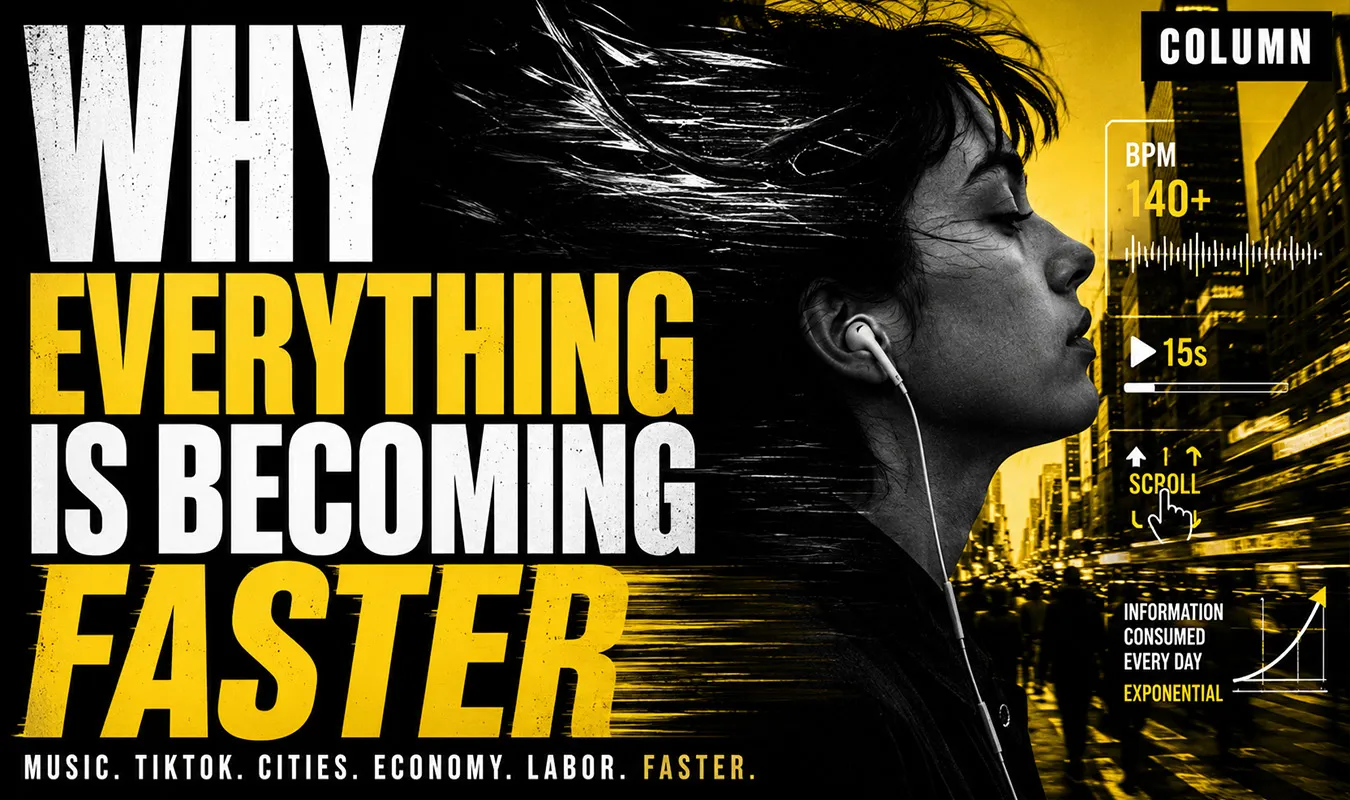
Why Everything Is Becoming Faster
Text: mmr|Theme: From the BPM of music to the length of TikTok videos, the scrolling of SNS, the speed of cities, and the immediacy of work, deciphering how the “speed” that dominates modern society has been tied into a single structure.
「速い」とは何なのか
「最近、すべてが速すぎる」。
この感覚は、単なる気分の問題ではない。
音楽を聴けば、イントロが短い。
動画を見れば、数秒ごとに画面が切り替わる。
When you open a social networking site, before you can finish reading one post, another one appears.
仕事ではメール、チャット、会議、通知が途切れない。
街では人々が歩き、電車が走り、商品が運ばれ、注文が処理される。
そして、私たちはそれらを「速い」と感じる。
しかし、ここで重要なのは、すべてのものが単純に高速化しているわけではないということだ。
BPMが必ず上がっているわけではない。
都市のすべての場所で人間の歩行速度が上がっているわけでもない。
一日の労働時間が単純に伸び続けているわけでもない。
変化しているのは、もっと別のものだ。
それは、一つの出来事から次の出来事までの間隔である。
音楽なら、音から音へ。
If it”s a video, it”s cut to cut.
SNSなら、投稿から投稿へ。
仕事なら、タスクからタスクへ。
消費なら、商品から商品へ。
現代社会は、次のものが現れるまでの時間をどんどん短くしてきた。
That”s why it”s “fast”.
速度とは、単純な物理量ではない。
それは、私たちがどれだけ短い間隔で「次」を受け取るようになったかという問題でもある。
現代の速さとは、必ずしも速度の上昇ではなく、「次」が到着するまでの時間が短くなったことなのだ。
速度は音楽の中にも存在する
音楽では、速さを最も分かりやすく表す数字がある。
BPM。
Beats Per Minute.
This is a number that shows how many beats are made in one minute.
120 BPMなら、1分間に120回の拍がある。
60 BPMなら60回。
180 BPM is 180 times.
音楽は、人間が時間をどう分割するかを非常に直接的に扱う芸術である。
However, if we only look at BPM, we lose sight of the “speed” of modern music.
たとえば、同じ120 BPMでも、曲の印象はまったく違う。
The density of time is different between a minimalist track with just a kick that plays at regular intervals and a song with a large amount of detailed hi-hats, vocals, synths, and percussion.
つまり、速さには二つの側面がある。
一つはテンポ。
もう一つは情報密度だ。
Even if the tempo is the same, the more information there is, the more the music will feel busy.
逆に、テンポが速くても、音数が少なければ空間を感じることができる。
これは現代の音楽を考えるうえで重要なポイントになる。
「音楽が速くなった」というと、多くの場合BPMの上昇を想像する。
しかし、実際には別の速度が存在する。
曲が始まるまでの時間。
Time until the first hook appears.
サビに到達するまでの時間。
音が変化する頻度。
曲そのものの長さ。
これらすべてが、音楽の「時間設計」を変えている。
現代音楽の速度は、BPMだけではなく、音楽がどれだけ早く「何かを起こすか」によって決まる。
3分という奇妙な基準
ポピュラー音楽の歴史を振り返ると、3分前後という長さは自然法則ではなかった。
レコード、ラジオ、放送時間など、当時の技術と産業構造によって形成されたものだった。
1950年代以降のBillboard Hot 100では、平均的なヒット曲の長さが長期的に変化してきた。
An analysis reported in 2024 found that while the average time in the 1950s was about 2 minutes and 46 seconds, it increased to 4 minutes and 14 seconds in the 1990s, and then decreased to about 3 minutes and 15 seconds in the 2020s.
ここには重要な歴史がある。
45回転のシングル盤には収録時間の制約があった。
ラジオには広告やニュースがあった。
そのため、ポップソングは一定の長さに収まりやすかった。
ところがテープやCDが普及すると、物理的な制約は緩くなった。
1990年代には平均曲長が4分21秒まで伸びたという分析もある。
つまり、曲の長さは「人間が3分しか集中できないから」決まったわけではない。
メディアの仕組みが、音楽の時間を作っていた。
そして現在、再び別の仕組みが曲の長さを変えている。
それがストリーミングとSNSである。
The length of music has been determined not only by the listener’s brain, but also by the media technology of the time.
ストリーミングが作った新しい時間
ストリーミングでは、音楽は「所有するもの」から「次々に選択するもの」へ変わった。
レコードを買えば、その作品を持っている。
CDを買えば、アルバム全体を持っている。
しかしストリーミングでは、次の曲をすぐ再生できる。
This difference is huge.
聴き手は、曲を最後まで聴く必要がない。
途中で変えてもいい。
別のアーティストに移ってもいい。
プレイリストを変えてもいい。
研究では、ストリーミング利用者が曲のどの時間帯でスキップするかと、曲の構造との間に関連があることが示されている。
つまり、音楽の時間そのものが、聴き手の行動データによって測定可能になった。
以前なら「この曲はここで退屈になる」という判断は、批評家やプロデューサーの経験に依存していた。
現在では、何秒でスキップされたかというデータとして記録できる。
音楽は、時間を作る芸術であると同時に、時間を測定される商品になった。
ストリーミング時代の音楽では、「曲が何分あるか」だけでなく、「何秒まで聴かれるか」が重要になった。
曲は短くなり、入口は早くなった
2020年代のポップミュージックを象徴する変化の一つが、曲の短縮である。
According to an analysis, half of Spotify’s hit songs in 2023 will be less than three minutes long.
2024年のGrammy候補曲でも、144曲中28曲が3分未満だった。
「短い曲が存在する」というだけなら、音楽史の中では珍しくない。
問題は、短い曲が特別な例ではなくなっていることだ。
Taylor Swiftの作品にも変化が見られる。
2010年の『Speak Now』では平均曲長が4分47秒だったのに対し、2019年の『Lover』では3分26秒まで短くなっている。
Of course, this is just one artist’s change and is not representative of all music.
しかし、より大きな傾向と重なっている。
なぜ短くなるのか。
理由は一つではない。
ストリーミング。
SNS。
プレイリスト。
アルゴリズム。
楽曲の再生回数。
そして、最初の数秒で聴き手をつかむ必要性。
曲の入口が重要になった。
長いイントロを待ってもらうより、最初から特徴的な音を出す。
曲の世界観をゆっくり作るより、早くフックを提示する。
これは作曲技法の問題であると同時に、時間経済の問題でもある。
曲の短縮は、単なる流行ではなく、聴き手が「次へ移動できる環境」で起きた適応でもある。
TikTokは曲を「曲」から「瞬間」に変えた
SNS、とくに短尺動画の登場によって、音楽の利用単位も変わった。
以前は曲を聴く。
現在は、曲の一部分を使う。
イントロではなく、サビ。
サビではなく、特徴的な一行。
一行ではなく、数秒のフレーズ。
音楽そのものよりも、「使える瞬間」が重要になることがある。
2022年にはLil Yachtyの「Poland」が83秒という非常に短い楽曲で大きな注目を集め、TikTok上で多数の動画制作につながった。
ここで起きているのは、単純な短縮ではない。
音楽の時間が分解されたのだ。
1曲という単位がある。
その中にイントロがある。
ヴァースがある。
コーラスがある。
そして現在では、その中から「SNSで再利用できる数秒」が取り出される。
曲は一本の時間軸ではなく、複数の切り出し可能な時間の集合になる。
TikTok時代には、曲そのものより「曲のどこを何秒使うか」が文化的な意味を持つようになった。
動画は短くなったのではなく、切り替えが速くなった
短尺動画を「短い動画」とだけ考えると、本質を見逃す。
重要なのは動画の総時間だけではない。
画面の切り替え。
テロップ。
ズーム。
音。
効果音。
表情。
字幕。
次の情報。
これらが短い間隔で投入される。
つまり、動画の中にある「次の出来事」が早くなっている。
YouTube Shortsは2024年10月から最大3分の動画をアップロードできるようになった。
これは興味深い。
「ショート」という名前なのに、必ずしも極端に短い必要はなくなった。
それでも短尺動画の文化では、短い時間の中に多くの情報を詰め込む編集技法が発達してきた。
だから「短い」というより、「濃い」。
30秒に30秒分の情報しかない動画と、30秒の中に数分分の情報を圧縮した動画では、体感速度が違う。
ニュース。
ミーム。
解説。
音楽。
ダンス。
商品紹介。
どれも同じ画面の中で高速に消費できる。
そして次の動画は、指一本で出てくる。
短尺動画の本当の特徴は「短さ」よりも、次の情報へ移動するコストがほとんどゼロになったことにある。
スクロールという新しい時間装置
Scrolling is a strange technology.
上へ動かす。
次を見る。
また上へ動かす。
次を見る。
そこには終点がない。
本を読むなら、ページがある。
新聞なら、紙面がある。
If it”s a TV, there”s a program list.
アルバムなら、最後の曲がある。
スクロールには、明確な終わりがない。
だから「次を見る」という行動が非常に簡単になる。
And you never know what’s going to happen next.
音楽。
政治。
料理。
猫。
広告。
news.
ダンス。
Accident footage.
Sports.
商品。
また音楽。
この予測不能性が、スクロールを連続的な行動にする。
2025年に発表された研究では、745人のSNS利用者を対象に、短尺動画利用の頻度や時間、そして「scroll immersion」と呼ばれる習慣的で意図しない没入が、注意の困難さ、ワーキングメモリの乱れ、認知疲労などと関連することが報告された。
これは「TikTokを見ると脳が壊れる」という単純な話ではない。
Since this is a cross-sectional study, it cannot establish a causal relationship.
However, what is important is that research has focused on the possibility that the way we use media itself is related to our cognitive state.
Scrolling not only speeds up information, but also automates the act of ““moving forward.’’
Information changes from “what you read” to “what flows”
インターネット以前の情報消費では、情報を探す行為そのものに時間が必要だった。
buy a newspaper
Turn the page.
Read magazines.
Go to the library.
Search for books.
Choose a TV program.
ラジオを聴く。
情報には入口があった。
The Internet has increased the number of entry points.
Search engines have shortened the distance to information.
SNSはさらに別の変化を起こした。
Information flows to you without you having to look for it.
Posts from people you follow.
recommendation.
関連動画。
trend.
notification.
Algorithmic recommendations.
In this system, too much information becomes a problem rather than a lack of information.
Therefore, we spend more time discarding information than searching for information.
「これは重要か?」
「これは読むべきか?」
「これは後で見るか?」
「これは広告か?」
「次に行くか?」
現代の情報消費は、受け取る能力だけでは成立しない。
You will need the ability to choose.
The problem of the information society is not that there is not enough information, but that the next piece of information arrives too quickly.
Attention has become a “resource”
This is where economics comes into play.
For social media companies, user screen time is an important economic resource.
Advertisements are displayed.
The video will play.
Posts can be seen.
商品が紹介される。
リンクがクリックされる。
視聴時間や反応が測定される。
In other words, human attention is converted into measurable behavioral data.
Music has the same structure.
ストリーミングでは、再生、スキップ、保存、プレイリスト追加など、聴取行動が記録される。
動画では視聴、離脱、再視聴、共有などが記録される。
SNSではいいね、コメント、シェア、滞在、スクロールが記録される。
These are all mechanisms for converting time into data.
Value lies not only in ““what people see,” but also in ““when they leave something.”
Research on streaming services has also analyzed the relationship between the timing of skip occurrence and song structure.
In the digital economy, time has gone from being consumed to being measured and optimized.
Cities also create “speed”
The story doesn’t end with smartphones.
都市そのものが、速度を生み出す装置でもある。
駅。
road.
elevator.
Convenience store.
物流センター。
highway.
空港。
office.
Home delivery.
In cities, goods, people, and information move in large quantities.
そして都市の価値は、しばしば「どれだけ早く移動できるか」と関係する。
From station to station.
From home to work.
From warehouse to store.
From order to delivery.
データセンターから端末へ。
都市は巨大な時間短縮システムとして発達してきた。
If railways were built, the time it would take to travel far away would be shortened.
As automobiles become more widespread, the range of movement will expand.
高速道路ができれば物流が速くなる。
Airplanes shorten the distance between cities.
スマートフォンがあれば、情報の移動時間はほぼ消える。
In other words, the history of cities is, in a sense, a history that separates distance from time.
現代都市は、距離そのものを消すのではなく、距離を感じる時間を短くすることで巨大化してきた。
“Waiting time” has decreased in city life
昔の生活には、待ち時間が多かった。
Wait for the mail.
電話を待つ。
新聞を待つ。
Waiting for a reply from the store.
Wait for the product to arrive.
Wait for the show time to watch the movie.
現在では、待ち時間の多くが短縮された。
メッセージは即座に届く。
Products may be delivered the same day.
動画は検索すればすぐ見られる。
Music can be played in seconds.
The map displays your current location.
You can call a taxi using an app.
The closer the waiting time gets to zero, the more vulnerable we become to waiting.
Waiting 10 minutes now feels longer than it used to.
なぜなら、別の選択肢がすぐに現れるからだ。
技術が待ち時間を短くした結果、私たちは待つこと自体を以前より強く意識するようになった。
The economy demands “faster”
Speed is not just about culture.
There are also economic pressures.
企業にとって、商品を早く作ることは競争力になる。
早く届ける。
早く返事をする。
Release new products quickly.
早くトレンドに対応する。
早く市場へ入る。
Improve quickly.
Sometimes being a day ahead of your competitors can be valuable.
This trend is even stronger in the digital economy.
ソフトウェアはアップデートできる。
広告はリアルタイムで変更できる。
Prices can be adjusted online.
Reactions to SNS posts can be measured immediately after publication.
ニュースは発生直後に世界へ広がる。
「次の機会」が常に存在する。
That’s why companies are hard to stop.
市場が止まらないからだ。
経済の速度が上がると、「速く働くこと」は個人の性格ではなく、競争環境への適応になる。
24時間経済
インターネットによって、仕事は場所から切り離された。
If you have a smartphone, you can check your email even when you’re not at work.
ノートPCがあれば、自宅でも仕事ができる。
クラウドサービスがあれば、ファイルはどこからでもアクセスできる。
これは明らかに便利だ。
通勤時間を減らせる。
柔軟な働き方ができる。
場所に縛られない。
But at the same time, it blurs the boundaries of work.
A 2017 report by the ILO and Eurofound found that while ICT-enabled telework and mobile work have benefits such as reduced commuting times and increased autonomy, they are also associated with long working hours, high work intensity, and a blurring of boundaries between work and home life.
Work will change from ““time spent at the office” to ““being able to connect at any time.”
これは労働時間の概念そのものを変える。
デジタル化は仕事を自由にした一方で、仕事が終わる場所と時間を曖昧にした。
Work is not “busy” but “a lot of changes”
現代の仕事を考えるとき、「労働時間」だけを見ると分からないことがある。
重要なのは、仕事の切り替え回数だ。
メール。
チャット。
会議。
資料。
通知。
電話。
タスク管理。
ブラウザ。
またメール。
また会議。
一つの仕事を8時間続けている人は少ない。
複数の仕事を細かく切り替えている。
2014年の研究では、ICT利用が仕事の強度化と関連し、その経路として、仕事のペースの高速化、割り込み、マルチタスクなどが指摘されている。
つまり、デジタル労働の「速さ」は、単純な作業速度ではない。
Switching speed.
2分ごとの割り込み
Microsoft”s 2025 Work Trend Index analyzed Microsoft 365 data and found that employees are interrupted by meetings, emails, or chats about once every two minutes on average during work hours. That”s 275 times per day.
Of course, this is data from organizations using Microsoft 365, and is not representative of all workers worldwide.
しかし、現代のデジタル労働がどのような時間構造を持つのかを示す一つの具体例にはなる。
The ““next’’ comes into my work.
And before that “next” is over, there”s another one.
これはTikTokのスクロールと驚くほど似ている。
動画。
次の動画。
次の通知。
次のメール。
Next meeting.
次のタスク。
Media and work are no longer separate worlds.
スクロールする時間と働く時間は、どちらも「次の刺激へ移動する時間」を短縮する方向へ進んできた。
SNSと職場は同じ時間構造を持ち始めた
ここに現代社会の大きな変化がある。
昔なら、仕事と娯楽には明確な境界があった。
職場では仕事をする。
家では休む。
テレビを見る。
listen to music.
本を読む。
しかしスマートフォンによって、その境界が崩れた。
Check social media while working.
Check work emails at home.
通勤中にニュースを見る。
Watch videos during your lunch break.
Check chat before going to bed.
仕事と娯楽が同じ端末に入っている。
しかも、同じ「通知」という形式で届く。
だから脳の側から見ると、異なる種類の情報が同じ入口から入ってくる。
Email.
ニュース。
音楽。
広告。
仕事。
friend.
movie.
すべてが同じ画面に並ぶ。
スマートフォンは仕事と娯楽を統合したのではなく、両者を同じ速度で処理する環境を作った。
通知は「未来」を現在に持ち込む
通知には独特の性質がある。
それは、何かが起きたことを知らせる。
In other words, it interrupts the current task and brings another event into the present.
メールが届く。
誰かが返信する。
動画が公開される。
商品が値下げされる。
ニュースが発生する。
通知は「後で見るもの」ではない。
「今、何かが起きた」と知らせる。
その結果、現在の時間が常に外部から更新される。
Even when you’re working, the world keeps moving.
音楽を聴いていても、新しい曲がリリースされる。
Even if you are watching a video, the next video is waiting.
休んでいても、通知が来る。
通知とは、世界が自分の現在を待ってくれなくなったことを知らせる小さな信号である。
「速い音楽」と「速い社会」は同じではない
Now I need to get back to the music.
社会が速くなったから、音楽のBPMも速くなった。
You can’t think of it that simply.
Ambientは遅い。
Droneはさらに遅い。
Dub Technoは反復を重視する。
Minimal Technoでは、変化を意図的に遅くすることがある。
AmbientやExperimental Musicは、現代社会の速度から離れるための音楽にもなり得る。
つまり、速い社会が必ず速い音楽を生むわけではない。
むしろ逆の場合もある。
社会が速くなるほど、遅い音楽が必要になる。
しかし、ここにも逆説がある。
Even slow music can become a fast consumption object in the current environment.
Don’t listen to the 10 minute Ambient, just watch the 30 second clip.
アルバムを聴かず、SNSで紹介された一部分だけを聴く。
Instead of watching the live video to the end, watch the clippings.
音楽そのものが遅くても、その周囲の消費速度は速い。
現代の音楽は、速い音楽と遅い音楽に分かれるのではなく、速い消費環境の中に置かれている。
Amapianoが示すもう一つの速度
このことを考えるうえで、Amapianoのような音楽は興味深い。
Amapianoはしばしば「遅く感じる」ダンスミュージックとして語られる。
しかし、そのグルーヴは単純な速度の遅さでは説明できない。
rhythm.
シンコペーション。
base.
log drum。
space.
Repetition.
When these things combine, the time that your body feels and the BPM don’t match.
これは重要なヒントになる。
Speed is not a number.
It is also the time when your body feels it.
SNSでも同じだ。
動画が15秒だから速いとは限らない。
情報量が少なければ遅く感じる。
逆に、15秒に大量のカット、字幕、音、動きが入れば非常に速く感じる。
速度とは、時計が測るものだけではなく、身体が一つの時間をどれだけ密度高く経験するかによって決まる。
Information density creates “speed”
現代社会を理解するためには、「速度」より「密度」という言葉が重要になる。
1秒間に何が起きるか。
How many times does it change in one song?
1分の動画に何個の情報が入るか。
1時間の仕事に何回割り込みが入るか。
1日の中で何回アプリを切り替えるか。
The more this number increases, the darker the time becomes.
In music, the number of notes increases.
In videos, the number of cuts increases.
SNSでは、投稿数が増える。
仕事では、タスク数が増える。
In the economy, transaction speed increases.
In cities, the amount of movement of people and goods increases.
These appear to be separate phenomena.
しかし、すべて「一つの時間に処理される出来事の数」が増えていると考えることができる。
現代社会の速度は、時間そのものより、一単位の時間に押し込まれる出来事の数によって決まる。
なぜすべてを速くする必要があるのか
では、なぜ私たちはこれほどまでに速度を求めるのか。
One reason is competition.
It is better to post first.
It’s better to release a song first.
最初にトレンドを取り入れた方が有利。
The sooner you reply, the better.
It is advantageous to deliver the product quickly.
早く改善した方が有利。
It is advantageous to get to market early.
速度が競争力になる。
そして一度速度が競争力になると、誰も簡単には遅くできない。
一社だけ返信を遅くすれば、競合に負ける。
一人だけ動画を長く作れば、短尺動画の流れに乗れない。
If just one person delays product delivery, they will choose another service.
If just one person ignores the trends, their existence will go unnoticed.
So speed is not a personal choice, but is required by the system.
「もっと速く」は誰か一人の命令ではなく、競争そのものが生み出す命令になっている。
Speed has economic benefits
速さには明確なメリットもある。
早く商品を届ければ顧客満足度が上がる。
早く情報を共有すれば意思決定が早くなる。
早く新しい技術を導入すれば生産性が向上する可能性がある。
早く音楽を発表すれば新しい市場へ到達できる。
The sooner the video is released, the more newsworthy it will be.
デジタル技術は、これらを可能にした。
Therefore, we cannot simply conclude that a fast society is bad.
実際、ILOはデジタル技術が仕事の自律性や通勤時間の削減、生産性向上などにつながる可能性を認めている。
The problem is that while speed brings benefits, it also comes at a cost.
疲労。
注意力の分散。
常時接続。
情報過剰。
Blurring of boundaries between work and private life.
そして、「遅いもの」が市場で不利になる可能性。
Speed is a tool to increase productivity, but at the same time it also creates costs to maintain speed itself.
速さは必ずしも生産性ではない
There is an important distinction here.
**There’s a difference between being busy and being productive. **
Even if you process 100 emails, you won’t necessarily generate new ideas.
Even if you hold 10 meetings, it doesn’t necessarily mean that decisions will be made.
Even if you update your SNS 100 times, you won’t necessarily get important information.
Even if you watch 100 videos, it doesn’t necessarily mean you understand anything.
Even if you listen to 100 songs, it doesn’t necessarily mean that you listened to each song deeply.
速度は量を増やす。
But quantity is not the same as value.
Microsoft”s 2023 Work Trend Index surveyed 31,000 people from 31 countries and found that 64% said they lacked the time and energy to work. And 68% say they don”t have enough uninterrupted focus time at work.
What we see here is the paradox of speed.
Introducing technology to speed up work.
But technology increases notifications and interruptions.
This will reduce your concentration time.
To fill this gap, we will introduce more efficiency tools.
There will be more notifications.
The technology used to increase speed creates speed itself.
Systems designed to help you work faster can break up your work into smaller pieces, taking away your time to concentrate.
Modern people have begun to wait for the “next”
昔のメディアには終わりがあった。
新聞を読み終える。
本を読み終える。
The movie ends.
レコードが終わる。
The TV show ends.
However, many digital services never end.
The feed continues.
The playlist continues.
Recommendations continue.
News will be updated.
The video continues.
Therefore, the feeling of ““it’s over’’ becomes weaker.
これは速度と深く関係している。
There’s no end to it, so move on.
You don’t have to stay on the current content for long because you can move on.
As a result, less time is spent on a single object.
終わりのないメディアは、私たちを「一つを終える人」から「次へ移動し続ける人」へ変えていく。
It”s not “I can”t wait”, it’s no longer necessary to wait
It is often said that ““modern people have lost their patience.’’
しかし、それだけでは説明できない。
The problem is that there is no longer a need to wait.
Previously, you had to wait to get information.
You can search now.
以前なら、曲を聴くためにレコードを買った。
現在は数秒で再生できる。
In the past, people watched movies according to the showtime.
Now you can play it whenever you want.
Previously, you would have had to go to the store.
You can now order using your smartphone.
技術が待ち時間を減らした。
そして、待たないことが標準になった。
As a result, waiting begins to feel “abnormal.”
Rather than we have lost patience, we have adapted to an environment that does not require waiting.
Speed becomes the style of culture
速度が長期間続くと、それは単なる効率ではなく文化になる。
Fast editing.
fast music.
fast fashion.
速いニュース。
fast conversation.
速い配送。
速い返信。
速いキャリア。
Sometimes “slow” can even have a negative connotation.
Late reply.
遅い配送。
遅い更新。
slow video.
遅い音楽。
However, if we look back at the history of music, there were times when slowness itself became valuable.
Listen through the album.
Listen to long songs.
Listen to the live show until the end.
Surrender yourself to repetition.
沈黙を聴く。
AmbientやDroneのような音楽は、こうした「速度から離れる聴き方」を可能にしてきた。
In other words, the more speed becomes dominant, the more slowness becomes a choice rather than just a delay.
In a fast society, slowing down becomes a cultural act in itself.
That’s why “slow music” is important
This is where the role of music changes.
音楽は社会の速度を反映するだけではない。
You can also resist the speed of society.
long intro.
長い余白。
Repetition.
ドローン。
無音。
Low BPM.
Live for a long time.
アルバム全体。
These factors seem inefficient in the modern information environment.
However, it is meaningful precisely because it is inefficient.
Listen to a 10 minute song.
1曲を最後まで聴く。
Listen to the albums in order.
同じ音を何度も聴く。
変化が起こるまで待つ。
This is the exact opposite of scrolling on social media.
Scroll asks for:
反復音楽は今に留まることを求める。
Slow music does not serve as a way to consume time, but rather as a device for re-sensitizing time itself.
Connecting the history of speed
If we summarize everything up to this point as one flow, modern ““speed’’ did not suddenly emerge.
産業革命では、生産と労働の時間が再編された。
鉄道によって移動時間が短縮された。
工場では作業が標準化された。
時計は労働を測定する重要な道具になった。
20世紀にはラジオとレコードが音楽の時間を規格化した。
テレビは番組という時間単位を作った。
コンピューターは計算速度を飛躍的に高めた。
インターネットは情報の移動時間を短縮した。
スマートフォンはその環境を常時携帯可能にした。
SNSは情報を無限のフィードに変えた。
短尺動画は情報の切り替え間隔を短くした。
Streaming has made music on-demand.
AIは情報生成そのものの速度をさらに引き上げようとしている。
Looking at it this way, TikTok cannot be the sole cause.
TikTokは、長い歴史の最後に登場した一つの装置にすぎない。
「速すぎる世界」はSNSが作ったのではなく、何世代にもわたる時間短縮の積み重ねによって形成された。
Chronology: What speed has changed
| Age | Technological and social changes | Impact on speed |
|---|---|---|
| 18世紀後半 | 産業革命 | 生産と労働の時間を標準化 |
| 19th century | Spread of railways | Speeding up intercity travel |
| 19世紀後半 | 電信 | 長距離通信の時間を大幅短縮 |
| First half of the 20th century | Radio broadcasting | Adapting music to broadcast time |
| 1940〜50年代 | 45回転盤・LP | 楽曲とアルバムの時間構造を規定 |
| 1950〜60年代 | テレビ普及 | 番組単位の時間消費を拡大 |
| 1980年代 | CD | 音楽の収録時間制約を緩和 |
| 1990年代 | インターネット普及 | 情報探索と通信を高速化 |
| 2000年代 | ブロードバンド | 動画・音楽のオンライン消費を拡大 |
| Late 2000s | Smartphones | Achieving constant access to information |
| 2010s | Streaming | Instant music selection |
| 2010年代 | SNSフィード | 情報を連続的に供給 |
| 2020年代 | TikTok型短尺動画 | 情報の切り替え間隔を短縮 |
| 2024年 | YouTube Shorts最大3分化 | 「短尺」の時間幅を拡大 |
| 2025年以降 | AIエージェント・生成AI | 情報生成とタスク処理の高速化 |
The history of speed is not only the history of machines getting faster, but also the history of how the time it takes for humans to move on to the next event has become shorter.
図:現代の速度は一つのシステムになった
音楽、都市、SNS、労働は別々に速くなったのではなく、互いの速度を押し上げる一つの循環に組み込まれた。
図:一秒あたりの情報密度
「速い」という感覚は、時計の速度ではなく、一つの時間単位にどれだけ多くの出来事が詰め込まれているかによって強く左右される。
すべてが速くなったわけではない
ここで最も重要な注意点がある。
The title “Everything is faster” is not a literal statistical fact.
現実には、社会の速度は分野によって違う。
労働時間には国や産業による大きな差がある。
都市交通は渋滞する。
物流には遅延がある。
There is a slow genre of music.
There are also long-form videos.
人間の生活には睡眠、食事、休息が必要だ。
In other words, the world as a whole is not speeding up in one direction.
Rather, what is important is that the difference between fast and slow areas is increasing.
On the one hand, there is real-time trading.
On the one hand, there is long-term care.
一方では即時配送がある。
一方では何時間もかけて料理する文化がある。
一方では数秒で消費される音楽がある。
一方では数時間にわたるコンサートがある。
Therefore, in modern society, “everything is fast”.
**The areas where speed can be selected and the areas where speed is required are expanding at the same time. **
現代社会の本当の特徴は、すべてが速いことではなく、速いものと遅いものが極端な形で共存していることにある。
Is it possible to escape from speed?
では、私たちはどうすればいいのか。
答えは「スマートフォンを捨てる」ではない。
That’s not to say that technology itself is bad.
The important thing is not to treat speed as one type of thing.
Reply speed.
思考速度。
Movement speed.
consumption rate.
創作速度。
Learning speed.
resting speed.
Each one is different.
There are times when it’s better to be faster at work.
創作では遅い方がいい場面がある。
ニュースでは早さが重要になる。
歴史理解では時間をかける必要がある。
音楽では一瞬の反応が重要な曲もあれば、30分かけて聴く作品もある。
The problem is trying to process everything at the same speed.
The important thing is not to eliminate speed, but to regain the ability to choose what to make faster and what to slow down.
Music becomes a testing ground for speed
この意味で、音楽は非常に面白い。
音楽は時間を直接扱うからだ。
BPM.
rhythm.
反復。
休符。
Intro.
ブレイク。
ドロップ。
Rust.
フェードアウト。
すべて時間の操作である。
And music doesn’t just reflect the speed of society.
You can also exaggerate its speed.
Conversely, it can also be delayed.
Industrial Technoは機械的な速度を強調できる。
Jungleは高速なブレイクビーツを身体へ直接送り込む。
Hardcoreはテンポの限界を押し広げる。
Ambient stretches time.
Droneは変化を極端に遅くする。
Dubは空間と反復によって時間を伸縮させる。
Minimalは小さな変化を長時間聴かせる。
そしてAmapianoのような音楽は、BPMと身体感覚の関係をずらす。
Music is also a place to experiment with what speed is.
Music is an art that allows us to experiment with not only ““how fast” but also ““how speed feels.”
未来はもっと速くなるのか
おそらく、すべてが単純に速くなるわけではない。
In fact, the difference in speed may become even larger.
AI can generate sentences in seconds.
Images can also be generated.
音楽も生成できる。
You can also generate videos.
The speed at which information is created may far exceed the speed at which humans have been able to create it.
However, as the production speed increases, other problems arise.
何を見るのか。
何を聴くのか。
what do you believe?
何を無視するのか。
何を残すのか。
選択の価値が上がる。
情報を作ることが難しい時代から、情報を選ぶことが難しい時代へ移る。
AI時代には、速く作る能力よりも、何を速く作らないかを判断する能力が重要になる可能性がある。
速さの次に来るもの
これまでの技術史では、速度が価値だった。
Fast communication.
速い輸送。
速い計算。
速い配送。
速い検索。
Fast production.
しかし、速度が十分に高くなると、速度そのものの価値は下がる。
メールが数秒で届くことは当たり前になった。
音楽が数秒で再生できることも当たり前になった。
検索結果が瞬時に出ることも当たり前になった。
AIが数秒で文章を作ることも、今後さらに一般化する可能性がある。
すると希少になるのは別のものだ。
時間。
Note.
信頼。
concentration.
沈黙。
relationships between humans.
And “the end”.
速度が無料になるほど、人間にとって本当に贅沢になるのは、速度ではなく、速度を止められる時間になる。
最後に:世界が速いのではない
「Everything Is Becoming Faster」。
However, the truth is a little different.
世界のすべてが速くなっているわけではない。
音楽のBPMが全部上がったわけでもない。
Not all videos are shorter.
Not all working hours have increased.
都市のすべてが高速化したわけでもない。
それでも、私たちは「速くなった」と感じる。
Why?
次のものが来るまでの時間が短くなったからだ。
Next song.
次の動画。
次の投稿。
Next notification.
Next email.
Next meeting.
Next item.
次のニュース。
Next trend.
次の仕事。
Next generation.
Next.
Next.
Next.
現代社会を特徴づけるのは、速度そのものではない。
切り替えの連続性である。
The music advances to the next beat.
SNSは、次の投稿へ進む。
The video advances to the next clip.
都市は、次の場所へ進む。
経済は、次の取引へ進む。
Labor moves on to the next task.
And we keep processing the “next” in all of this.
Therefore, the biggest problem in modern society is not just “moving too fast.”
止まる場所が少なくなったことだ。
音楽が終わらない。
フィードが終わらない。
仕事が終わらない。
ニュースが終わらない。
通知が終わらない。
情報が終わらない。
だから、意識的に終わらせなければならない。
一曲を最後まで聴く。
Read one sentence to the end.
一つの仕事を終える。
スマートフォンを置く。
何も起きない時間を持つ。
遅い音楽を聴く。
長い映画を見る。
Return to the same place over and over again.
それは、現代社会から逃げることではない。
速度を選ぶことだ。
世界はこれからも速くなるだろう。
AI creates information even faster.
ネットワークはさらに速くなる。
配送はさらに速くなる。
Images become more instantaneous.
音楽も新しい時間構造を生み出す。
しかし、人間の一日は24時間しかない。
Here lies the biggest contradiction.
**Even though there is no limit to the speed at which the world can create information, there is a limit to the amount of time humans can experience. **
だから最後に残る問題は、「どうすればもっと速くできるか」ではない。
「この限られた時間を、何に使うのか」である。
世界が速くなるほど、私たちは初めて「時間を速くすること」と「時間を豊かにすること」は同じではないと気づくのかもしれない。
Reference data and main facts covered in this article
本稿では、音楽の曲長、ストリーミングにおけるスキップ行動、短尺動画、SNS利用、ICTと労働強度、デジタルワークに関する公開研究・報告を基礎資料として使用した。
Regarding music in particular, they referenced research on changes in the average song length of the Billboard Hot 100 from the 1950s to the 2020s, the percentage of Spotify hit songs that are under three minutes, changes in Taylor Swift’s average album length, and skipping behavior in the streaming era.
短尺動画については、YouTube Shortsが2024年10月から最大3分まで対応したこと、短尺動画とスクロール行動に関する2025年の研究を参照した。
労働については、ILOおよびEurofoundによるICTモバイルワークと仕事強度に関する報告、ICT利用と仕事の強度化に関する研究、MicrosoftのWork Trend Indexを参照した。
これらの資料から確認できるのは、「すべてが一方向に高速化している」という単純な事実ではない。
むしろ、メディア、音楽、労働、都市、経済のそれぞれで、情報やタスクの切り替え速度、選択可能性、常時接続性が拡大してきたことである。
速さとは数字ではなく、現代社会が私たちに要求する「次への移動回数」そのものなのかもしれない。