[Column] Wanda Jackson: The Queen Who Turned Country Into Rock "n" Roll

Column en CountryMusic RockAndRoll Rockabilly
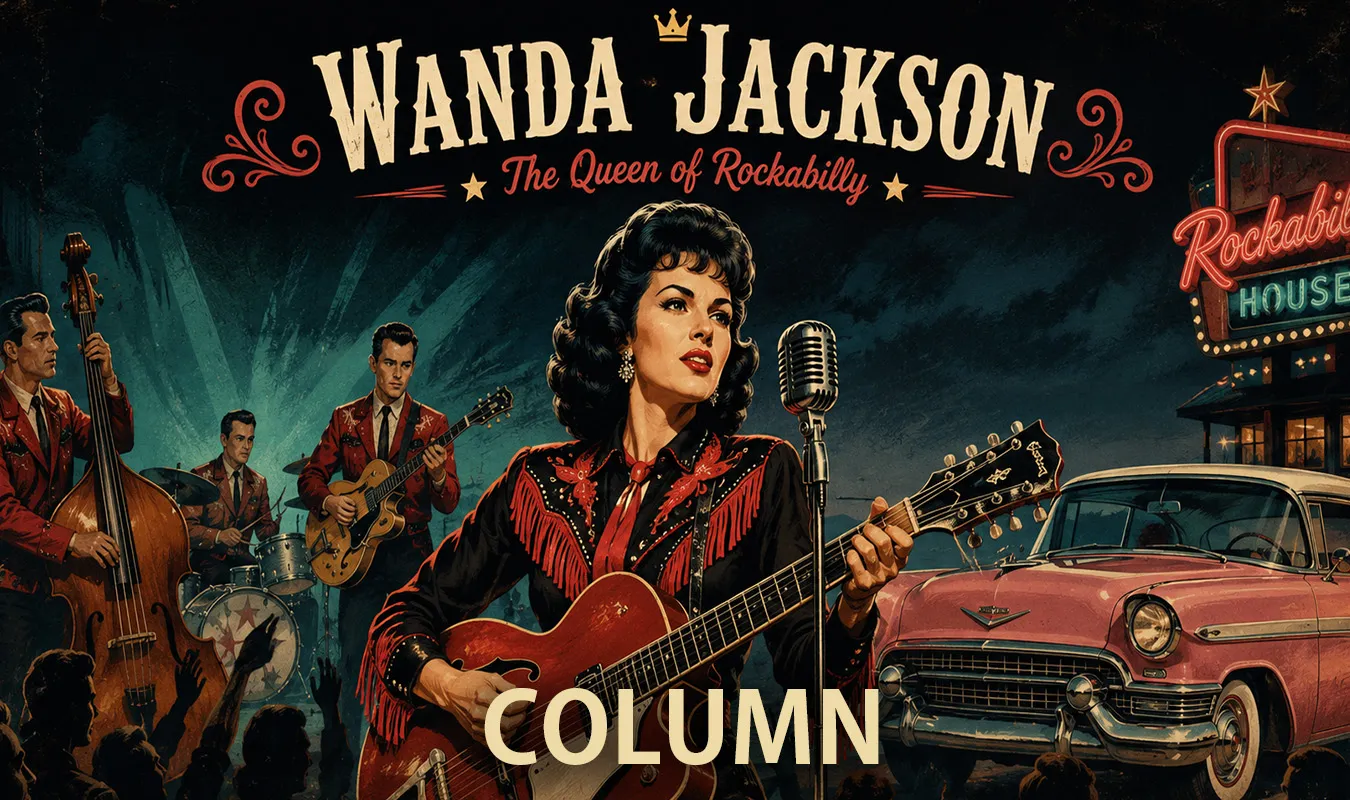
[Column] Wanda Jackson: The Queen Who Turned Country Into Rock

America before rock and roll

Text: mmr Theme: In the 1950s, in the male-dominated world of rock and roll, Wanda Jackson proved that women could rock. Follow her life as she cuts through the ages with her voice, crossing country, rockabilly, and gospel.

After World War II, the musical landscape in America was rapidly changing. Country music spread mainly on local radio stations, rhythm and blues was nurtured in the black community, and gospel took root in the South. As these things mixed together, a new youth culture called “rock and roll” was about to be born.

But in the early 1950s, rock and roll was largely a man’s world. Only male singers strum their guitars, scream, and get the audience excited. Female singers were still expected to be ““elegant” and ““neat.”

At that time, there was a woman who appeared with a fierce shout and a sharp sense of rhythm.

That person was Wanda Jackson.

graph TD A["Country"] --> D["The Birth of Rock"n"Roll"] B["Rhythm & Blues"] --> D C["gospel"] --> D D --> E["Explosion of youth culture"] E --> F["Wanda Jackson appears"]

At a time when rock”n”roll was still “man’s music,” Wanda Jackson jumped head-on into it.


A girl who grew up in Oklahoma

Wanda Lavon Jackson was born on October 20, 1937 in Maude, Oklahoma, USA. Music has been around her since she was young, and she grew up listening to country music under the influence of her father.

The family later moved to California, but returned to Oklahoma. During her nomadic life, she was strongly influenced by radio culture. In America in the 1950s, radio was the greatest source of entertainment and a device for creating new stars.

Wanda was praised for her singing ability as a child and began appearing on local radio programs. She particularly stood out on country and western programs, and her singing voice attracted attention from an early stage.

Already a regional star in high school, he entered the music industry at a young age.

timeline title ワンダ・ジャクソン初期年表 1937 : オクラホマ州で誕生 1940s : ラジオ音楽文化に親しむ 1950s : 地元番組で歌唱活動 1954 : プロ契約へ接近

Wanda Jackson’s origins lie in Southern American radio culture and country music.


From country girl to rock and roll

In 1954, Wanda Jackson signs with Decca Records. At first, she was marketed as a typical country singer.

But someone appears that changes her life.

It was Elvis Presley.

At the time, Elvis was still on the verge of his breakout success, but he was beginning to gain attention after touring the South. Wanda meets Elvis on tour, and he advises her that she should sing rock”n”roll, not just country.

This encounter was decisive.

Wanda has always had a strong sense of rhythm. Furthermore, her deep, punchy voice deviated greatly from the conventional image of female singers. It was a perfect match for rock”n”roll.

However, at the time, there was great resistance to women singing rock music. Television and radio stations shunned her as “radical,” and she was criticized by conservatives.

However, Wanda did not change her style.

flowchart TD A["Activities as a country singer"] --> B["Meet Elvis"] B --> C["I"m encouraged to play rock"n'roll"] C --> D["Going the rockabilly route"] D --> E["Establishing your own style"]

Meeting Elvis liberated Wanda Jackson from being an “ordinary country singer.”


The impact of “Fujiyama Mama”

In 1957, Wanda Jackson released “Fujiyama Mama”.

This song is a rockabilly piece with a ferocious sense of speed and energy, and has become her signature song. Her explosive singing, roaring rhythm, and wild shouts completely destroyed the image of female singers at the time.

This song is known for being a big hit, especially in Japan.

The word “Fujiyama” in the title and lyrics reminiscent of the atomic bomb would later provoke various debates, but in the United States in the 1950s it was also used as a symbol of “energy” and “explosive power.”

Wanda herself was concentrating on singing with all her might.

The audience was surprised to hear her song. It was extremely rare to find a female singer who could shout and dominate the stage like a male singer.

graph TD A["Fujiyama Mama"] --> B["Intense rockabilly"] A --> C["Renovating the image of women"] A --> D["Popular in Japan"] A --> E["Representative song"]

"”Fujiyama Mama’’ was the work that etched Wanda Jackson into rock history.


Birth of the Rockabilly Queen

In the late 1950s, Wanda Jackson released a series of rockabilly songs.

“Mean Mean Man” “Let’s Have a Party” “Hard Headed Woman”

In these songs, her characteristic “growling delivery” was on full display.

Fashion was even more important.

Fringe dresses, high heels, and flashy makeup. Wanda brought an unusual level of flamboyance for a country singer, and was even involved in the costume design herself.

She didn’t erase her “femininity.”

Rather, they acquired the strength of rock while retaining their femininity.

このスタイルは後の女性ロックシンガーたちに大きな影響を与えた。

mindmap root((wanda jackson)) 音楽 ロカビリー カントリー ロックンロール スタイル フリンジドレス ハイヒール 強烈な歌唱 影響 女性ロック歌手 ロカビリー文化 ステージ表現

Wanda Jackson redefined ““a woman playing rock.’’


Wall of female rock singers

In the 1950s and early 1960s, the music industry remained male-dominated.

Female singers were expected to be ““pretty,’’ and violent expressions and sexual energy were not welcomed.

But Wanda was different.

She provoked the audience on stage, sang wildly, and exposed her emotions. They were competing in the same arena as male artists.

However, the trade-off was that the industry sometimes viewed them as ““difficult to deal with.’’ He also experienced restrictions on his television appearances and backlash from conservatives.

Still, she continued touring.

It gained support not only in the United States, but also in Europe and overseas.

graph TD A["Image of women in the 1950s"] --> B["Cleanliness"] A --> C["obedience"] D["Wanda Jackson"] --> E["Offensive performance"] D --> F["Rock expression"] D --> G["Pioneer of female rock"]

Wanda Jackson pushed the boundaries not only of music but of female expression itself.


Return to country and changing times

In the 1960s, rock music changed rapidly. The wave of the British Invasion arrived and ushered in a post-Beatles era.

Meanwhile, 1950s-style rockabilly gradually fell out of the mainstream.

Wanda Jackson also shifted her focus back to country music.

She hasn’t completely given up on rock. However, since he was able to perform more stably in the country market, he has since become more of a Nashville artist.

Even so, her singing always retained a rock-like power.

flowchart TD A["1950s Rockabilly Golden Age"] --> B["1960s Music Change"] B --> C["British Invasion"] C --> D["Rockabilly decline"] D --> E["Country Return"]

Even though the times have changed, Wanda Jackson’s “core strength” has remained the same.


Encounter with Gospel

In the 1970s, Wanda Jackson deepened her religious values ​​and turned to gospel music.

This was a major turning point in her life.

He distanced himself from the rock”n”roll lifestyle of his youth and began to pursue activities more rooted in his faith. She began releasing gospel music and appearing at religious events.

However, even here, she did not lose the power of her voice.

The emotional expressions cultivated during the rock era were also powerfully persuasive in gospel music.

graph TD A["1970s"] --> B["Deepening of faith"] B --> C["Gospel Activities"] C --> D["New expression"] D --> E["Continuation of emotional expression"]

Singing has always been a way of life for Wanda Jackson.


Rockabilly Queen being reevaluated

From the 1980s onward, as rockabilly and roots music began to be reevaluated, Wanda Jackson once again attracted attention.

Punk and garage rock artists were strongly influenced by her rawness.

It”s not that she”s rocking it even though she’s a woman.

“He was a real rock singer from the beginning.”

That’s how it came to be appreciated.

Furthermore, in the 2000s, she gained support from the younger generation, and many musicians began to talk about her as the “mother of rock.”

graph TD A["Since the 1980s"] --> B["Rockabilly Re-evaluation"] B --> C["Discovered by the younger generation"] C --> D["Recognized as the origin of women's rock"] D --> E["Legendary"]

Wanda Jackson was reevaluated not as a star of an era, but as “rock history itself.”


Rock and Roll Hall of Fame

In 2011, Wanda Jackson will be inducted into the Rock and Roll Hall of Fame.

This was not just a meritorious award.

It had the meaning of formally inscribing into history the role that female artists played in the early days of rock”n”roll.

There were other female singers before her. However, Wanda Jackson held a special place as a head-on expression of the intensity of rock ‘n’ roll.

Its influence extends to current female rock artists.

timeline title ワンダ・ジャクソン再評価の流れ 1980s : ロカビリー再評価 1990s : ルーツロック界で支持拡大 2000s : 若い世代から再発見 2011 : ロックの殿堂入り

Wanda Jackson’s induction into the Rock and Roll Hall of Fame was the moment when her existence was recognized as “history.”


Wanda Jackson’s legacy

Wanda Jackson’s accomplishments go beyond just having a hit song.

She broke down the stereotypes of how women should sing.

It’s okay to scream. It’s okay to be intense. It’s okay to control the audience.

He was one of the first to pave the way.

Her spirit has been inherited by later Janis Joplin, Joan Jett, and even other female artists after punk.

And above all, Wanda Jackson was “a woman who seriously rocked.”

That is the reason why it still attracts so many people.

graph TD A["Wanda Jackson"] --> B["Pioneer of female rock"] A --> C["Symbol of rockabilly"] A --> D["Bridge to Country"] A --> E["Influence on posterity"] E --> F["Janis Joplin"] E --> G["Joan Jett"] E --> H["Female punk generation"]

Wanda Jackson was the person who unleashed the “potential of female rock” into the future.


Chronology

Year Events
1937 Born in Oklahoma
1954 Signed with Decca Records
Mid-1950s Interaction with Elvis Presley
1957 “Fujiyama Mama” announced
1958 “Let’s Have a Party” hit
1960s Transition to country music
1970s Full-scale gospel activities
Since the 1980s Re-attention due to reappraisal of rockabilly
2011 Rock and Roll Hall of Fame induction

At the end

The history of rock and roll has often been told in a male-centered manner.

However, in the very beginning, there was a woman who grabbed the microphone, screamed, and excited the audience.

Wanda Jackson wasn’t special because she was a woman.

It was pure rock as hell.

Wanda Jackson’s voice continues to resonate with the primal energy of rock and roll.


Monumental Movement Records

Monumental Movement Records