[Column] Suddenly cardboard — a strange form of the Japanese underground born of fluctuations in everyday life and language
Column en Experimental Post-Punk Underground
What was cardboard all of a sudden?
Text: mmr|Theme: The singularity of the Japanese underground, which deconstructs the very form of music based on everyday words and physical sensations
Music that starts with a strange name
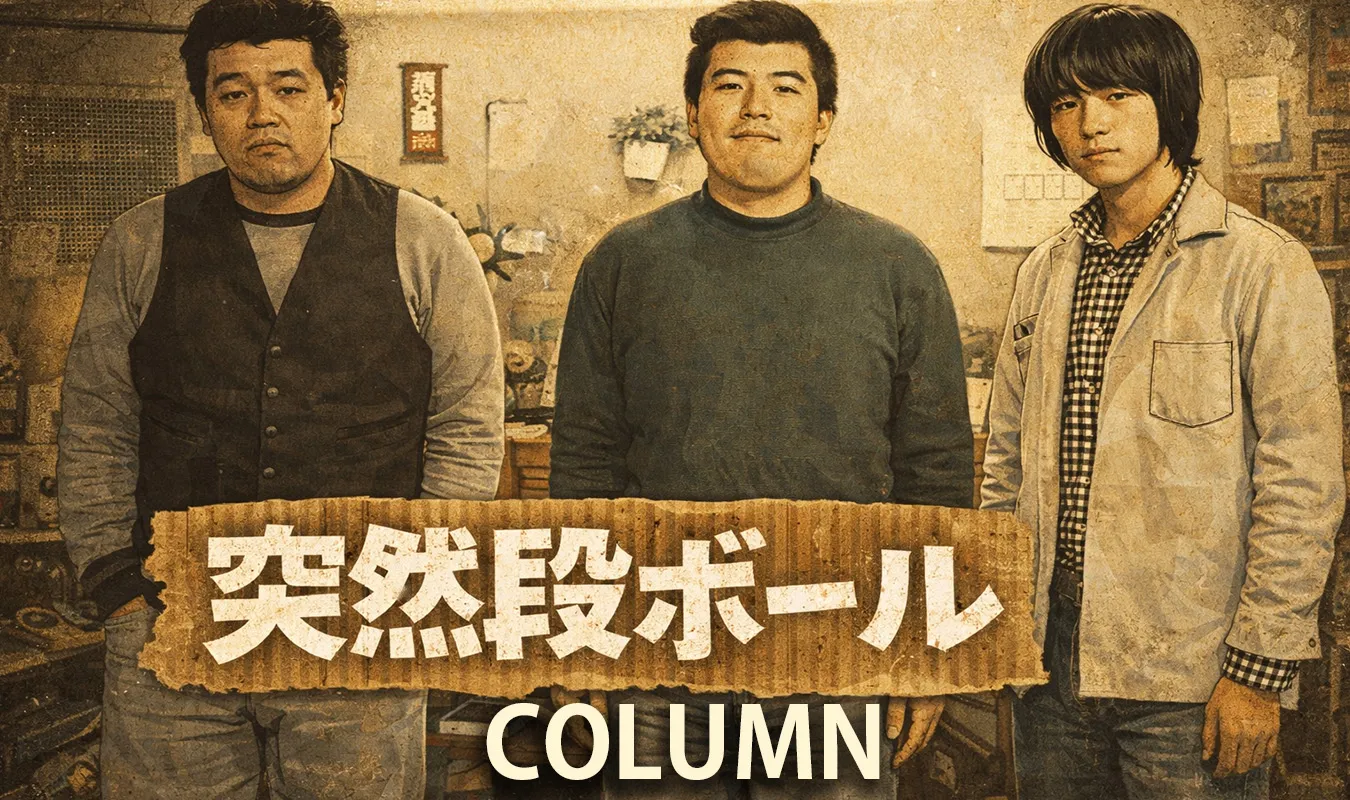
In the history of Japanese independent music, the name ““Sudden Danboard’’ has an extremely foreign ring to it. This unit was formed by older brother Eiichi Tsutaki and younger brother Shunji Tsutaki, and began their own activities in the late 1970s.
Whereas many rock bands of the time relied on clear genres and styles, suddenly Cardboard’s music was deliberately deviating from those frameworks. Although the songs have unstable rhythms and simple structures, there is a unique logic within them.
The sound is not at all technical. However, it also includes a critique of existing music. By rejecting structured performances and clear chord progressions, he posed the question, ““What is music?’’
The discomfort of the name itself symbolized the discomfort with the existing view of music.
Historical background of the late 1970s
Distance between cities and individuals
In the late 1970s, Japan was at the end of its period of high economic growth, and society’s values were beginning to waver. The city continued to expand, but within it individuals felt increasingly isolated and uncomfortable.
Even in the field of music, there is a movement to distance itself from the popular popular songs and rock. In contrast to the industrial structure centered around large studios and record companies, small-scale, autonomous production began to be explored.
Cardboard suddenly appeared in this context. Their music directly expressed the subtle discomforts and indescribable sensations felt in urban life.
Changes in society have led to a more internal expression of individual expression.
DIY culture and independent production sites
Media called cassette
Suddenly, the media called cassette tapes is indispensable when talking about cardboard activities. From the late 1970s to the 1980s, cassettes became popular as a low-cost, reproducible medium, making it possible for individuals to produce and distribute music.
They actively utilized this medium and produced works recorded at home. The recording environment was never set up, and the sound quality was rough and there was a lot of noise. However, this restriction actually became a factor that accentuated the individuality of the sound.
Additionally, by handling everything from production to distribution themselves, they brought about changes in the music distribution structure itself. The works are not mass-produced products, but expressions that are handed over.
Cassettes were not just a medium, but a device that changed the very nature of expression.
Deconstruction of musical structure
Rhythm fluctuation
The most characteristic feature of Sudden Cardboard’s music is the instability of its rhythm. Rather than maintaining a constant tempo, the beat that moves back and forth subtly dominates the entire song.
This fluctuation is not a coincidence; it is intentionally created. Because the rhythm is not fixed, the listener must constantly pay attention to changes in the sound.
As a result, the music has a strong presence, refusing to be consumed as a “background”.
The instability of the rhythm is a device that allows us to actively listen to music.
Repetition and variation
Their songs often repeat short phrases. However, the repetition is not an exact copy, but involves subtle changes.
This approach is similar to minimal music, but it appears in a more intuitive and raw form. The slightest deviation in repetition distorts the flow of time.
Even though the listener is supposed to be hearing the same phrase, they always get different impressions.
Repetition is not stability, but rather functions as a means of emphasizing instability.
Language deconstruction and rearrangement
Departure from meaning
Suddenly Cardboard lyrics often don’t have a clear story of meaning. Everyday words and fragmented phrases are arranged and arranged as sounds.
Words are essentially a means of conveying meaning. However, they intentionally weaken this function and emphasize the sound aspect.
As a result, lyrics are presented as something to be felt rather than something to be understood.
By deconstructing the meaning of language, the purity of sound is increased.
Japanese rhythm
Unlike English-based rock, Japanese has a different syllable structure and accent. By incorporating these characteristics into music, a unique rhythm is created.
Suddenly, Cardboard’s singing prioritizes the rhythm of the words themselves, rather than putting the words on top of the melody. Therefore, although the melody is often monotonous, it has movement due to the flow of words.
The Japanese language itself functions as a rhythm generating device.
Distance from contemporary music
Attitude that does not belong to any genre
From the late 1970s to the early 1980s, the influence of punk and new wave was widespread in Japan. But suddenly cardboard doesn’t quite belong to those styles.
Their music is difficult to categorize into a specific genre. Although they had post-punk elements, they were not interested in recreating them.
Rather, there is an attitude of relativizing the framework of genre itself.
Freedom of expression was ensured by not relying on existing genres.
Impact on home recording culture
Expansion of personal production
Sudden Cardboard’s activities later had an important meaning in the Japanese indie scene. In particular, it was significant in that it showed that recording at home can be an effective means of expression.
Their practice spread the awareness that ““anyone can make music.’’ This is not a technical issue, but an awareness issue.
Music production does not require a special environment. Rather, unique expressions are born within constraints.
Creation within constraints opens up new possibilities.
Chronology
Conceptual diagram of musical structure
Background of reevaluation
Resonance with the digital age
In modern times, cardboard works are suddenly being evaluated in a new context. Now that the spread of digital technology has made it easier for individuals to produce music, their DIY spirit has become more realistic.
Additionally, lo-fi sound quality and an aesthetic that affirms imperfection are widely accepted in the contemporary music scene.
Past experiments are being reinterpreted as modern standards.
Conclusion: A presence that shakes the boundaries of music
Suddenly Cardboard”s music doesn”t fit into a finished form or clear genre. Rather, it is an attempt to question the boundaries of music itself.
Discrepancies in rhythm, fragments of words, and rough sound quality. All of these elements were intentionally selected and function as a critique of existing values.
Their work was not a huge commercial success. However, its influence continues to spread quietly.
Their greatest legacy is their attitude of continually questioning the definition of music.
YouTube Podcast
*This podcast is in English, but you can watch it with automatic subtitles and translation.