[Column] The Durutti Column: Another horizon of post-punk drawn by silence and reverberation
Column en Ambient Post Punk
Post-punk begins with silence
Text: mmr|Theme: The trajectory of Durutti Column, who transcended the boundaries of post-punk and redefined the contours of music with silence and blank spaces.
Music that speaks through “pauses” rather than loud sounds
In the late 1970s, music was being created in Manchester, England that inherited post-punk impulses but moved in a different direction. Among them, The Durutti Column was unique.
While many post-punk bands focused on aggressive rhythms and politics, this project went in almost the opposite direction. The guitar is not distorted, but rather transparent and delicate. The rhythm is not assertive and blends into the space. What was there was the idea of ”“creating music by reducing the amount of sound.’’
Although the guitar playing of the central figure, Vini Reilly, was influenced by classical music, jazz, flamenco, etc., he sublimated it into a unique grammar without directly quoting them. His sound is more like a trembling air than a melody.
At this point, The Durutti Column was already outside the framework of post-punk.
Their music could be said to deal with ““space itself’’ rather than genre.
Factory Records and the City of Manchester
The intersection of music and art
The birth of The Durutti Column is inseparable from Manchester’s legendary label Factory Records. This label produced artists such as Joy Division and New Order, and released works of art that included not only music but also design and concept into the world.
The Durutti Column’s debut film, The Return of the Durutti Column, is a symbol of this. The jacket was made of a sandpaper-like material, a provocative design that would damage other records. This was both an artistic irony and a critique of the music industry itself.
However, the music on the inside, in contrast to its exterior, was extremely calm and rather introspective. This gap is at the heart of Factory Records’ aesthetic.
This label was characterized by its ability to simultaneously reflect both urban devastation and the inner world of individuals.
Redefining the guitar
Don’t just make a sound, make it resonate
Vini Reilly’s guitar almost nullifies the concepts of “riff” and “solo” in the context of rock. His performances are composed of silences between sounds.
Although he makes extensive use of delay and reverb, they are not just effects, but function as a means of manipulating time itself. Once a sound is played, it repeats, overlaps, and forms a new layer in space.
This method had a major influence on later ambient and post-rock. In particular, there are many parts that resonate with Brian Eno’s philosophy, and they share the perspective of viewing music as ““part of the environment.’’
Below is a simplified diagram of its structure.
His guitar didn’t play melodies, it sculpted time.
Evolution by album
From introspection to the outside world
The Durutti Column’s works are consistently tranquil, yet show clear changes from period to period.
His early works strongly reflected solitude and introspection, but from the mid-1980s onwards he gradually incorporated elements of rhythm and electronic sounds.
A typical flow is shown below.
For example, in ““LC,” a clearer structure emerges, and in ““Another Setting,” classical elements are emphasized.
Even so, there is always a “margin” in the center, and even if the number of sounds is increased, the density will never become excessive.
What remained consistent, even as it changed, was the philosophy of ““subtraction’’ in music.
Outside of post-punk
Music that rejects genres
The Durutti Column is often classified as post-punk, but in reality it was more of a resistance to the genre itself.
Their music is extremely abstract, even compared to their contemporaries The Smiths and Echo & the Bunnymen.
The rhythmic emphasis is weak, and there are almost no songs. Therefore, it does not rely on common pop structures. Although this was commercially disadvantageous, it resulted in an extremely long career.
Additionally, their music has had an impact across genres. Traces of this can be seen in post-rock, ambient, and even modern lo-fi and electronica.
Rather than belonging to a genre, they continued to create a space outside of the genre.
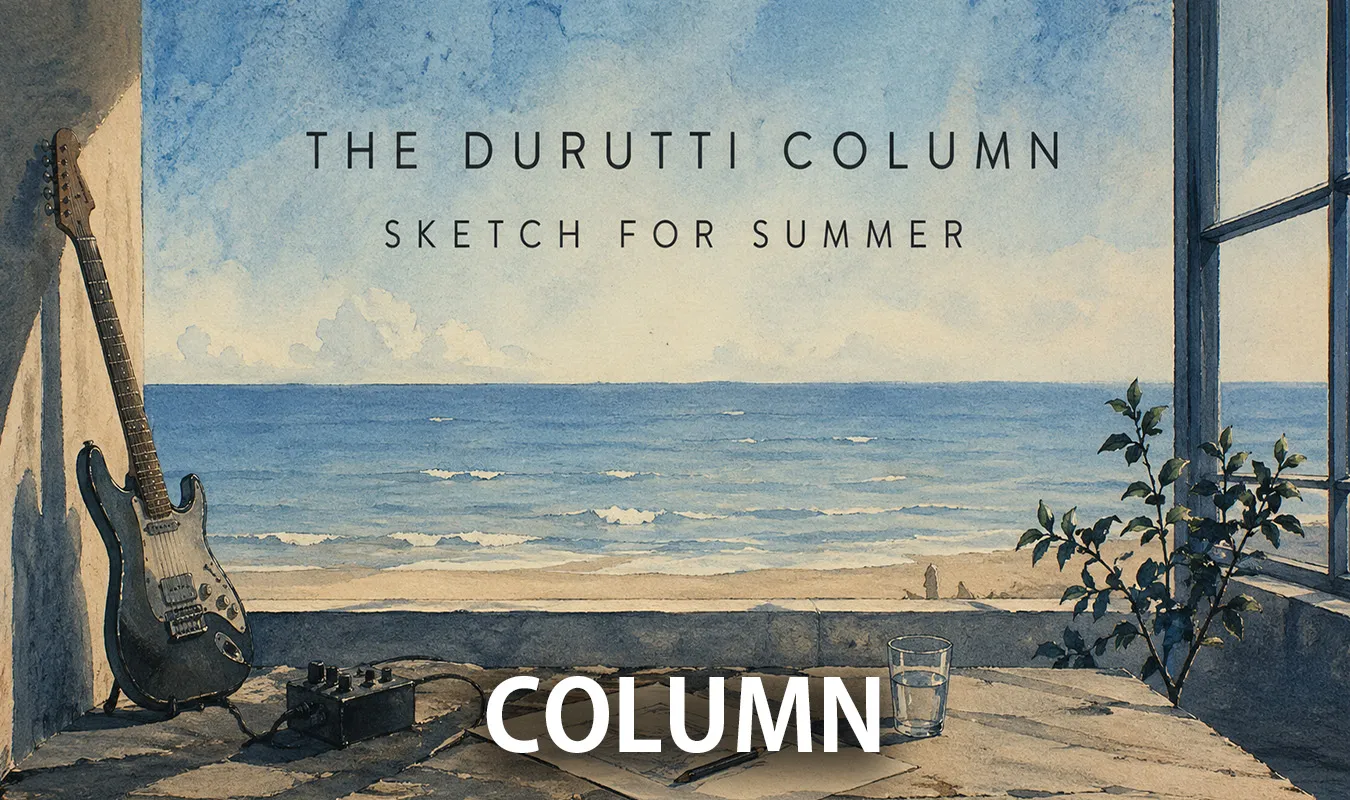
Deconstruct “Sketch for Summer”
Songs that create a world in just a few minutes
Sketch for Summer is one of The Durutti Column’s most iconic songs, from their 1980 album The Return of the Durutti Column.
It’s only about two and a half minutes long. However, their aesthetic is almost completely condensed in its short length. There are no flashy developments or a clear chorus. Even so, after listening to it, I am left with the feeling of seeing a single landscape.
This song is based not on “structure” but on “feeling”.
Sound as “grain” of guitar
The centerpiece is Vini Reilly’s guitar, but the important thing here is not the phrase, but the grain of the sound.
Normal rock guitar moves time forward through riffs and chord progressions, but with “Sketch for Summer,” time expands in the opposite direction. Single notes are repeated with a delay, overlapping each other with slight shifts, creating a flow that feels like rhythm but is not.
Visualizing this structure looks like this:
This “pseudo-rhythm” is the driving force of this song.
Sound does not move forward, but instead diffuses into space.
Melody ambiguity and memorability
This song seems to have a clear melody line, but it”s actually vague. It leaves an impression on you while you”re listening to it, but it’s difficult to accurately reproduce it afterwards.
This is no coincidence. Reilly’s performance is designed to leave the melody as a “feel” rather than a fixed “sign”.
Therefore, as you listen to this song repeatedly, you will gradually begin to see its outline. What was initially felt as a landscape gradually became understood as a structure.
What remains in the memory is not the melody, but the texture of the atmosphere itself.
Meaning of the title Summer
The title “Sketch for Summer” is very suggestive. The important word here is “Sketch” rather than “Summer.”
This piece is presented as a sketch/study rather than a completed work. However, in reality, its unfinished nature is the core of the work.
The sound leaves a lot of blank space and doesn’t tell everything. Therefore, listeners have the space to project their own memories and emotions onto it.
Similarly, the season of summer has a specific image but has different meanings depending on the person.
This song does not “depict summer” but “reminds me of summer.”
Distance from post-punk
The uniqueness of this song is even more striking when compared to the post-punk works of the same era.
For example, while Joy Division expressed inner tension and despair with strong beats, ““Sketch for Summer’’ has almost no tension.
Still, he’s not completely emotionless. Rather, subtle fluctuations of emotion ooze out from the gaps in the sound.
This “emotional sparsity” was strongly connected to the context of later ambient and chillout music.
New expressions are created by diluting emotions rather than emphasizing them.
Positioning as spatial music
This song is often described as ambient, but it’s not exactly ambient music either.
While Brian Eno defines ambient as ““music you can listen to or ignore,” ““Sketch for Summer” is a little more foregrounded.
If you listen carefully, you can see the delicate structure, but it also works well when played as a background. This “in-between position” gives rise to the uniqueness of this song.
Ambiguity, which can be both background and foreground, is the essence of this song.
Impact on subsequent
The influence of ““Sketch for Summer’’ is far-reaching, although it is rarely cited directly.
It is familiar to the texture-oriented approach of guitar in post-rock, the ambiguous sonic image in lo-fi, and even the use of white space in contemporary ambient pop.
In particular, the idea of ”“creating a rich space with less sound’’ has become an important reference point for many artists.
This song has been passed down as a ““methodology’’ rather than a style.
Why does it still resonate today?
It’s clear why this song, created over 40 years ago, still sounds fresh.
This is because it does not depend on the era. Elements such as drum machine tones or synth trends are almost absent, and the focus is on the structure of the sound itself.
As a result, the song always resonates in the present tense, without being anchored to a specific era.
“Sketch for Summer” is not music from the past, but music separated from time.
Chronology
Main steps of The Durutti Column
Meaning of quiet revolution
What is the “strength” of music?
At first glance, The Durutti Column’s music seems weaker and less assertive. However, the reality is extremely radical.
Music that is created by reducing the sound. A structure that emphasizes reverberation rather than melody. Sustainability independent of genre. All of this was a quiet rebuttal to rock’s traditional values.
What”s most important is the fact that the music still hasn”t gotten old. In fact, in the modern listening environment, that “margin” resonates more richly.
The longest lasting music exists in silence.