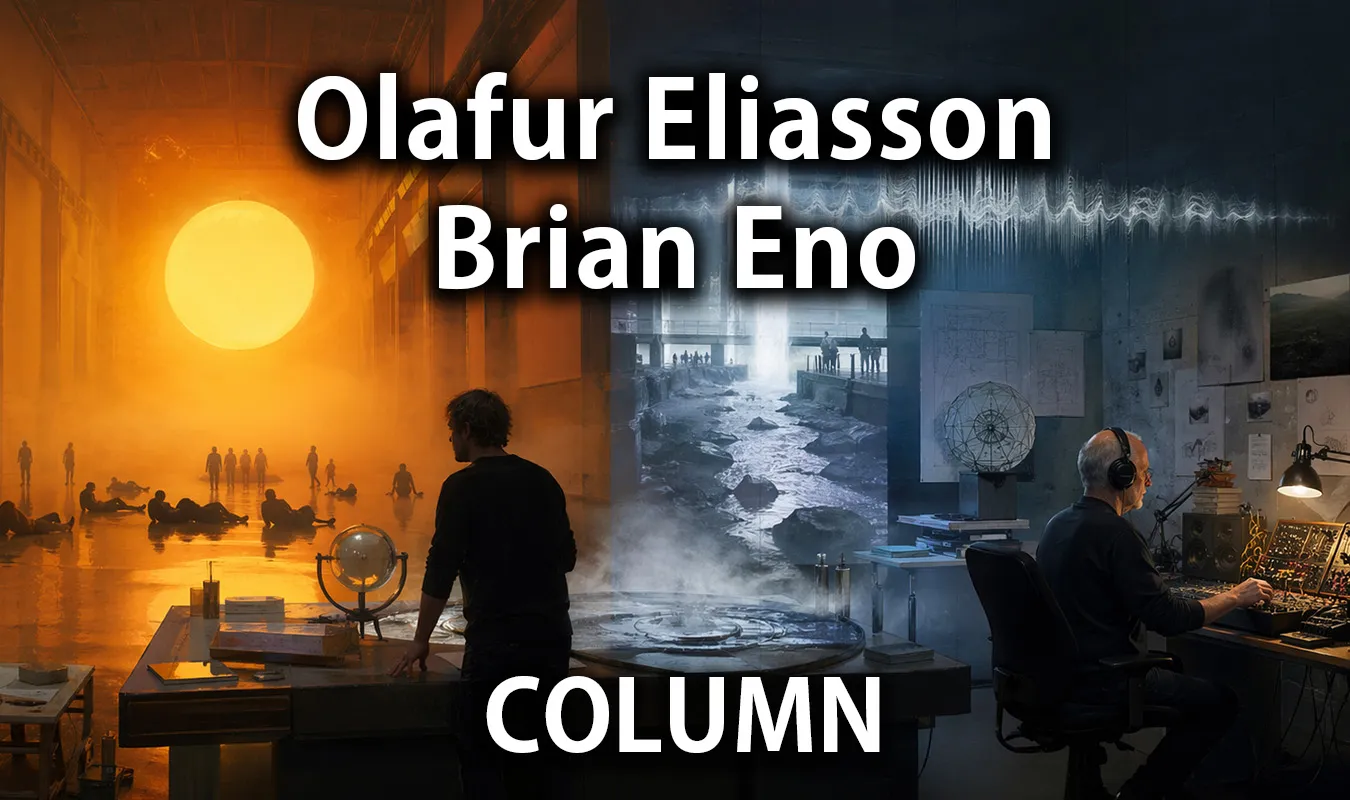
[Column] Listening to light and space: Olafur Eliasson and ambient perception experiments
Column en Ambient Art Sound
Introduction: Conditions for “feeling” space
| Text: mmr | Theme: How does human perception change when light and sound overlap? Exploring the intersection of visual art and ambient music. |
The works of Danish artist Olafur Eliasson quietly betray the act of viewing. There, the act of ““viewing’’ is not necessarily completed with the eyes. The body is caught up in space, and the sense of sight is dragged along by elements such as temperature, humidity, reflections, and particles.
Brian Eno’s music, on the other hand, refuses to occupy the center of consciousness. His sound rewrites the very contours of space without appearing in the foreground.
Although the practices of these two people belong to different fields, they intersect at one point. The question is, “How can we design perception?”
We are not looking at the work, but rather the way we see it is changed by the work.
Olafur Eliasson’s masterpieces and anecdotes: Designing the experience of light
《The Weather Project》(2003)
A giant artificial sun installed at London’s Tate Modern. This work is not just a visual experience, but has developed into a social phenomenon.
During the exhibition period, visitors spontaneously began to lie down on the floor. Eventually, the act spread like a ““ritual,’’ and people began to confirm each other’s presence through the reflections on the ceiling.
What’s interesting is that no one is directing their actions. In other words, the space provoked action, and the work contained a ““protocol of experience’’.
Furthermore, it has been pointed out that this work is not unrelated to the regional characteristics of London’s weather: cloudy skies and lack of sunlight. The artificial sun was not just a device, but also a device that intervened in the psychology of the city.
Light not only illuminates vision, but also designs human behavior itself.
《Riverbed》(2014)
This work creates an artificial valley inside a museum in Copenhagen by bringing rocks and water streams. There is an interesting anecdote about the process of creating this work.
Eliasson was particular about ““bringing in nature’’ rather than recreating it. The rocks actually used are real, and the placement is not completely random, but is designed to avoid instability when walking.
Audience members are forced to watch their step while staying in a safe museum space. This “redistribution of attention” is the core of the work.
One critic described the work as “rehabilitation for city dwellers.” Freed from the homogeneous floor, the body is forced to adapt to the environment again.
Unstable footing brings back forgotten physical sensations.
《Ice Watch》 (2014–)
A project to transport ice cubes from Greenland to cities and show them how they melt naturally. This work has a symbolic episode.
During the exhibit, a child touched the ice and asked, ““Will this disappear in the future?’’ This phrase brings the abstract issue of climate change into a very concrete sense of time.
In addition, the sound of melting ice - minute cracks and falling water drops - is hardly noticeable, but it definitely marks time in space. Here, sound also functions as part of the environment.
You can’t see time, but you can feel change.
Brian Eno’s Masterpieces and Anecdotes: Redefining Music
Ambient 1: Music for Airports (1978)
This piece is based on my experience at the airport. Eno himself encountered ““almost inaudible music’’ while hospitalized after an accident, which led him to reconsider the role of music.
He believed that in the stressful environment of an airport, music should alleviate anxiety rather than amplify it.
The result is music that doesn’t assert itself, a sound that blends into the environment.
Music does not manipulate emotions, but rather adjusts the environment.
Discreet Music (1975)
This work has a famous anecdote. When Eno was lying down, the volume on the playback device was so low that he could barely hear it. But he found the situation “ideal.”
Music does not have to be completely recognizable. Rather, the state of being half audible gives the space a new texture.
This discovery was a decisive turning point in moving music from the ““foreground” to the ““background.”
Ambient 4: On Land (1982)
This work is not a real landscape, but a reconstruction of the landscape in my memory as sound. Although Eno refers to specific places, he obscures them and presents them as psychological topography.
In an interview, he said, ““I don’t use actual natural sounds, but many people can feel nature.’’
This shows that perception is based on internal interpretation rather than reproduction of the external world.
We don’t listen to sounds, we reconstruct memories through sounds.
The studio is a testing ground: the fusion of production and environment
Eliasson’s studio is not just a place of production, but also a laboratory of perception. In this space where architecture, science, and art intersect, every element is subject to adjustment.
Ambient music plays an important role in this. Sounds without a strong rhythm or melody do not steal attention, but they also create a state of not complete silence.
This “intermediate state” is extremely important for creation.
- Concentration without too much concentration
- unconscious consciousness
- Unfixed thinking
Creation is born not from silence, but from minute fluctuations.
Matching ambient and spatial perception
Eliasson and Eno’s practices are consistent in that they do not present ““works” but rather design ““conditions of experience.”
In this structure, the audience is not a passive entity. Rather, it functions as a part of the work and participates in the generation of perception.
Art is not something to be seen, but something to participate in.
Chronology: Parallel evolution of light and sound
| Year | Events |
|---|---|
| 1948 | Brian Eno is born |
| 1967 | Birth of Eliasson |
| 1975 | “Discreet Music” |
| 1978 | “Ambient 1” |
| 1982 | “On Land” |
| 1995 | Studio established |
| 2003 | 《The Weather Project》 |
| 2014 | 《Riverbed》 |
| 2014〜 | 《Ice Watch》 |
Innovations in different fields converge on the same perceptual problem.
Conclusion: Art as design of perception
What Eliasson and Eno have in common is that they transformed art from “expression” to “design.”
There, the work is not a finished object, but an ever-changing condition, and the viewer becomes a participant rather than a receiver.
Light and sound are not just materials. They are devices that shake up our perceptions and change the way we see the world.
Art is a technology that does not change reality, but changes the way we perceive reality.