
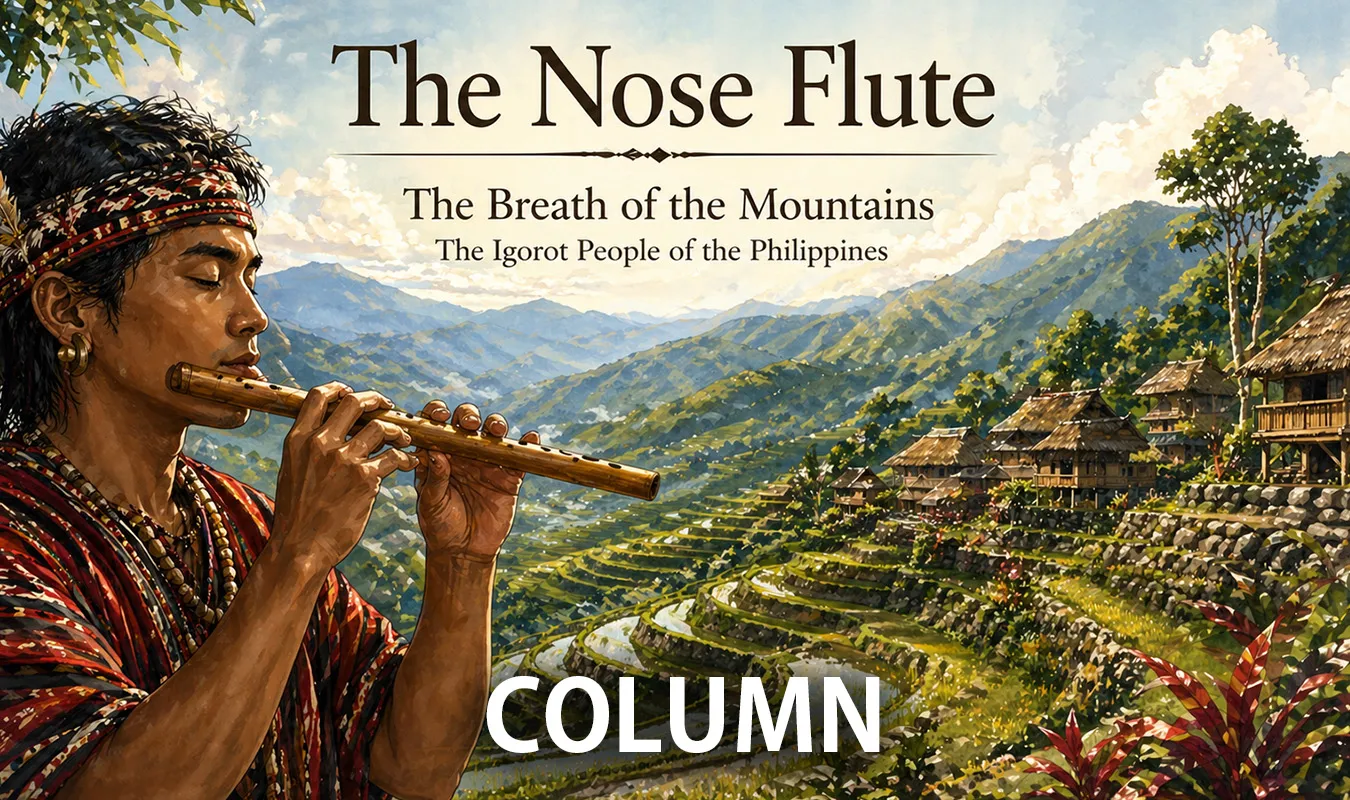
[Column] The sound of the mountain wind - the deep layers of the nasal flute and sound culture of the Igorot people of the Philippines

Column en Flute History Tribal
[Column] The sound of the mountain wind - the deep layers of the nasal flute and sound culture of the Igorot people of the Philippines

Prologue: “Breathing melody” that is not a voice or an instrument

Text: mmr Theme: The nasal flute of the Igorot people who live in the mountainous regions of the northern Philippines is not a voice or a musical instrument, but is ““music of breathing.’’ This paper deciphers the relationship between mountain culture and sound, focusing on its origin, structure, and social role.

The Cordillera region is located in the mountainous region of Luzon Island in the northern part of the Philippines. The Igorot people who live in this area have built their own culture along with the steep rice terraces. Among them, an instrument called the ““nose flute’’ has a unique presence.

A nasal flute is a wind instrument that produces sound by blowing air through the nose, and has a fundamentally different principle of sound than a typical flute played with the mouth. This musical instrument is not just a sound device, but has long functioned as a means of mediating emotions and social relationships.

Sounds are more ambiguous than words, but they leave a strong impression on your mind. For the Igorots, the sound of the nasal flute is considered a part of nature, just like the wind in the mountains or the flow of water.

The nasal flute is not something to be played, but a sound made by breathing.


What are the Igorots: Mountain culture and community

Igorots are not a single ethnic group, but a collective term for multiple ethnic groups living in the Cordillera region. Representative groups include Ifugao, Bontoc, and Kalinga.

Their society has long developed under geographical conditions that make them less susceptible to external influences. While the steep mountains and terraced fields prevented foreign invasion, they also served as the foundation for maintaining a unique cultural system.

Music has also adapted to this environment. In contrast to the strong percussion culture (gong), the nasal flute is a very personal and reflective music. This shows the dual structure of sounds that go outside the community and sounds that go inside.

The nasal flute is not a sound for a group, but a sound that quietly conveys individual emotions.


Structure and acoustic principles of the nasal flute

A nasal flute is a small wind instrument usually made of bamboo or wood. The structure is simple, with several finger holes that allow you to change the pitch.

The performer breathes in through one nostril and closes the other with his fingers. At this time, the mouth is closed, and breathing control directly affects the tone.

Compared to a whistle played with the mouth, the sound of a nasal whistle is softer and has a slightly hoarse texture. This unique tone produces a sustained and smooth melody without a strong attack.

Also, since breathing through the nose requires less pressure than breathing through the mouth, the volume is naturally reduced. As a result, the nasal flute is an instrument better suited for communication over short distances than in large outdoor spaces.

The sound of a nasal flute is not a sound that reaches far away, but a sound that is felt nearby.


Use case: courtship and private communication

The most symbolic use of the nasal flute is during courtship. Cases have been recorded of young men performing to express their feelings to women.

By expressing his feelings through melodies rather than words, he conveys his feelings while avoiding direct confessions. It is this indirectness that enhances the cultural value of the nasal flute.

The nasal flute is also used for personal time. It is often played during breaks while working in the mountains or during alone time, and functions as a means of self-expression.

Importantly, this instrument does not exist for public performance. In the sense that it is music that does not assume an audience, the nasal flute is an extremely introverted cultural device.

The nasal flute is not meant to be heard by others, but is a sound used to ““gently express’’ emotions.


Scale and melody: freedom within limited sounds

The scale of the nasal flute is limited, and it does not have the complex harmonic structure of Western music. However, within these constraints, a unique melody has developed.

It often uses short repetitions of phrases and subtle changes in pitch. This has a continuity close to that of natural sounds, and has acoustic characteristics that blend in with the mountain environment.

The melodies are improvisational, and are more like ““sounds born on the spot’’ than fixed pieces of music. This is a typical feature of music in oral culture.

Music is not recorded; it exists in the moment and disappears. That fragility is part of the charm of the nasal flute.

The melody of the nasal flute is not something that can be reproduced, but is a one-time sound that is created and then disappears on the spot.


Chronology: Historical flow of the nose flute and Igorot culture

timeline title イゴロット族と鼻笛の歴史 先史時代 : 山岳地帯での定住文化形成 16世紀 : スペイン到来(山岳地帯は直接支配を回避) 19世紀 : 外部との接触増加、文化記録の開始 20世紀前半 : 民族音楽としての研究対象化 20世紀後半 : 近代化により伝統文化の変容 21世紀 : 文化遺産として再評価

View from the outside: Research and records

In the 20th century, with the development of ethnomusicology, Igorot music also became a subject of research. Through fieldwork, recordings and recordings progressed, and the existence of the nasal flute became widely known.

However, these records are from an outside perspective, and it is difficult to completely recreate the local context. In particular, personal music such as nasal flutes may lose its original meaning when recorded.

Value as a research object and practice as a culture. There is always a tension between the two.

The moment a nasal flute is recorded, its original nature as a “private sound” changes.


The modern nasal flute: preservation and change

In modern times, the nose flute is sometimes played in the context of tourism and cultural preservation. While this has the aspect of passing on tradition, it is also a situation that is different from the original usage situation.

Among younger generations, the frequency of traditional musical instrument use is decreasing due to urbanization and education. However, at the same time, there is also a movement to reevaluate it as a cultural heritage.

The nasal flute is not a disappearing culture, but continues to exist, albeit in different forms. What is important is to view this change not as a simple loss, but as a cultural adaptation.

The nose flute is not a relic of the past, but lives in an ever-changing culture.


Diagram: Mechanism of nasal whistle pronunciation

flowchart TD A[breathe out through the nostrils] --> B[Air vibrates inside the tube] B --> C[sound occurs] C --> D[Adjust pitch with finger holes] D --> E[melody formation]

Conclusion: Making the unsound a sound

A nasal flute is a device that expresses feelings that cannot be put into words through sound. The sound is small and does not reach far. However, it is just that much more intimate and direct.

The presence of the nasal flute stands in contrast to contemporary music, which often strives for loudness and complex structures. It is music that is created by ““reducing the sound” rather than ““increasing the sound.”

A man breathes in the silence of the mountains. That action becomes music. Through its extreme simplicity, the nasal flute questions the essence of music.

The nasal flute is the most primitive device that converts breathing itself into music.


Monumental Movement Records

Monumental Movement Records