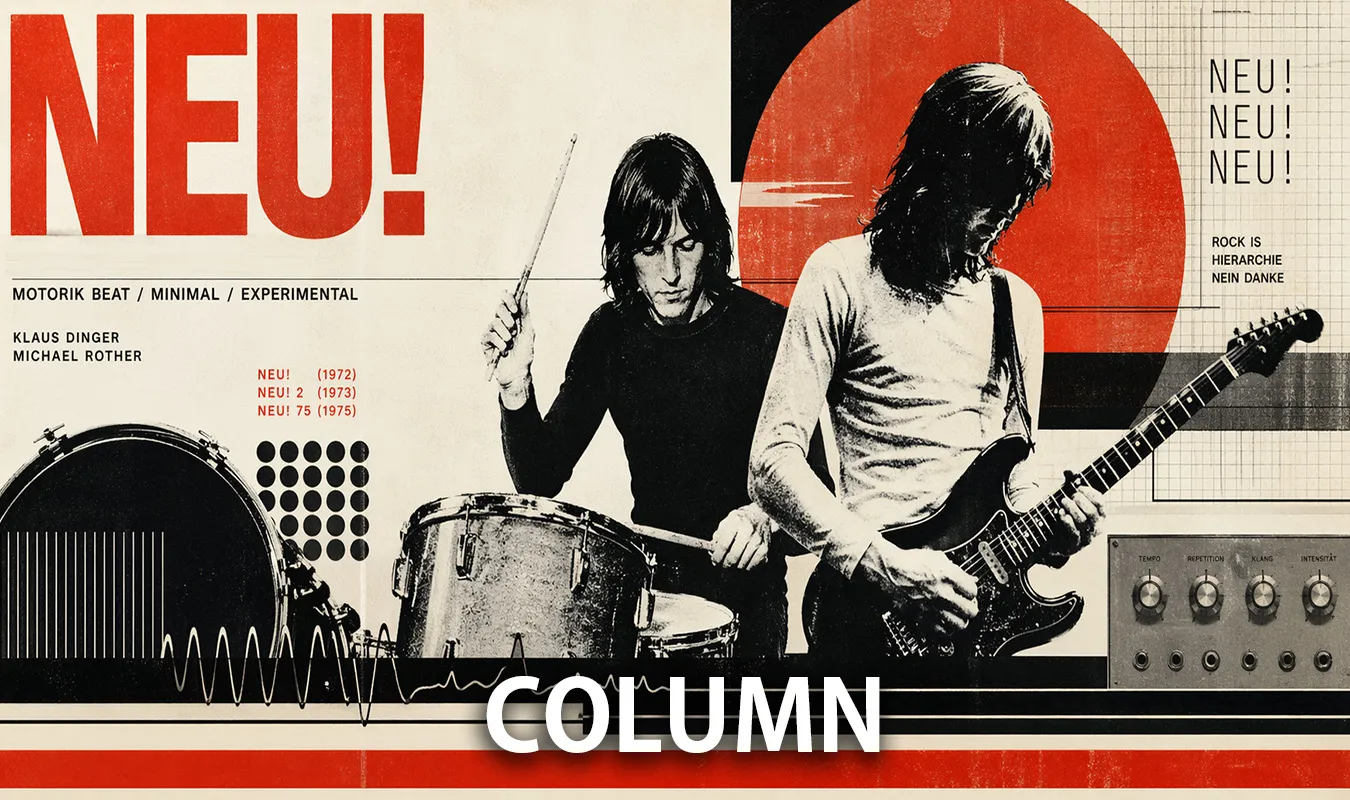
NEU!とは何か——クラウトロックの中核に位置する存在
文:mmr|テーマ:反復と機械性が音楽を変えた瞬間——NEU!と時間感覚の革命
ドイツ実験音楽の中での立ち位置
1970年代初頭、西ドイツでは戦後の文化的再構築とともに独自の音楽運動が生まれた。後に「クラウトロック」と呼ばれるこの潮流は、英米ロックの模倣から脱却し、自律的な音楽言語を模索する試みだった。その中心にいたのが、NEU!である。
NEU!は1971年、Klaus DingerとMichael Rotherによって結成された。両者はそれ以前にKraftwerkの初期ラインナップに在籍していたが、音楽的方向性の違いから離脱し、新たなプロジェクトとしてNEU!を始動させた。
Germany at this time was acutely aware of its political and cultural disconnect with its past. There was a feeling that it was necessary to create a ““German sound” rather than just copying British and American rock. NEU! responded to this request by changing not the language or lyrics, but the ““structure” itself.
またバンド名の「NEU!(新しい)」は、単なるネーミング以上の意味を持つ。レコード店のポップ広告や消費社会のコピーに由来すると言われており、彼らの音楽が商業的な記号と実験性の間に位置していることを象徴している。
NEU!は単なるバンドではなく、戦後ドイツにおける音楽思想の転換点そのものである。
モータリック・ビートの発明
Innovation of linear rhythm
One of NEU!’s most important contributions is the rhythm style called “mortal beat.” This is a type of drumming primarily established by Klaus Dinger, and is characterized by maintaining a constant tempo and sustaining an almost constant beat.
このスタイルは、従来のロックにおけるグルーヴやスウィングとは異なり、まるでアウトバーンを走り続けるような感覚を生み出す。実際、Dinger自身はこのリズムを「永遠に前進するビート」と語っていたとされる。
An interesting anecdote is that Dinger was extremely averse to fluctuations in tempo during live performances, and was obsessed with maintaining a constant mechanical speed. There are also testimonies that even physical movements were kept to a minimum in order to avoid increasing the tempo due to the enthusiasm of the audience or the atmosphere of the venue.
このビートは後のテクノ、ポストパンク、さらには現代のエレクトロニック・ミュージックにまで影響を与えた。
モータリック・ビートは人間的な揺らぎを排し、音楽を時間そのものへと変換した。
デビュー作『NEU!』と音響的実験
ミニマルと空間の構築
1972年にリリースされたデビューアルバム『NEU!』は、音楽史における重要作品の一つである。このアルバムでは、反復と静的な構造をベースに、ギターやノイズ、環境音が層状に重ねられている。
Michael Rotherのギターは旋律というよりもテクスチャとして機能し、空間的な広がりを生み出す役割を担う。一方で、Dingerのドラムはその上を貫く軸として機能する。
録音は非常にシンプルな環境で行われ、スタジオの制約も多かったが、それが逆に音の余白や静寂を強調する結果となった。特に「Hallogallo」は、コード進行がほぼ固定されたまま10分近く続くが、聴き手には時間の経過が曖昧になる感覚を与える。
また、当時このアルバムは商業的には成功しなかったものの、一部の批評家やミュージシャンの間では極めて革新的な作品として認識されていた。後年、再発盤のライナーノーツなどで「未来から来た音」と評されることもある。
『NEU!』は音の変化ではなく、聴覚体験そのものを設計した作品である。
『NEU! 2』と編集という発想
Innovation born from constraints
1973年のセカンドアルバム『NEU! 2』は、制作予算の不足という現実的な制約の中で生まれた。アルバムの後半では、既存の音源を回転数を変えて再生するという手法が用いられている。
これは単なる再利用ではなく、「音の再解釈」というコンセプトに近い。スピードを変えることで、同じ素材が全く異なる意味を持つ音楽へと変化する。
この制作過程には興味深い逸話が残っている。予算が尽きた際、通常であれば制作を中断するのが一般的だが、NEU!はその制約を逆手に取り、「同じ音源を変形させる」というアイデアに到達した。これは結果的に、後のDJ文化やリミックスの概念を先取りするものとなった。
当時この手法は賛否両論を呼び、批評家の中には未完成と評する者もいたが、現在ではむしろ最もラディカルな試みとして評価されている。
"”NEU! 2” is a work that brings to the fore the concept of ““editing” in music production.
『NEU! 75』と二面性の完成
Contrast between static and dynamic
On 1975’s NEU! 75, the first half and second half of the album take a clearly different direction. The first half is ambient and melodious songs led by Rother, and the second half is aggressive and noisy songs led by Dinger.
この構造は、バンド内部の音楽的志向の違いをそのまま作品に反映したものとも言える。実際、両者の関係はこの時期すでに緊張状態にあったとされ、録音も別々に行われたという証言がある。
The songs in the second half in particular had a roughness similar to later punk and industrial music, and could be said to be ahead of their time.
This album ended up presenting the polar opposites of the NEU! project, leading to its subsequent suspension of activities.
『NEU! 75』は統一ではなく分裂を通じて完成された作品である。
影響と再評価
後続世代への波及
NEU!の音楽は、1970年代当時よりもむしろ後年になって再評価された。特に1980年代以降、David BowieやBrian Enoらによってその価値が広められた。
In Bowie’s “Berlin Trilogy”, the influence of NEU!-like repetition and spatial processing has been pointed out. Eno also showed a strong interest in the sustained structure of NEU! in the context of ambient music.
From the 1990s onwards, post-rock and techno artists rediscovered NEU!, and its influence expanded once again. In Japan as well, with the wave of reappraisal of Krautrock, NEU! is positioned as an important reference point.
NEU!は同時代よりも未来に向けて開かれていた音楽である。
年表
NEU!の主要な動き
短い活動期間にもかかわらず、NEU!は長期的な音楽史に深く刻まれている。
Conclusion——The future presented by NEU!
Redefining musical time and structure
NEU! changed the way time is handled within the rock format. Continuation rather than change, repetition rather than development. This idea was extremely radical at the time.
彼らの音楽は一見単調に聴こえるかもしれない。しかし、その単調さの中には微細な変化と知覚の揺らぎが存在する。聴き手はその中で時間の流れを見失い、音そのものではなく「状態」としての音楽を体験することになる。
This feeling is an important element in modern club music and ambient music, and NEU!’s philosophy continues to be updated.
NEU!は音楽を「聴くもの」から「体験するもの」へと変換した存在である。
YouTube Podcast
※このPodcastは英語ですが、自動字幕・翻訳で視聴できます
Explore more like this