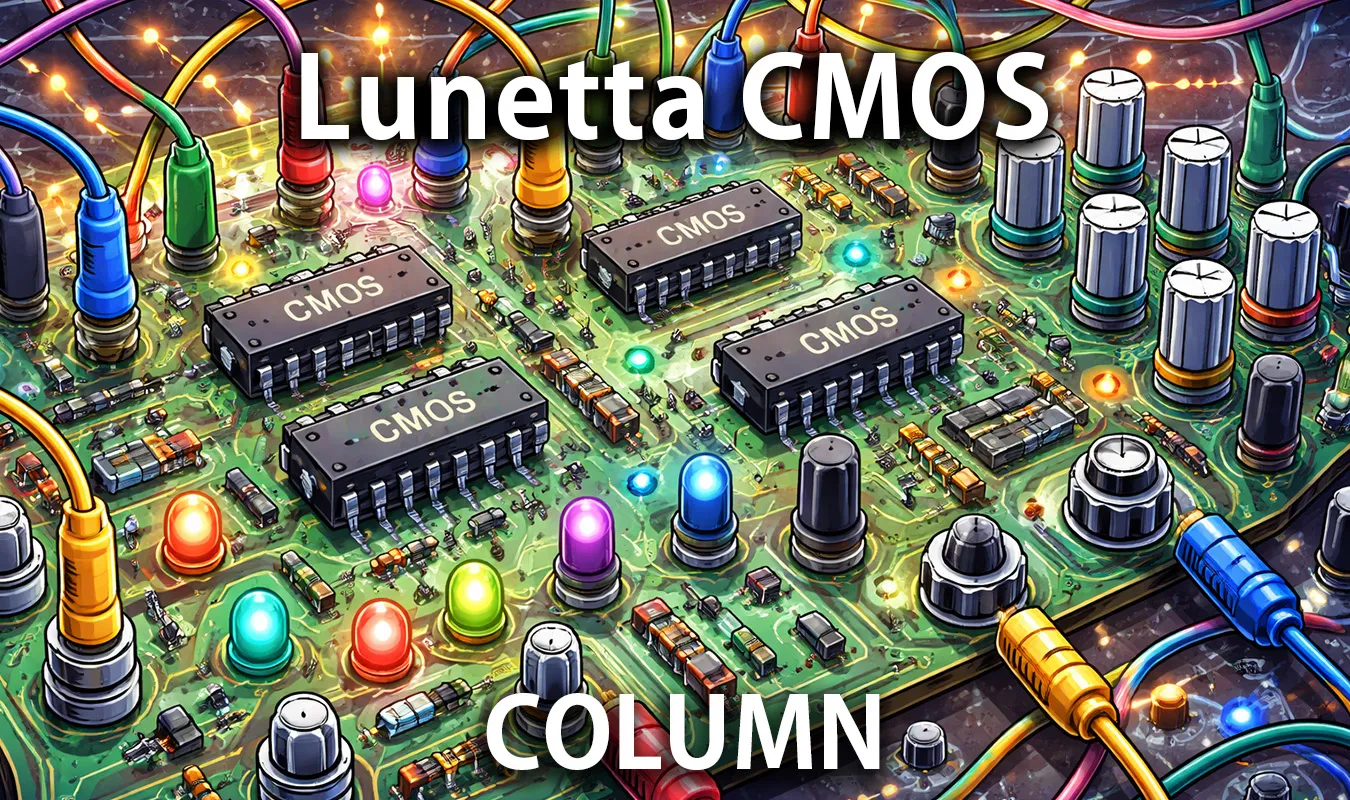
[Column] The world of CMOS Synth and Lunetta: The aesthetics of primitive electronic music played by logic circuits
Column en CMOS DIY Lunetta
What is CMOS Synth?
Text: mmr|Theme: The moment when logic circuits become music ─ The world of primitive electronic acoustics depicted by CMOS Synth and Lunetta
The so-called Lunetta Synth, a DIY synthesizer using CMOS logic ICs, is a culture that generates sounds from extremely simple and primitive circuits, in contrast to today’s sophisticated electronic music environment. This article will discuss its origins, structure, acoustic characteristics, and modern re-evaluation based on historical facts and technical perspectives.
The moment when logic IC becomes sound
CMOS Synth is a general term for synthesizers that generate sound using CMOS logic ICs originally designed as digital circuits. These ICs are originally intended for calculations and signal processing, but by devising a clock and feedback structure, they can oscillate and generate audible sounds.
Typical ICs include the following.
- 40106: Schmitt trigger inverter *4040: Binary counter
- 4017: Decade counter *4070: XOR gate
These can produce sounds on their own, but when combined, complex rhythms and patterns can be created.
Definition of Lunetta Synth
Lunetta Synth is a name derived from the name of Italian DIY builder Stanley Lunetta, and specifically refers to a system with the following characteristics.
- Consisting only of CMOS logic ICs *Basically do not use analog filters or VCA *Free connection by patching
- Tone change due to power supply voltage
It is these constraints that have created a unique sound and culture.
CMOS Synth is a field in which electronic circuits themselves become musical instruments, rather than musical equipment.
Technical Basics: Why does sound come out?
Mechanism of oscillation
CMOS inverters have the characteristic that the input and output are inverted. By combining this with a resistor and a capacitor, a self-oscillating circuit (oscillator) is constructed.
This loop causes the voltage to change periodically, generating a square wave.
Frequency division by counter
A counter IC divides the input clock and generates signals with multiple different periods. This provides the following effects.
- Generation of rhythm patterns
- Polyrhythm structure
- pseudo melody
Sound transformation using logic operations
Logical operations such as XOR and AND change the relationship between signals. This creates a complex spectrum even with a simple waveform.
*XOR: Increases overtones and becomes noisy
- AND: Gate-like intermittent sound *OR: Density increase due to overlap
Sound generation is based on logical operations rather than analog.
Historical background
The interface between digital circuits and music
In the 1970s, CMOS ICs became popular as low-power, inexpensive electronic components. Around the same time, experiments in electronic music gradually expanded from analog to digital.
However, the idea of using CMOS as a sound source was not mainstream, and existed as an attempt by some experimentalists.
Connection with DIY culture
In the early 2000s, CMOS sound creation was rediscovered through Internet forums and personal sites. The following factors are particularly important.
- Parts availability *Circuit simplicity *Low cost
- Can be manufactured by soldering only
In this vein, the concept of “Lunetta Synth” spread and became established in the DIY community.
Relationship with modular synths
Lunetta has a different philosophy from modular synths, but they intersect in the following points.
- Structural changes due to patching
- Modular design
- Experimental sound generation
However, the decisive difference is that the focus is on logic signals rather than voltage control.
Lunetta is not a modular simplification, but a completely different evolution.
Acoustic characteristics
Dominance of square waves
The basic waveform of CMOS Synth is a square wave. This results in the following characteristics:
- Strong harmonic components
- Digital hard texture
- Rhythmic discontinuity
Instability and contingency
The behavior of CMOS circuits changes depending on the power supply voltage, temperature, and wiring.
- Clock fluctuation
- Aperiodic pattern
- Chaotic rhythm
This results in music with low reproducibility.
Connection outside the audio range
By dividing the high frequency clock, the process of dropping it into the audible range itself becomes a musical structure.
Music is not generated, but extracted from a hierarchy of frequencies.
Circuit design and practice
Basic configuration
The simplest Lunetta has the following configuration.
*Oscillator (40106)
- Counter (4040)
- Output mixing
As a result, signals having multiple periods are output simultaneously.
Patching culture
Lunetta’s feature is not fixed wiring, but connection changes using jumpers and patch cables.
- Freely connect inputs and outputs
- Generating a feedback loop
- Unpredictable behavior
Importance of power supply voltage
CMOS ICs operate at around 3V to 15V, but the sound changes depending on the voltage.
- High voltage: high speed/treble range
- Low voltage: low speed/distortion
The voltage itself acts as a parameter.
Breaking the stability of the circuit creates musicality.
Timeline: Deployment of CMOS Synth and Lunetta
1970s-1990s
- 1970s: Popularization of CMOS ICs
- 1980s: Mainstreaming of digital sound sources
- 1990s: Fragmented practice of DIY electronic music
2000s
- Early circuit sharing on the Internet
- Popularization of the name Lunetta Synth
- Activation of individual production
Since 2010s
- Re-evaluation in parallel with modular revival
- Workshops and community building
- Development as a work of art
Circuits, which were a by-product of technology, became independent as a culture.
Position in modern times
Relationship with noise/experimental music
Lunetta has a high affinity with the following genres.
- Noise music
- Industrial
- Experimental electronic music
This is due to the emphasis on contingency rather than control.
Educational value
CMOS Synth is also effective as an introduction to electronic engineering.
- Understanding logic circuits
- Experience the oscillation principle
- Visualization of the relationship between sound and electricity
Circuits as art
The circuit itself becomes a visual object and is also used as an installation.
- Visualization with LED
- Synchronization of sound and light
- Physical layout aesthetics
Lunetta sits at the interface of music, engineering, and art.
Conclusion: Why CMOS Synth now?
In contrast to today’s highly optimized music production environments, CMOS Synth is inefficient and uncontrollable. However, this very restriction creates unpredictable sounds and structures.
- Simple circuit *Complicated results
- Non-reproducibility
These are elements that digital music tends to lose, and that”s where Lunetta”s value lies.
Primitive circuits pose the most modern questions.