[Column] Japanese Techno - The trajectory of Japan's electronic music culture and its influence on the world
Column en Japanese Techno Techno YMO
Introduction
| Text: mmr | Theme: Japanese techno has not only embraced foreign culture, but has had a great influence on electronic music around the world through its unique aesthetic sense and technological innovation. Tracing its history from both historical and cultural perspectives |
When most people hear the word techno, they might think of sterile beats blaring in huge clubs or cities like Berlin or Detroit. However, the history of techno in Japan has taken a slightly different path.
Japanese techno is not simply an adaptation of music that originated overseas. The company has achieved unique development through the combination of a deep inquisitiveness toward electronic musical instruments, precise performance techniques, fusion with pop culture, and one of the world’s leading audio and electronic equipment industries.
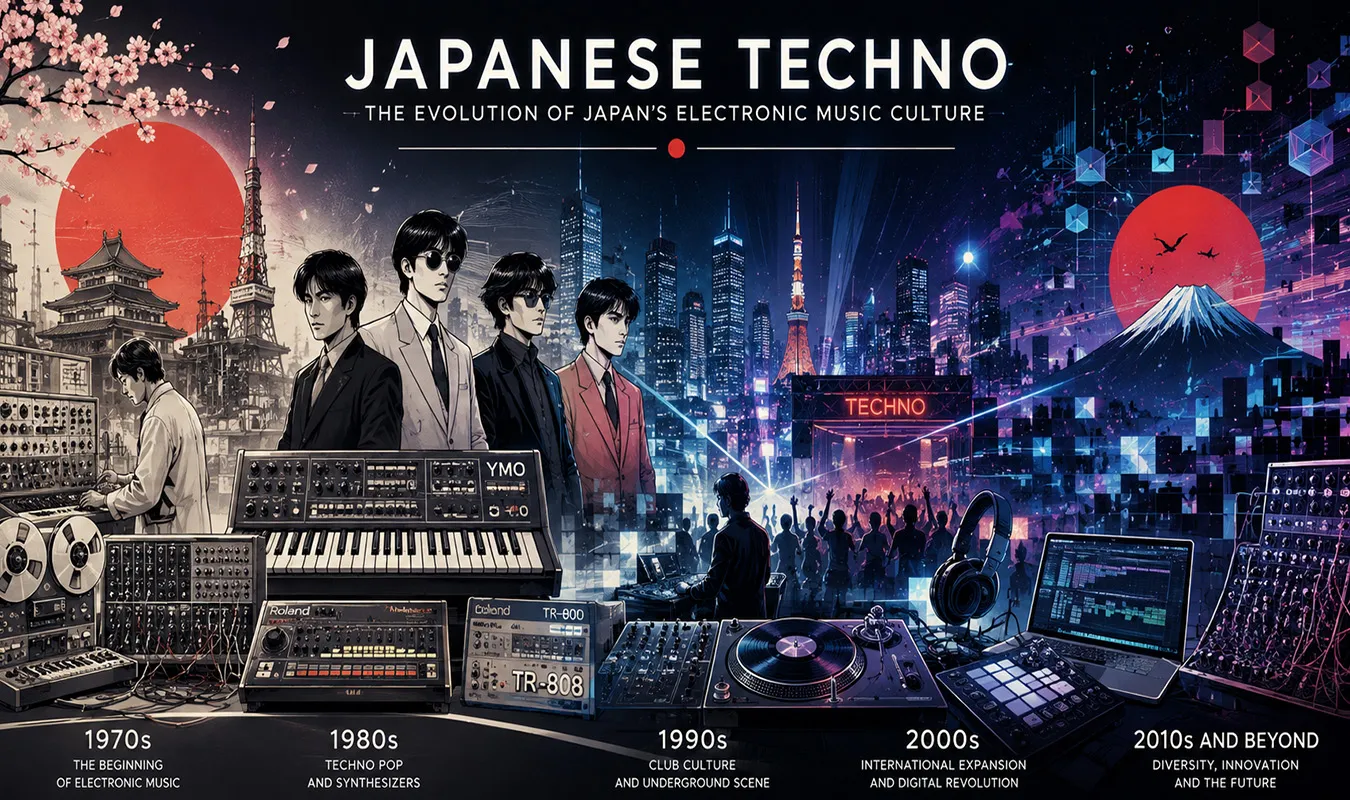
In the late 1970s, synthesizers gradually became known to the general public in Japan, and musicians began to explore their possibilities. In the 1980s, techno pop became a social phenomenon, and in the 1990s, as club culture matured, a full-fledged techno scene was formed. Since the 2000s, Japanese artists have been showing their presence on labels and festivals around the world.
This article traces the history of Japanese techno, not just as a music genre, but also in its relationship with culture, technology, cities, and the creative industry.
The origin of Japanese techno
First encounter with electronic music
Electronic music began to be produced in Japan in the 1950s and 1960s.
Broadcasting stations and universities produced experimental music using tape editing and oscillators, and while influenced by musique concrète and electronic music developed in Europe, uniquely Japanese works were also created.
On the other hand, for general listeners, electronic music was still in the realm of avant-garde art and was not widely popular.
The turning point was the 1970s.
Overseas, large synthesizers such as the Moog and ARP began to become popular, and in Japan, manufacturers of electronic musical instruments accelerated their own development.
Companies such as Roland, Korg, and Yamaha would later grow into equipment manufacturers that support electronic music around the world.
This was the beginning of an era in which Japanese companies were supplying the world not only with music itself, but also with “tools for creating sound.”
Establishment of synthesizer culture
In the late 1970s, an increasing number of Japanese musicians began to actively use synthesizers.
Overseas, Kraftwerk and Giorgio Moroder incorporated mechanical rhythms into their music, and electronic music was also evolving as dance music.
Musicians who have absorbed these trends with a uniquely Japanese sensibility are not just imitating them, but are exploring new electronic music by incorporating various elements such as the Japanese language, game culture, animation, and design.
The symbol of this was Yellow Magic Orchestra (YMO), which was formed in 1978.
Japanese techno did not begin in clubs, but built its own unique foundation through the intersection of two streams: electronic music and musical instrument development.
The world opened by YMO
New music called techno pop
Formed in 1978 by Haruomi Hosono, Yukihiro Takahashi, and Ryuichi Sakamoto, YMO has had a major influence on popular music not only in Japan but also around the world.
While actively utilizing synthesizers, sequencers, and drum machines, they release many works that combine familiar melodies and humor.
At the time, the word “techno” was widely used in Japan, and it was widely covered on TV and in magazines.
The songs, which boldly incorporate game sounds and computer sounds, give off a futuristic impression, and coinciding with Japan’s period of high economic growth, they have come to be accepted as sounds symbolizing the “near future.”
Impact on the world
YMO’s activities were not limited to Japan.
They successfully toured overseas and showed European and American musicians new ways to use electronic instruments.
Many techno, house, electronica, and hip-hop artists active since the 1980s have openly stated that they were influenced by YMO.
Furthermore, the performance of Japanese-made synthesizers and rhythm machines became highly acclaimed around the world, and Japanese companies began to greatly contribute to the development of electronic music culture.
YMO was not just a popular group, but an existence that proved that ““Japanese electronic music can interact with the world on an equal basis.’’
YMO not only popularized techno in Japan, but also became a symbol of the beginning of an era in which electronic music from Japan would influence the world.
From techno pop to club culture
Changes in the late 1980s
In the late 1980s, acid house became popular in Europe, and in Detroit, a new type of dance music that would later be called techno was born.
In Japan, such music gradually began to be introduced through specialty stores that handled imported records and club DJs.
Although the word techno was still often associated with YMO, the younger generation of DJs and music fans gradually began to understand techno as club music.
Club, a new place of expression
From the late 1980s to the early 1990s, the club scene became active mainly in Tokyo.
DJs established a style of creating long grooves while splicing records, and the musical experience, which was different from live performances, attracted young people.
Clubs are becoming more than just places for dancing; they are becoming cultural spaces where new fashion, visual expression, art, and design intersect.
From here, Japanese techno began its history as full-fledged club music.
At the end of the 1980s, Japanese techno changed from a symbol of pop culture to club music that supported urban culture.
The 1990s, the beginning of the golden age of Japanese techno
Club culture spread after the bubble burst
In the early 1990s, Japan’s entire society was undergoing a major transition following the collapse of the bubble economy. Meanwhile, in urban areas, young people seeking a new culture begin to flock to clubs.
Overseas, Detroit techno, Berlin techno, and British rave culture were rapidly developing, and cutting-edge sounds were being introduced to Japan through imported records and foreign DJs visiting Japan.
Clubs back then were not just places for dancing. It was also a testing ground where fashion, video, lighting, architecture, contemporary art, and more were mixed to create a new urban culture.
In Tokyo, clubs of all sizes were born, mainly in Shibuya, Nishi-Azabu, Aoyama, and Shinjuku, and in Kansai, a unique scene was forming mainly in Osaka and Kyoto.
DJs are beginning to be recognized as not only the ones who select the music, but also the ones who design the flow of the entire space throughout the night, and the profession of DJ is gradually gaining social recognition in Japan as well.
In the early 1990s, Japanese techno began to rapidly grow as an urban culture unique to Japan, rather than as a receptacle for foreign culture.
Connection with Detroit Techno
Mechanical yet human music
Techno, which was born in Detroit, America in the late 1980s, had a huge impact on Japanese creators.
Synthesizers reminiscent of a futuristic city, precise rhythm machines, and an immersive feeling created by repetition.
Unlike the “techno pop” that had been common in Japan up until then, its minimalist structure, designed for long dances in clubs, presented new possibilities to many DJs and producers.
Furthermore, the ““precision” and ““aesthetics of repetition” that the Japanese had for a long time naturally resonated with the philosophy of Detroit techno.
The idea of creating a deep world view with a small number of sounds gradually permeated the Japanese electronic music scene.
Foreign artists coming to Japan
In the 1990s, opportunities for DJs and producers from around the world to play in Japan increased.
Performances by foreign artists were a valuable opportunity to learn the latest play styles from Japanese DJs, and also helped improve the level of the domestic scene.
Japanese clubs are highly regarded for their sound equipment, and many overseas DJs are starting to place importance on performing in Japan.
His encounter with Detroit techno significantly changed Japanese techno from ““music to listen to” to ““music to experience.”
Exchange with Berlin
New values created by post-unification Berlin
In the 1990s, a club culture was rapidly growing in Berlin, making use of vacant buildings and factory sites after the fall of the Wall.
The techno event, which lasts until morning in a huge space, has a strong influence on Japanese club people.
Berlin was characterized by a culture that valued not only music but also free expression and anonymity.
The idea that music itself, rather than clothes or titles, brings people together is gradually permeating Japanese club culture.
In the late 1990s, we began to see examples of Japanese DJs and producers working in Berlin, and the exchange deepened further.
Japanese techno evolved in its own direction, learning the musicality from Detroit and the spirit of club culture from Berlin.
Role played by major Japanese clubs
World-class acoustic space
In the 1990s, clubs that supported techno culture sprang up one after another across Japan.
In Tokyo, in addition to large clubs, there are also many small-scale establishments that are particular about their acoustics.
Each club had a different sound system, lighting, and spatial presentation, and each club developed its own unique personality.
Their commitment to sound equipment has been highly praised by overseas DJs, and an increasing number of artists are looking forward to performing in Japan.
Additionally, each region had its own distinctive scene, with Osaka supporting harder techno and Kyoto supporting experimental electronic music.
Maturity of DJ culture
Around this time, DJs began to be recognized as not just people who played music, but artists who edited music and created a space.
Record shops also became hubs for exchanging information, and many DJs gathered on the day new releases arrived.
The culture of seeking imported foreign records played an important role in fostering Japan’s unique DJ community.
Clubs and record shops became symbols of the 1990s as the two pillars that supported Japanese techno culture.
Rise of Japanese artists
Establish your own style
In the mid-1990s, Japanese producers not only followed up on foreign works, but also began to create their own unique sounds.
Diverse styles such as minimal techno, hard techno, ambient, and electro coexist, and the delicate sound creation unique to Japan has become highly acclaimed overseas.
The style of working as a DJ while also producing music has become commonplace, and many artists are releasing their works on overseas labels.
Evolution of live performance
At club events, not only DJs but also live performances using synthesizers and samplers are gaining popularity.
The live set, which assembles sounds in real time, goes well with the advanced performance techniques of Japanese artists, and is a factor that has earned them acclaim at festivals overseas.
In the late 1990s, Japanese techno steadily grew into a scene that no longer followed the world, but was transmitting music to the world.
Fuji Rock and the arrival of large festivals
Techno spreads to the general public
In the late 1990s, large-scale outdoor music festivals began to take hold in Japan.
Not only rock, but also electronic music and DJ culture began to be introduced on the same stage, and techno expanded its scope of activity outside of clubs.
The outdoor festival featured long DJ sets and live performances, gaining a new fan base.
This environment will revitalize Japan’s electronic music scene as a whole and foster the next generation of artists.
The 1990s marked a turning point in Japanese techno’s transition from underground culture to widespread social recognition, laying a solid foundation for the next era.
Internationalization of Japanese techno in the 2000s
Towards an era of connecting with the world in real time
In the 2000s, the Japanese techno scene entered a new phase.
Until the 1990s, the latest information from overseas was often transmitted at different times through imported records and music magazines. However, with the spread of the Internet, it has become possible to instantly access music information from all over the world, and Japanese artists are rapidly becoming closer to the overseas scene.
The sound source production environment has also changed significantly. Improvements in computer performance and the spread of DAWs (Digital Audio Workstations) have made it possible to produce high-quality music without the need for a large studio.
Thus began the era of the ““home studio,’’ where people could broadcast their work to the world from a single room in their home.
Young Japanese creators are creating new expressions in parallel with electronic music scenes not only in Berlin and Detroit, but also in London, Amsterdam, Paris, and other parts of the world.
The spread of the Internet and digital production environments was a major turning point that directly connected Japanese techno to the global market.
Spread of minimal techno
Aesthetics of creating a space with “less sounds”
In the techno scene of the early 2000s, minimal techno became a global trend.
The method of suppressing flashy melodies and development, and repeating a limited number of sounds while changing them little by little, was compatible with the delicate sensibilities of the Japanese people.
By reducing the number of sounds, each timbre, reverberation, and rhythmic fluctuation become more prominent.
As a result, Japanese artists have gained acclaim for their meticulously designed sound designs.
Overseas, Japanese works are sometimes described as ““minimalist yet warm,’’ and their uniqueness, rather than just a mechanical impression, is attracting attention.
Feeling of playing the space itself
In this era, live performances were more about ““designing a space” than ““playing a song.”
As the integration of lighting and video production progresses, audiences will become more attracted to events where they can experience not just the sound but the entire space.
The sound, which changes little by little during a long set, brought a new sense of value to Japanese club culture.
Minimal techno has become an important genre that impresses the world with Japan’s precise sound creation.
The era of laptop live performances
Changes in playing style
In the 2000s, live performances using laptops became commonplace.
Live performances that previously required large rack equipment and multiple synthesizers can now be performed with a single computer.
Advances in software synthesizers and samplers have made it possible to change tones in real time and compose songs on the spot during live performances.
The performers transcend the boundaries between DJ and live act, pursuing free expression that incorporates improvisation.
Fusion with video
At the same time, VJ culture is also maturing.
The performance, which involves manipulating images in real time to match the sound, has been incorporated into many events in Japan.
Collaborative productions with filmmakers, lighting designers, and installation artists increased, and techno events developed into comprehensive media art.
Techno has evolved not only as ““music’’ but also as a comprehensive art that includes images and spatial production.
Presence of Japanese labels
Send your work to the world market
In the 2000s, Japanese labels began to actively distribute their products overseas.
Not only CDs but also analog records and digital distribution have become more available, and production of works that are not limited to Japan has become commonplace.
Collaborative productions and remix projects with overseas artists are increasing, and Japanese producers are naturally integrating into the global scene.
Labels are no longer just sales companies, but function as communities for sharing musicality, and have become important entities for discovering new talent.
Evaluation of Japanese-style sound creation
What attracted the attention of foreign critics and DJs was the unique sound design found in Japanese works.
Japanese production techniques, such as carefully organized mixes from low to high frequencies, detailed reverberation processing, and precise rhythm structures, came to be highly trusted by club DJs.
This reputation, coupled with trust in Japanese-made audio equipment and electronic musical instruments, increased the value of the Japanese techno brand as a whole.
Japanese labels not only served as a place to present works, but also functioned as a window for delivering Japan’s unique sound to the world.
Maturation of festival culture
Diversification of domestic events
In the 2000s, many electronic music festivals began to be held across Japan.
In addition to urban events, outdoor events that take advantage of natural environments such as mountain areas and beaches also gained popularity.
Festivals, which offer different musical experiences during the day and night, have a different appeal than clubs, and many foreign artists come to perform.
Japanese event management was praised for its time management and high sound quality, and gained the trust of international performers.
Festival as a community
The festival was not just a live event, but also played an important role as a community where people could interact.
Creators from a variety of fields, including not only music fans but also videographers, designers, architects, and people in the fashion industry, gather together to create new collaborations.
Techno continued to expand as a culture that transcended genres.
With the maturation of festival culture, Japanese techno has developed into a multifaceted culture that connects not only cities but also nature and art.
Fusion with electronica
Electronic music that blurs the boundaries
In the late 2000s, the boundaries between techno, ambient, click, glitch, IDM, and electronica gradually became blurred.
In addition to 4/4 music for clubs, the number of works designed for listening has also increased.
Japanese creators are not bound by genre and are working in a wide range of fields, including video works, contemporary art, game music, and advertising music.
Electronic music is no longer limited to club culture, but has spread to music that can be heard in various situations in daily life.
The 2000s was a time when Japanese techno transcended the boundaries of clubs and matured into a comprehensive expression that was linked to contemporary art and digital culture.
New developments in Japanese techno since the 2010s
New scenes created by the digital age
In the 2010s, Japan’s techno scene became even more diverse.
With the spread of music distribution services, SNS, and video sharing services, the way people present their work has changed dramatically. We are now in an era where it is possible to release the music you create to the world without having to go through a record company or distribution network, and a new generation of producers and DJs are emerging one after another.
In the past, the center of activity was concentrated in urban areas such as Tokyo and Osaka, but as Japanese creators living in regional cities and overseas can now share their works in the same arena, Japanese techno is freed from geographical constraints.
Information sharing about club events has also moved online, making it easier to interact and collaborate with overseas artists than before.
The Internet has transformed Japan’s techno scene from a culture centered on the domestic market to a network that connects people with the world on a daily basis.
Evolution of live set
Flow of hardware regression
In the mid-2010s, we began to see a change in live performance, which used to be computer-centric.
While digital production has become commonplace, live performances using analog synthesizers, drum machines, and modular synthesizers are once again gaining attention.
Live performances, in which sounds are assembled while operating equipment in real time, create a unique development for each performer, and have become highly appealing as ““performances that can only be heard on the spot.’’
Hybrid live performances that combine computers and hardware have become commonplace, and Japanese artists have demonstrated their presence overseas by leveraging their advanced performance techniques.
Modular synthesizer popularity
Modular synthesizer culture centered on the Eurorack standard is also spreading worldwide, and specialty shops and events are increasing in Japan.
The joy of designing the tone itself goes well with Japan’s electronic musical instrument culture, which has continued since the 1970s, and many creators are creating original sounds.
This trend has also stimulated exchanges with improvisational performance, ambient music, and experimental music, further enriching Japan’s unique electronic music culture.
The return to hardware became a symbol of a new creative style that was born in an era when digital technology had matured.
Japanese sound design appreciated around the world
Evaluation of precise sound creation
The precision of sound design is often cited as a reason why Japanese techno is highly praised overseas.
Japanese production sites have a culture of paying close attention to detail, such as detailed noise processing, use of spatial effects, low frequency control, and precise localization design.
This is deeply connected to recording technology and audio culture that have been built over many years.
Furthermore, the fact that Japanese synthesizers and rhythm machines continue to be used in studios around the world has become an important element supporting Japan’s electronic music culture.
Flexibility that transcends genres
Modern Japanese producers don’t necessarily produce only techno.
Activities that cross various fields such as ambient, house, electro, IDM, experimental music, game music, and film music are common.
The attitude of not fixating genres has become a major characteristic of Japanese creators, and their flexible ideas are praised even overseas.
Japanese techno is not just a genre, but has developed into a creative platform that brings together diverse electronic music.
Changes in club culture
Increase in small events
Many techno events are now being held not only at large clubs but also at small live houses, galleries, cafes, and event spaces.
At events that involve close contact with the audience, new forms of expression are being tried out, such as live sets, improvisations, and audiovisual works.
These small-scale communities also serve as places for young creators to gain experience, and unique scenes are forming across Japan.
A new form of distribution event
Around 2020, live streaming DJ events and online festivals also spread.
Now that Japanese artists can not only gather at physical venues but also participate in events around the world from home, there are more opportunities for Japanese artists to directly deliver their performances to listeners overseas.
Online distribution has become established as a complement to real events, and continues to be an important means of presentation.
While the club space continues to be important, the experience is also expanding online, forming a new music culture.
Japanese electronic musical instrument industry and techno
Manufacturer that continues to create global standards
When talking about Japanese techno, the existence of electronic musical instrument manufacturers is essential.
Equipment developed by Japanese companies, such as synthesizers, drum machines, sequencers, and samplers, has supported music production around the world for many years.
From the 1980s to the present, many products have continued to be used as standards, and new models are attracting attention from creators around the world.
These technological capabilities have enriched the music production environment in Japan, and at the same time have had a major impact on electronic music culture around the world.
Maturity of production environment
Nowadays, production that freely combines hardware and software is common.
High-quality works are now being created not only in studios but also at home and in small-scale production environments, and unique works are being produced from all over Japan.
Music production has become more accessible, making it easier for younger generations to realize new ideas.
Japan”s electronic musical instrument industry continues to play an important role as the technological foundation that supports the world”s techno scene.
What Japanese techno left behind to the world
Cultural influence, not just technology
The influence that Japanese techno has had on the world goes beyond just equipment and sound production.
The fusion of various cultures, such as animation, games, video art, media art, fashion, and architecture, is a unique feature of Japan and has inspired creators around the world.
Another important feature of Japanese electronic music culture is that it has brought pop music and experimental music closer together.
His approach to both friendliness and experimental spirit continues to influence many overseas artists.
Passing on to the next generation
Today, new producers and DJs are emerging, and Japanese techno continues to evolve.
Even as generations change, the ““spirit of inquiry into sound’’ that has been built since the 1970s remains unchanged.
The development of electronic musical instruments, the fusion of club culture, digital technology, and art.
All of these things are tied together, and Japanese techno continues to play a part in the world’s electronic music culture.
Japanese techno not only accepts foreign cultures, but also continues to enrich electronic music around the world by fusing Japan’s unique aesthetic sense and technical strength.
Japanese techno timeline
| Period | Event | Significance |
|---|---|---|
| 1950s | Electronic music production begins at broadcasting stations and research institutes | The dawn of electronic music in Japan |
| 1960s | Tape music and experimental music develop | Form the basis of modern electronic music |
| Early 1970s | Domestic synthesizer development progresses | Electronic musical instrument industry begins to develop |
| 1978 | YMO formed | Providing techno pop to the world |
| 1979 | “Solid State Survivor” released | Expansion of techno boom |
| 1980s | Japanese-made electronic musical instruments spread around the world | Great impact on the world’s music production environment |
| Late 1980s | Full-fledged influx of foreign club music | The foundation of club culture is formed |
| Early 1990s | Techno clubs revitalize mainly in Tokyo and Osaka | Japan’s unique club scene grows |
| Late 1990s | Japanese artists expand overseas | International reputation increases |
| 2000s | Production using DAW became common | Production environment changed significantly |
| Late 2000s | Minimal techno and electronica spread | Diversification of musical expression |
| 2010s | Distribution services and SNS become popular | It will be an era to directly deliver works to the world |
| Late 2010s | Modular synthesizer popularity expands | Hardware culture is reevaluated |
| 2020s | Live streaming and real events coexist | A new form of techno culture takes root |
Genealogy of Japanese techno development
Interrelationship with the world
Features that represent Japanese techno
Precise sound creation
When talking about Japanese techno, the first thing that comes up is the meticulous sound design.
His carefully designed works, including detailed volume balance, spatial processing, and noise control, have been highly praised by DJs and engineers around the world.
This is deeply connected not only to the technological capabilities of electronic musical instrument manufacturers, but also to the quality consciousness that Japan’s recording and audio culture has cultivated over many years.
Fusion of technology and art
When new equipment appears in Japan, there is a tendency to view it not as just a convenient tool, but as a new way of expression.
Synthesizers, samplers, drum machines, computers and modular systems.
All of these have been combined with performance techniques to create new musical expressions.
Collaboration with film, architecture, and contemporary art also progressed from an early stage, and techno developed as a comprehensive art.
Japanese techno has utilized technology as a means to realize new expressions, rather than aiming for technological innovation.
Dialogue with the world
Japanese techno has learned a lot from overseas cultures.
They’ve absorbed forward-looking sound design from Detroit, club culture and long-form grooves from Berlin, and experimental spirit and minimalism from across Europe.
However, in the process, Japan did not lose its unique sensibilities.
Precision, beautiful white space, compositions that accumulate small changes, and the attitude of considering the acoustic space itself as a work of art continue to be communicated to the world as uniquely Japanese values.
Japan and other countries do not have a unidirectional relationship of influence, but rather they stimulate each other.
Japanese techno has grown into a culture that continues to create new value on its own while learning from the world.
Conclusion
The history of Japanese techno is also the history of electronic music culture spanning about half a century.
Experiments with electronic music that began in the 1950s led to synthesizer culture in the 1970s, and spread widely into society through YMO, which was formed in 1978. Later, in the 1990s, club culture matured, and a uniquely Japanese style was formed while deepening interaction with overseas techno scenes.
In the 2000s, internationalization progressed with the spread of the Internet and digital production environments, and Japanese artists and labels began to have a solid presence in the global electronic music scene. Since the 2010s, techno has become even more diverse, actively incorporating new technologies and cultures such as distribution services, SNS, modular synthesizers, and audiovisual expression.
Looking back on this history, we can see that Japanese techno was never a culture that simply followed overseas trends. Japan has continued to provide a unique perspective on electronic music around the world through the development of electronic musical instruments, sound technology, recording culture, visual expression, and fusion with pop culture.
Japanese techno is also one of the few musical cultures where tradition and innovation coexist. While incorporating cutting-edge digital technology, the appeal of analog equipment and live performance is also being reconsidered. This attitude of trying to incorporate human sensations and chance into music, rather than just pursuing efficiency, is still strongly inherited in the current scene.
Future techno will continue to change as it combines with new technologies such as AI, spatial sound, XR, and interactive art. However, the ““spirit of exploring unknown sounds’’ at its core has remained unchanged from the time when electronic music was born to the present day.
Japanese techno is not cold music played by machines.
It is a culture that continues to evolve, born from the interplay of human creativity and technology, urban culture and art, and imagination for the future.
Japanese techno has undergone a unique evolution through the development of electronic musical instruments, club culture, artistic expression, and interaction with the world, and continues to create new music culture for the future.