[Column] The future of interactive music experiences - the current state of listening and creation as technology expands
Column en Interactive Streaming Technology
What is an interactive music experience?
Text: mmr|Theme: Future vision of music experiences redefined by technology
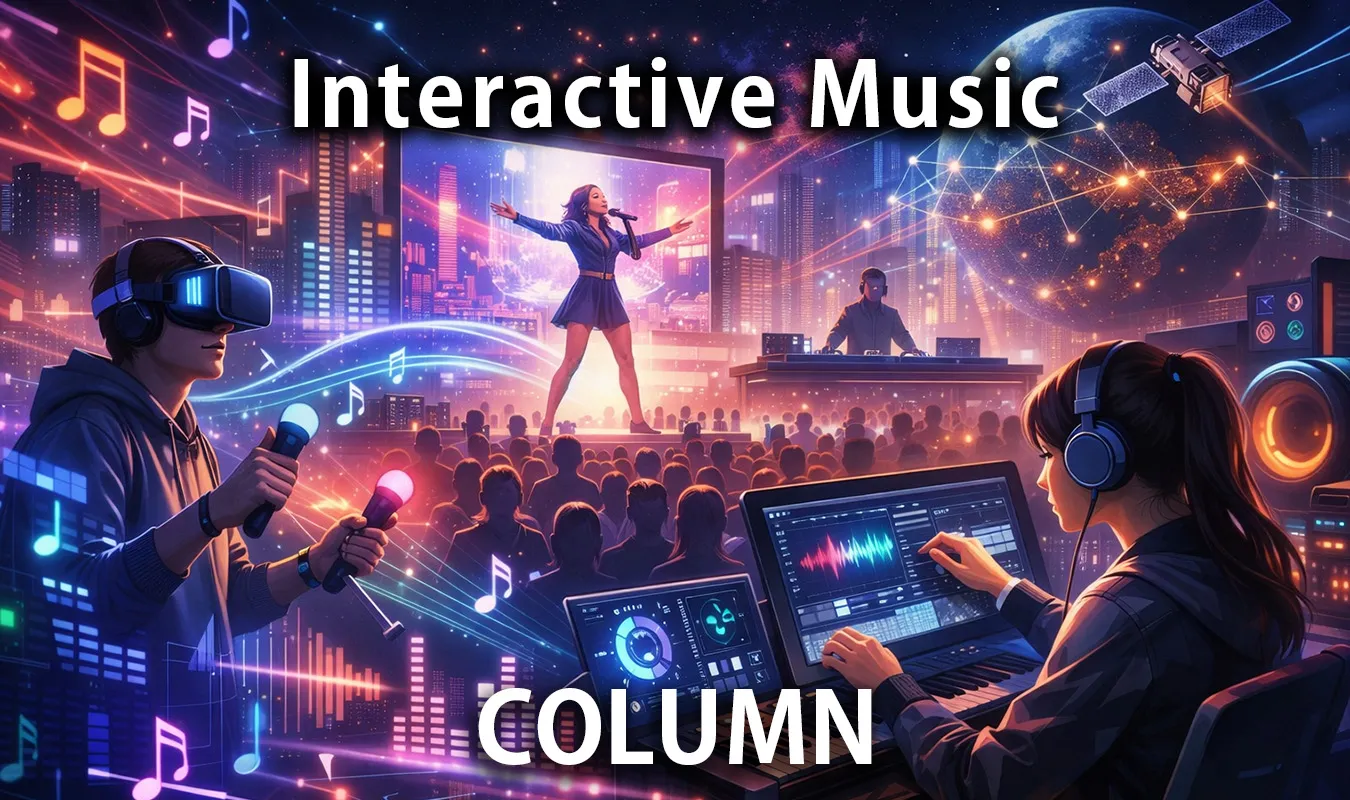
Interactive music experiences refer to forms in which listeners do not passively consume music, but rather influence the sonic experience through selection, manipulation, and participation. The playback order, structure, space, vision, body movements, algorithms, etc. change the experience.
The main elements are as follows.
- Real-time response (sound changes according to input)
- Branching structure (changes in song development depending on selection)
- Spatial audio (3D audio/location information)
- Visual/physical linkage (VR/motion)
- Algorithm generation (AI/procedural composition)
- Network synchronization (online co-creation)
Music is moving from being a work to be played to an environment in which to participate.
History
The beginnings of interactive music date back to the pre-digital era. Tape manipulation and live improvisation were already “changing music.” However, it was with the development of computers and game culture that it became a clear structure.
1970s-1980s: Electronic instruments and MIDI
In 1983, the MIDI standard was established to standardize communication between electronic musical instruments. Performance data can now be controlled, and sounds can be treated as a “collection of events.” This mechanism became the basis for later game music and real-time generation.
1990s: Evolution of game music
With the spread of home game consoles, music has acquired a mechanism that changes according to the player’s actions. A system has been established in which layers change depending on battle, exploration, and events.
As a prime example, the music of Nintendo’s works is a precursor to interactive design.
- Situation change music in 1985 “Super Mario Bros.”
- Theme change in 1998 “The Legend of Zelda: Ocarina of Time”
2000s: The fusion of online and music
With the spread of broadband, music begins to be linked to network connections. MMORPGs and online games have created experiences where music is synchronized in a shared space.
2010s: VR/AR/Streaming
With the advancement of VR technology, music is becoming spatial. With a head-mounted display and spatial sound, music has a “location.”
Typical examples include:
*Beat Saber
- Live events in Fortnite
2020s: AI and real-time generation
Thanks to advances in machine learning, music generation has become real-time. It is integrated into games, apps, and production tools to generate individually optimized music.
Interactive music has not evolved step by step, but has been redefined with each technological innovation.
Key Artists
Interactive music is not a standalone genre. It is made up of a cross-section of composers, developers, and technologists.
Brian Eno
Presenting the concept of generative music. 1978’s Music for Airports laid the foundation for environmental music. Influenced on later app-based generated music.
Koji Kondo
Established situation-related music design for Nintendo works. Popularizing the interactivity of game music.
Yuzo Koshiro
Designed a dynamic song structure within the constraints of the in-game sound source.
Imogen Heap
Practice gesture control live using Mi.Mu gloves.
Holly Herndon
Using AI as a creative partner, we present algorithmic production.
Interactive music is an area where the thoughts of not only composers but also designers are tested.
Essential Tracks
An important work that symbolizes interactivity.
- Music for Airports – Thoughts on environmental generation
- The Legend of Zelda: Ocarina of Time – Situational Theme
- Rez – Control and music sync
- Journey – Online shared experience
- PROTO – Examples of AI co-creation
What’s important is not the song alone, but the experience design itself.
Cultural Impact
Interactive music has changed listening culture.
1. From passive to active
Listening becomes a participatory act as players and users influence acoustic changes.
2. Fusion of music and games
With the expansion of the game market, the field of music production that relies on interactive design is increasing.
3. Redefining live
A live performance with millions of simultaneous participants is now possible in the online space. Live experiences that are not limited to physical spaces have become commonplace.
4. Changes in industrial structure
Musicians are becoming a presence that provides not only ““music” but also ““experience design.” Cross-disciplinary knowledge of UX, programming, and sound design is important.
Interactive music is reshaping the very concept of audience.
Chronology
History has always been linked to technological innovation.
FAQ
Is interactive music a new genre?
It is not a specific genre, but a methodology for experience design. It exists across a wide range of fields, including games, ambient, pop, and club music.
Will AI-generated music replace composers?
Current technology mainly plays a supporting role. Design thinking and curation are still in the hands of humans.
Is VR necessary?
Not required. It also works well on smartphones and web-based systems.
What are your future prospects?
It is predicted that individually optimized music environments, biofeedback linkage, and spatial acoustics will become more sophisticated.
The future of interactive music lies in the philosophy of experience design, not technology.