[Column] Hikashu: A cross-border history of avant-garde pop—a musical experiment that continues from the 1970s to the present
Column en 70s New-Wave Techno Pop![[Column] Hikashu: A cross-border history of avant-garde pop—a musical experiment that continues from the 1970s to the present](/../assets/images/column-hikashu.webp)
Covers creative methods, members, chronology, and charts
| Text: mmr | Theme: A long column by Hikashu, who appeared at the dawn of techno/new wave at the end of the 1970s and pioneered “Japanese experimental pop.” Trajectory from formation to present |
Hikashu is a group that occupies a unique position in Japanese pop/rock history. Since their debut in 1978, they have freely crossed elements such as new wave, avant-garde music, music theater, improvisation, electronic music, and folk music while maintaining their unique creations that ““continue to shake up the concept of genre.’’
It is generally known for its bizarre and humorous performances centered around Koichi Makigami (voice, theremin), and for early techno hits such as “At the End of the 20th Century.” However, the reality is that his scope is far broader, and he has always been involved in the main lines of Japanese experimental music history.
In this article, we will analyze the changes in Hikashu’s activities over the past 45 years from multiple perspectives, including historical context, musical analysis, work background, and changes in live culture.
1. The Eve of Formation: The Intersection of Underground Theater and Experimental Music (~1977)
Hikashu’s roots lie in the underground theater, avant-garde dance, and free improvisation culture that was spreading in Tokyo in the 1970s.
- Koichi Makigami has a background in theatrical vocalizations and improvisational physical expression, and is devoted to methods that treat voice as an “instrument.”
- Chojin Mita (guitar) explores a sonic approach that connects rock and contemporary music
- Makoto Inoue (keyboard) also touched on electronic music and tape works, which later led to his unique synth work.
This diverse background has created the foundation for Hikashu, not just a band that focuses on performing, but a group that crosses over theater, sound art, and pop music.
2. Formation and early activities (1978–1980)
—With the wave of techno/new wave
In 1978, the official “Hikashu” started. Around the same time, YMO debuted in Japan, and the bridge between electronic music and pop music became immediately visible. However, Hikashu, while staying close to this trend, develops a strange pop that barely deviates from the grammar of popular pop.
In particular, the performances from 1979 to 1980 are said to be more than just their sound, but rather their “existence itself is avant-garde,” and they have the following characteristics:
- Absurd lyrics
- Also acoustic vocal manipulation (harmonic chanting, exhalation modulation, meaningless syllables)
- Connection with techno songs
- Increase awareness among the general public through media exposure (TV appearances, etc.)
"”At the End of the 20th Century’’ in 1980 became their biggest hit and is still highly regarded as a representative song of Japanese techno music.
3. Indieization and deepening (1981–1985)
—From pop to “musical experiment”
In the early 1980s, Hikashu left the framework of a major label and moved to a creative system with greater freedom.
Important points during this period:
- Although the sound is pop, the structure is clearly modern music.
- Strong theatrical staging
- Complex time signatures and acoustic guitar approach
- Noise expression by voice
It is the beginning of a break from the genre, and cannot be categorized as so-called “new wave/techno.”
4. Expansion of Koichi Makigami”s activities (late 1980s – 1990s)
—To techno, folk music, theremin, and performing arts
In parallel with the group’s activities, leader Koichi Makigami is expanding the scope of his activities with a focus on expansion of voice.
- Further exploration of overtone singing
- Collaboration with contemporary dance
- Connection with John Zorn (NY avant-garde world)
- Driven the theremin boom in the late 1990s and contributed to its spread in Japan
Hikashu itself introduced ethnic music rhythms, non-Western scales, and abstract poetry, transforming into ““experimental pop of unknown nationality’’.
5. 2000s: Golden live system with stable members
—Exquisite balance of improvisation and pop
Since the 2000s, Hikashu has continued to perform monthly live performances for a long time, and has entered an extremely stable state as a band.
Characteristics of this period:
- Based on improvisational usage, but also emphasizes structural music
- Demonstrate a high level of performance while maintaining nonsense and humor
- Multi-directional development including live sound sources, limited editions, minimally structured experimental works, etc.
Especially since the 2010s, the number of overseas performances has increased several times a year, and the group has become a regular at avant-garde music festivals around the world.
6. Modern Hikashu (2010–2020s)
—Make your work about “continuing experimentation”
Hikashu continues to be active into the 2020s, and although they are a long-lived band, they are unique in that their creative policy is not fixed at all.
- Re-emphasis on electronic music
- Reinterpretation of voice and body
- Introduction of ethnic instruments
- Abstract work with minimal ensemble
- A live arrangement that boldly reconstructs songs from yesteryear.
Hikashu’s style of ““re-experimenting” using past works rather than ““reproducing famous songs from the past” is unique to Hikashu.
7. Detailed analysis of musical characteristics
—Elements that make Hikashu Hikashu
■ 1. The idea of turning the voice into an instrument
Koichi Makigami’s voice is a mixture of the following elements:
- Overtone chanting
- Tone manipulation by changing oral resonance
- Breath sound enhancement
- “acoustic words” with meaningless syllables
- Dramatic voice acting
These are not just vocals, but an exploration of the voice as an acoustic material.
■ 2. Multi-layered rhythm
In the early stages, the new wave-like stoic beats stand out, but from the middle onwards, complex ensembles with multiple beats existing at the same time increase.
■ 3. “Structural humor” rather than “absurdity”
Hikashu’s lyrics and performances may seem bizarre, but many of them are extremely precisely structured. Nonsense is not a “thought-stopping gag” but a device for shaking the boundary between language and sound.
■ 4. Theremin and electronic acoustics
Elements that characterize Hikashu since the 1990s. The theremin’s unstable pitch disturbs the structure of the song while giving it a sense of spatial expansion.
8. Overview of main members
- Koichi Makigami: Voice: Theremin. the center of the band. A wide range of activities from avant-garde music to theater to folk music.
- Mita Chojin: Guitar. Skilled in acoustic processing and irregular playing techniques.
- Akira Toyama (temporary participation): Drums. Introducing a sense of jazz/improvisation into the band.
- Masami Sakaide: Bass. Contributes to the complexity of the rhythm structure.
- Makoto Inoue (initial): Keyboard. It determined Hikashu’s techno/new wave feel in the early days.
*The history of the members is long and complicated, but only the main characters will be dealt with here.
9. Chronology (main trends)
10. Representative works (excerpt)
- At the end of the 20th century (1980)
- Rumors of humanity
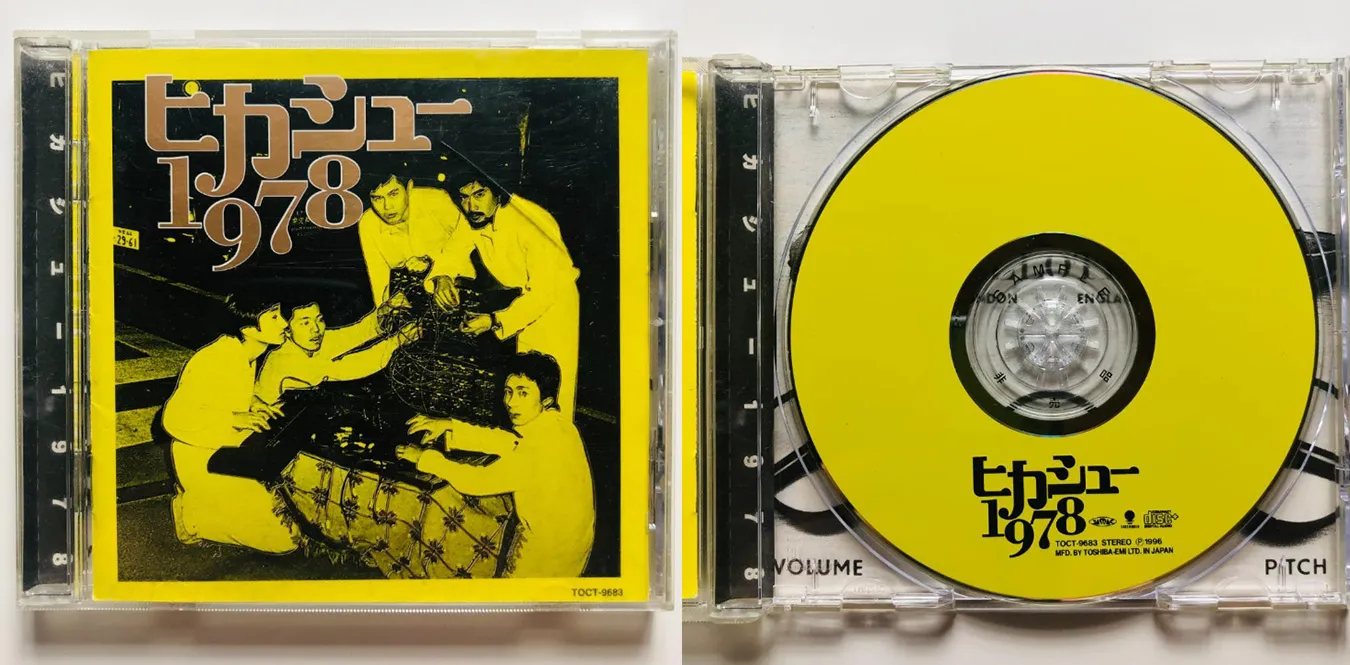
- Hikashu (debut album)
- Living
- Human face
- Improvisational and structural works (prolific in the 2000s)
These works continue to develop Hikashu’s unique worldview, regardless of trends.
11. Significance of Hikashu
—Not a “long-lived band” but a “sustaining experiment”
Hikashu’s uniqueness lies in the fact that it has continued to be a natural art group that changes over time.
- Freely go back and forth between major and underground
- Pursuing acoustic art centered on voice
- Attitude to continue creating regardless of the trends of the times
- Liberation from the framework of traditional rock bands
- Live philosophy that always crosses genres and makes even re-performances an “experiment”
It is not enough to simply talk about Hikashu as a ““legend of Japanese new wave’’; rather, he should be positioned as an important juncture in the history of Japanese contemporary music and avant-garde art.
12. Conclusion
—The “state” of hikashu
Hikashu is more than a “band”, it’s a testing ground for sound, body, and humor. Even though it has been over 45 years since their formation, they have always appeared on stage not to reenact the past, but to discover the “now” anew.
This attitude is of unique value in the history of Japanese music. Hikashu never ends. They always exist as an ongoing “state.”
Explore more like this