[Column] Francis Bacon and music: an auditory experience for depicting extreme emotions

Column en History Music Opera
[Column] Francis Bacon and music: an auditory experience for depicting extreme emotions

An abnormal space called a studio surrounded by music

Text: mmr|Theme: The deep structure of creation built through music and anecdotes by a painter who pursues the limits of emotion

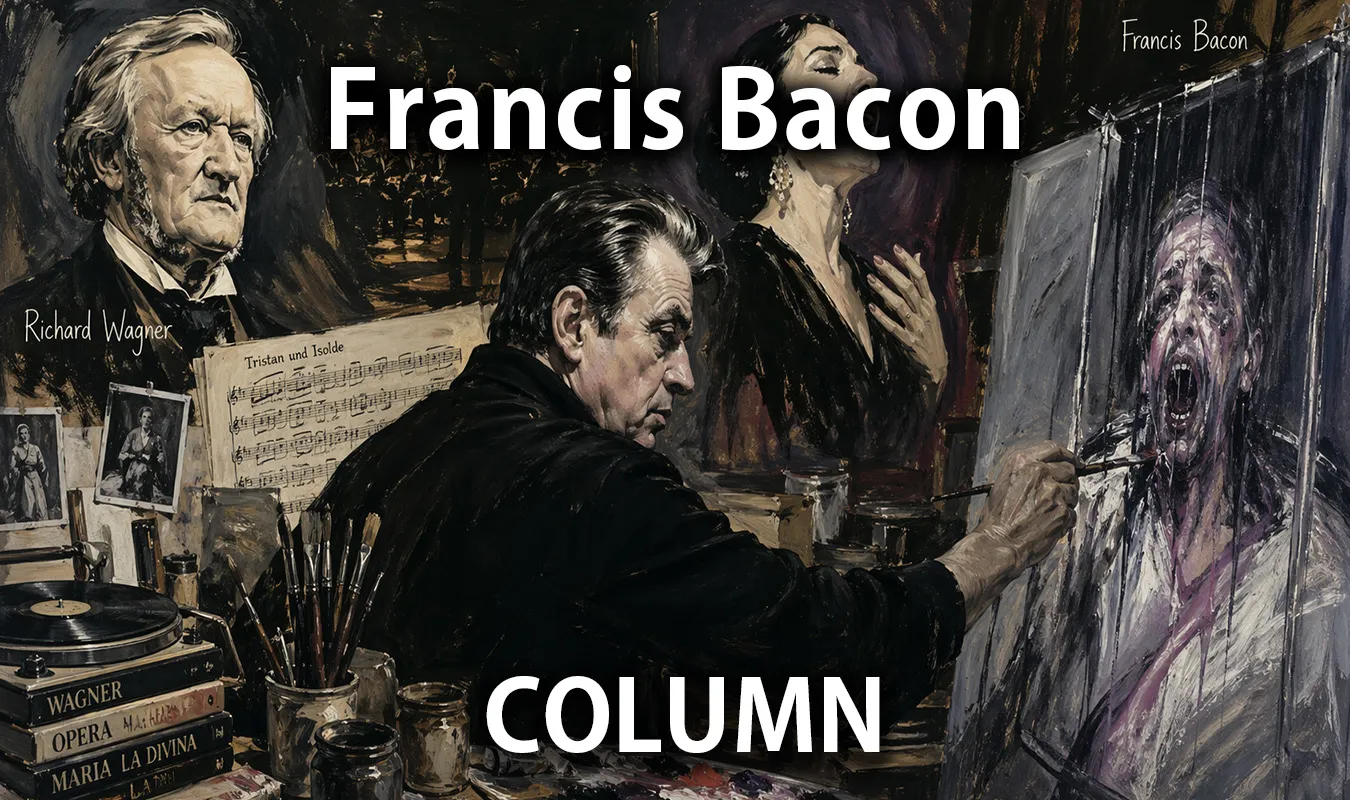
Francis Bacon’s studio was more than just a production location. It was a space almost like a ““laboratory’’ where visual and auditory senses intermingled.

His studio in Leith Mews, London, was filled with photographs, newspaper clippings, torn books, cans of paint and records. Materials are scattered on the floor, and images pasted by chance overlap on the walls. During his productions, he often played music at high volume.

According to testimonies from visitors, the moment they entered the studio, they were overwhelmed by the chaos of sounds, smells, and sights. A friend said, ““It was no longer an art studio, but like the inside of a device where emotions were amplified.’’

Bacon himself disliked ordered environments and intended to preserve chance and chaos. This chaos is further accelerated by music.

Bacon’s studio was not a place where works were created, but a place where emotions ran wild.


Wagner and London at Night: Painting in Excess

Richard Wagner”s music is also deeply connected to Bacon”s nightlife.

He was more active at night than during the day, often spending long hours at casinos or bars before returning to the studio to begin production. At that time, Wagner’s operas were sometimes played.

One anecdote is that he listened to Tristan and Isolde over and over again while listening to it over and over again, with little sleep, and was able to decide on the composition of his important work within a few hours.

He is also quoted as saying of Wagner’s music, ““It pushes the emotions too far.’’ This was not a criticism, but rather an evaluation that reflected his own approach to production.

The more excessive the music, the more extreme the painting is pushed.

Wagner”s music was a device that separated Bacon”s production from reason.


Maria Callas Recording and Repetition Ritual

Maria Callas” recordings were famously played repeatedly in Bacon”s studio.

Particularly famous is his habit of rewinding and listening to the same aria over and over again. He was keenly interested in specific phrases - moments when the voice was about to break down, or notes that were extremely stretched out.

According to one account, he would play the same passage more than a dozen times in a row, stopping his pen and listening intently. When he eventually started drawing again, a clear change appeared on the screen.

This repetition is not just an appreciation. Rather, it was an act that imprinted “emotional waveforms” on the body.

For Bacon, the crow’s voice was not something he heard, but something that invaded his body.


Anecdotes: Images created by chance and accidents

Chance plays an important role in Bacon’s creation. There is also music in the background.

He often welcomed “accidents”. For example, there were times when I used the marks left by a brush stroke or the unintentional spread of paint as the center of my work.

In one famous anecdote, he was working on a painting after drinking and accidentally left a large stain on the canvas. However, he did not erase it, but rather found a new form from it.

This ““acceptance of accidents”’ resonates with the improvisational nature of music. Wagner”s long pieces and Callas’ wavering voice contain moments when they deviate from complete control.

graph TD A[fluctuation of music] --> B[psychological change] B --> C[hand instability] C --> D[accidental occurrence] D --> E[Discovery of new shapes]

Coincidence is not a failure, but a gateway to creation.

For Bacon, the accident was a moment closer to truth than intention.


Intersection between masterpieces and anecdotes

There are especially many anecdotes about Study after Velázquez’s Portrait of Pope Innocent X.

Bacon did not actually see Velázquez’s original painting, which was the basis for this work, but only consulted photographs and reproductions. He is said to have said that this is because ““I get overwhelmed when I see the real thing.’’

This method of distancing is similar to our relationship with music. He preferred recording to live performance, working with music in a form that could be played over and over again.

In other words, what was important to him was not ““direct reality,” but ““reconstructed sensation.”

Bacon did not depict reality as it is, but re-edited it as emotion.


Night, booze and production: a legendary life

Bacon’s life is often told in legend.

He spent much of his time in bars and clubs in Soho, gambling and drinking regularly. Afterwards, he would return to the studio and begin production even though he was tired or inebriated.

Although this lifestyle may seem destructive, it was also a way for him to keep his emotions in an extreme state.

A friend said, ““He was always able to draw at very close to his limits.’’

Music pushes this state even further. Wagner’s long pieces and Callas’ intense voice lead the spirit to extreme amplitude.

Bacon’s production could only take place in a state of deviation from everyday life.


Painting as emotional amplitude

The key to understanding Bacon’s work lies in the concept of ““amplitude.’’

Amplitude in music appears as volume or intensity, but he translated it into visual form.

  • Strong amplitude → shape distortion
  • Extreme amplitude → scream
  • Loss of amplitude → blank space
graph LR A[sound amplitude] --> B[emotional intensity] B --> C[body deformation] C --> D[painting expression]

Through this transformation, his works function as “visible sound.”

Bacon’s paintings are traces of fixed emotional amplitude.


Conclusion: Anecdote reveals the essence of creativity

Anecdotes and legends surrounding bacon are not just peripheral information. They show the core of his production.

The chaos of the studio, the repetition of music, the acceptance of chance, the extremes of life - all these things came together to create his work.

At its core, the music of Wagner and Callas functioned as a device that continued to amplify emotions.

His paintings are both visual art and musical experiences.

Bacon’s works are ““living emotional structures’’ that can only be understood when they include anecdotes.


Monumental Movement Records

Monumental Movement Records