[Column] Fado: The song "Saudade" that resonated from the port city of Lisbon to the world
Column en Folk Music Portugal
What is Fado?
Text: mmr|Theme: Understanding why fado, which was born in a port town in Portugal, went beyond “sadness” and became a global cultural heritage from the perspective of history, cities, politics, and musical structure.
Music that means “fate”
The word fado is said to be derived from the Latin word “fatum”. The meaning is “fate”.
As its etymology suggests, fado is not just a popular song. It has developed as a music that sings of emotions that humans cannot avoid, such as the uncertainty of life, separation, the feeling of waiting for the return of those who went to sea, poverty, love, and the loneliness of city life.
Of particular importance is the uniquely Portuguese feeling of ““saudade.’’
Saudade is often translated into Japanese as ““nostalgia,” ““mistache,” or ““feelings for what has been lost.’’ However, in reality, it is not a word that completely encompasses them.
It is understood as a complex emotional concept that includes not only nostalgia for the past, but also feelings for time that cannot be returned, love for a person that cannot be seen, and desires for a future that does not exist.
Fado was music that expressed this saudade through the voice.
It is thought to have been sung in Lisbon in the 19th century by dockworkers, sailors, prostitutes, bar musicians, and the city’s lower class. In other words, Fado did not exist as “high culture” from the beginning.
Rather, it was folk music that grew up on the fringes of cities.
Bars, alleys, the sea, betrayal, jealousy, fate, and resignation appear repeatedly in the lyrics.
On the other hand, Fado has a very strong poetic quality. It has matured into an art form that beautifully condenses and presents emotions, rather than simply music of sadness.
The core of fado is not sadness itself.
The idea is to sing despite the sadness.
Fado, which grew up in the port city of Lisbon, supported people’s emotions as ““songs for accepting life.’’
Music born in the city of Lisbon
Shadow of the Age of Exploration
In order to understand Fado, one cannot avoid the history of the city of Lisbon.
In the 15th and 16th centuries, Portugal was a central nation in the Age of Discovery.
Starting with Vasco da Gama’s arrival in India, Portuguese ships expanded to Africa, Brazil, India, and Southeast Asia.
The port of Lisbon became a huge maritime trading city, where cultures, languages, and music from all over the world intersected.
However, that prosperity was always accompanied by separation.
It was not uncommon for sailors to go to sea and not return.
The families, lovers, and wives left behind lived their lives while waiting for their return.
The sea, which frequently appears in fado, is not a romantic symbol, but a reality where life and death are adjacent.
Lisbon also had a cultural mix due to African people and people coming and going from Brazil.
Researchers have also pointed out that African dance music and Brazilian musical elements may have influenced the creation of fado.
In other words, Fado was not born in isolation as “pure folk music.”
It was urban music that was formed in the mixed culture unique to port cities.
Alfama and Mouraria districts
The Alfama and Mouraria districts of Lisbon’s old town are particularly important as the birthplace of Fado.
Slopes, narrow cobblestone pavements, densely packed houses, and alleys with swaying laundry.
This area has long been a living space for the working class and poor.
Fado was sung not in theaters but in bars, taverns, and communal settings.
The distance to the audience is extremely close.
Singers were not evaluated solely on their skill, but also on ““how much emotion they possess.’’
As a result, a culture was created in which fado singers were required to have life experience and presence.
This is why Fado is called “music of the voice.”
Although the accompaniment was important, it was the singing voice and the emotion itself that was central.
Lisbon was not just a backdrop, but a “device” that shaped Fado itself.
The history of cities heading to the sea and the emotions of people waiting for their return formed the basis of Fado.
Fado performance structure
Existence of Portuguese guitar
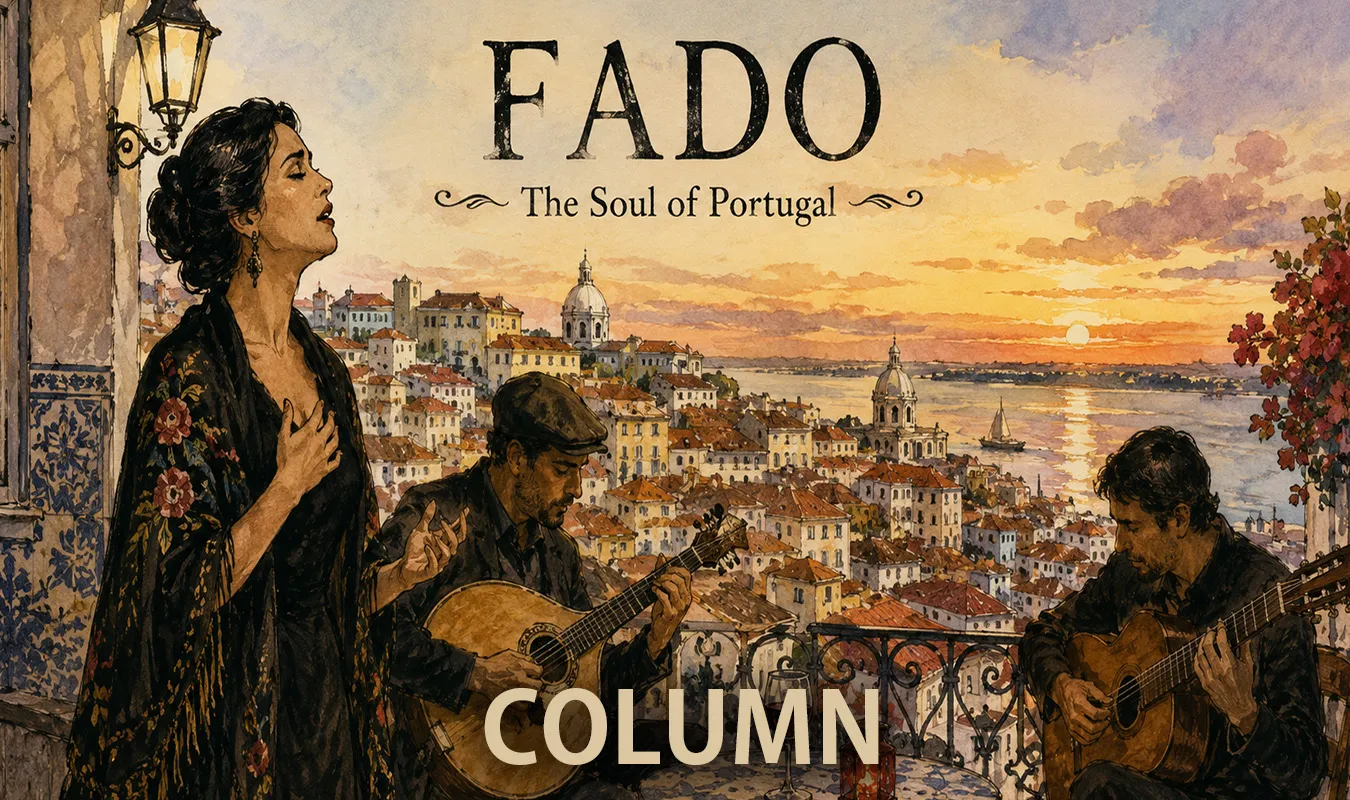
The Portuguese guitar is known as the instrument that symbolizes fado.
This instrument, with its teardrop-shaped body and 12-string structure, has a different sound from typical classical guitars.
It is characterized by the sharpness and lingering sound of the metal strings, giving the melody a unique melancholy.
Normally, a fado performance is organized as follows.
- Fadista (singer)
- portuguese guitar
- Viola (classical guitar accompaniment)
In some cases, a bass guitar may also be added.
Excessive arrangements are not preferred in fado performances.
Rather, the emphasis is on “pause” and “silence.”
There is a culture in which the audience refrains from speaking privately during performances, creating an atmosphere in which the entire store is focused on the song.
This sense of tension is very different from club music or rock concerts.
Fado is music that shares emotions throughout the space.
Improvisation and lyrics
Although Fado has a formal structure, it has a strong sense of improvisation in its emotional expression.
The tempo, intonation, and pauses vary greatly depending on the singer.
Also, the lyrics have a high degree of perfection as poetry.
It has a deep relationship with Portuguese literature, and from the 20th century onwards, the works of famous poets were increasingly used as lyrics.
Fado was both folk music and a culture of urban poetry.
In a Fado performance space, emotional density takes precedence over flashiness.
Fado has functioned more as a “space to sink into one’s emotions” than as “music to listen to.”
The legend of Maria Severa
First Fadista
Maria Severa is an indispensable figure when talking about the history of Fado.
She is said to have existed in the first half of the 19th century, and is often referred to as the “first Fadista.”
She is said to have been both a prostitute and a singer, and became a symbol of Lisbon’s downtown culture.
Records regarding Severa are limited, and there are many myths about him in later years.
However, what is important is that she played a decisive role in forming the image of ““Fado = urban lower culture.’’
Love, tragedy, and a short life.
Its narrative nature became strongly connected to the “fatefulness” of fado.
In the 20th century, the statue of Severa was reproduced in movies and plays, and it was positioned as the origin of Fado culture.
Female singers and fado
Female singers have a very strong presence in fado.
This is no mere coincidence.
This is because the emotional expressions of those who wait, those who lose, and those who continue to hold on to love have been strongly visualized by female singers.
Of course, there are many male singers, but Fado’s global image has long been represented by the voices of female singers.
Severa exists on the border between historical fact and legend.
However, it was this ambiguity that strengthened the mystique of fado music.
Globalization with Amalia Rodriguez
The arrival of the “Queen of Fado”
At the turn of the 20th century, Amalia Rodríguez was the person who helped push Fado into international music.
Born in 1920, she is said to have grown up in a poor environment from an early age.
Since the 1940s, he has become a representative figure in the fado world with his overwhelming singing ability and presence.
Amalia’s achievements go beyond simple popularity.
Fado, which had previously been seen as a part of downtown culture, was redefined as art.
While preserving traditional fado, she enhanced her poetic expression and stage artistry.
They also actively performed overseas and received high acclaim in Europe, South America, and Japan.
Through her, Fado changes from a ““Portuguese domestic folk song” to a ““global cultural expression.”
Relationship with the Salazar regime
On the other hand, Amalia’s relationship with politics was complicated.
Portugal in the mid-20th century was under the Salazar dictatorship.
The regime used Fado as a “national culture” and treated it as a symbol of conservative values.
For this reason, after democratization, some people criticized Fado as the music of the dictatorship.
However, in reality, Fado culture as a whole was not simply supportive of the regime.
Amalia herself has had her relationships with left-wing intellectuals and anti-establishment positions reevaluated in later years.
In other words, although fado was used by the state, it was a complex culture that could not be explained by that alone.
Amalia is more than just a star.
Due to her presence, Fado transformed into an ““emotional culture exported to the world.’’
Dictatorship, Revolution, and Silence
The Eve of the Carnation Revolution
In the early 1970s, Portuguese society was undergoing major turmoil.
Long-term dictatorship, colonial wars, and economic stagnation.
As social unrest increases, youth culture leans toward new music.
Rock, protest songs, foreign pop.
As a result, some people began to distance themselves from Fado as ““the music of the old system.’’
In 1974, the dictatorship collapsed with the Carnation Revolution.
Portuguese society has undergone major changes due to democratization.
However, immediately after the revolution, Fado’s presence temporarily weakened.
This is because it was not seen as music that symbolized a new era.
The road to reevaluation
However, since the 1980s, the situation has changed again.
Fado began to be reevaluated as a music that recorded the history of Portuguese society itself, rather than just a part of the culture of the regime.
The younger generation of singers seeks new expressions while maintaining tradition.
From here, the flow of modern Fado was formed.
The revolution did not erase fado.
Rather, Fado resurfaced as an opportunity to reconsider “what constitutes Portuguese culture.”
Modern fado reproduction
Generations after Mariza
From the late 1990s to the 2000s, Fado once again attracted worldwide attention.
One of the central characters was Marisa.
Born in Mozambique, she inherited traditional fado while incorporating modern stage expression.
Black costumes, powerful singing, and a large hall performance.
Fado is being redefined as an ongoing art form, rather than “traditional music for tourists.”
In addition, singers with diverse styles such as Ana Moura and Carminho appeared.
As it became closer to jazz, pop, and Brazilian music, fado ceased to be a closed genre.
UNESCO Intangible Cultural Heritage
In 2011, Fado was registered as a UNESCO Intangible Cultural Heritage.
This is not just a tourist resource certification.
This means that Fado has been internationally recognized as a culture that inherits the memories and emotions of urban communities.
In Lisbon, there is still a performance space called ““Casa di Fado’’ where many singers continue to sing every night.
Modern fado is not just about preservation.
Fado continues to exist as a ““living culture’’ by continuing to renew itself while retaining its past.
Fado and literature
Portugal, the country of poetry
Poetry occupies a very important place in Portuguese culture.
Many poets, including Fernando Pessoa, shaped Portuguese culture in the 20th century.
Fado also has strong ties to poetry.
The lyrics incorporate symbolism, allusion, religiosity, and urban landscapes.
Rather than being simple love songs, they often include philosophical questions about how to perceive life.
The sound of Portuguese itself is also important.
The flow of vowels, the lingering sound at the end of words, the soft consonants.
The emotional expression of Fado is closely related to the acoustic characteristics of Portuguese.
Night culture
Fado is not daytime music.
A bar at night, quiet seating, dim lighting.
Demonstrate maximum strength in such an environment.
At night in Lisbon’s old town, not only tourists but also locals head to the fado houses.
There, people not only listen to music, but also share ““city time’’ itself.
Fado is not only music, but also a poetic culture in Portuguese.
Therefore, there is a layer of emotion that cannot be fully reproduced through translation.
Tourism and authenticity
To a world-class tourism resource
In the 21st century, Lisbon has become one of Europe’s leading tourist cities.
Among these, Fado functions as an important tourist content.
Commercialization has also progressed, with fado shows attached to restaurants, short performances for tourists, and collaboration with cruise tours.
There is also criticism that ““the original Fado spirit is lost’’.
However, on the other hand, the reality is that tourism has helped maintain performance spaces, allowing many young singers to continue their careers.
In other words, modern fado continues to strike a balance between “preservation” and “commercialization.”
Tradition is not fixed
To begin with, Fado itself was a music that was formed amidst urban changes.
African culture, Brazilian culture, port culture, popular culture.
Considering the history of absorbing these things, it is impossible to understand them from the viewpoint of only looking for “pure prototypes.”
Fado is a culture that is passed down through changes.
Fado is not a relic of the past.
It continues to sing “Saudade” even though its appearance changes with the changes in the city.
Influence on world music
After World Music
After the 1980s, as the market concept of “world music” was formed, fado received an international reappraisal.
In Europe and Japan, there was a strong tendency for it to be perceived as “quiet emotional music.”
It is also frequently compared to Argentine tango.
This is because both were born out of port town culture, have a background in lower urban culture, and share a strong sense of nostalgia.
Furthermore, in modern times, there are increasing connections with ambient, jazz, chamber music, and contemporary music.
Movies and Fado
Fado also goes well with film music.
The unique atmosphere of fado has become widely known as it has been used not only in Portuguese films but also in international films.
When combined with visual works, fado functions not just as ““sad music,” but as ““music that makes you feel the passage of time.”
Although Fado is a local music, it has gained emotional resonance in many parts of the world.
This may be because the ““feelings of what is lost’’ are shared across borders.
Chronology
Major chronology of Fado history
| Years | Events |
|---|---|
| 15th-16th century | Portuguese Age of Discovery |
| Late 18th century | Formation of downtown Lisbon culture |
| First half of the 19th century | Early fado established |
| Around 1820 | Birth of Maria Severa |
| Late 19th century | Fado expanded as urban popular culture |
| 1920 | Amalia Rodriguez is born |
| 1940s | Amalia gains national popularity |
| 1960s | Expansion of international performances |
| 1974 | Carnation Revolution |
| 1980s | Reappraisal of Fado |
| 1990s | A new generation of fadistas appears |
| 2011 | Registered as UNESCO Intangible Cultural Heritage |
The history of Fado overlaps with changes in Portuguese society itself.
That’s why Fado is talked about as a ““cultural history’’ that goes beyond a mere musical genre.
Why is Fado still needed?
Music that doesn’t rush emotions
In modern society, the speed of music consumption has become extremely rapid.
Short videos, snippets of hits, and algorithmic recommendations.
Among them, Fado is a very “slow music”.
Don’t resolve your feelings immediately.
Don’t just provide excitement.
Rather, they accept the contradictions and sense of loss that humans face as they are.
That is why it continues to have a certain level of support even today.
Universality of Saudade
In a globalized world, people continue to move.
Migration, tourism, urbanization and digitalization.
As a result, an increasing number of people are experiencing a feeling of not fully belonging anywhere.
Saudade connects with exactly these feelings.
People I can’t meet.
A place of no return.
lost time.
Fado does not deny these things and continues to sing quietly.
Fado is not just music for nostalgic memories of the past.
By affirming “the feeling of living with loss,” it is deeply connected to modern times.
At the end
From a port town to the world
Fado didn’t start out as a huge industry.
It was small urban music sung in bars in port towns.
However, there was a condensation of emotions that humans cannot avoid.
separation.
destiny.
love.
A ship that never returns.
irreversibility of time.
That’s why Fado resonates across borders.
Globalization, post-revolutionary reappraisal, and renewal by the modern generation by Amalia Rodríguez.
Its history shows that “tradition is something that continues to change.”
Even now, at night in Lisbon, the sound of singing echoes in some Casa di Fado.
Both tourists and locals listen quietly.
Fado is not music that makes a loud statement.
However, it quietly penetrates deep into human emotions.
It is not only the history of the country of Portugal, but also the memory of the people themselves.
Fado is not ““music of sadness,’’ but is still sung as a culture for living with sadness.