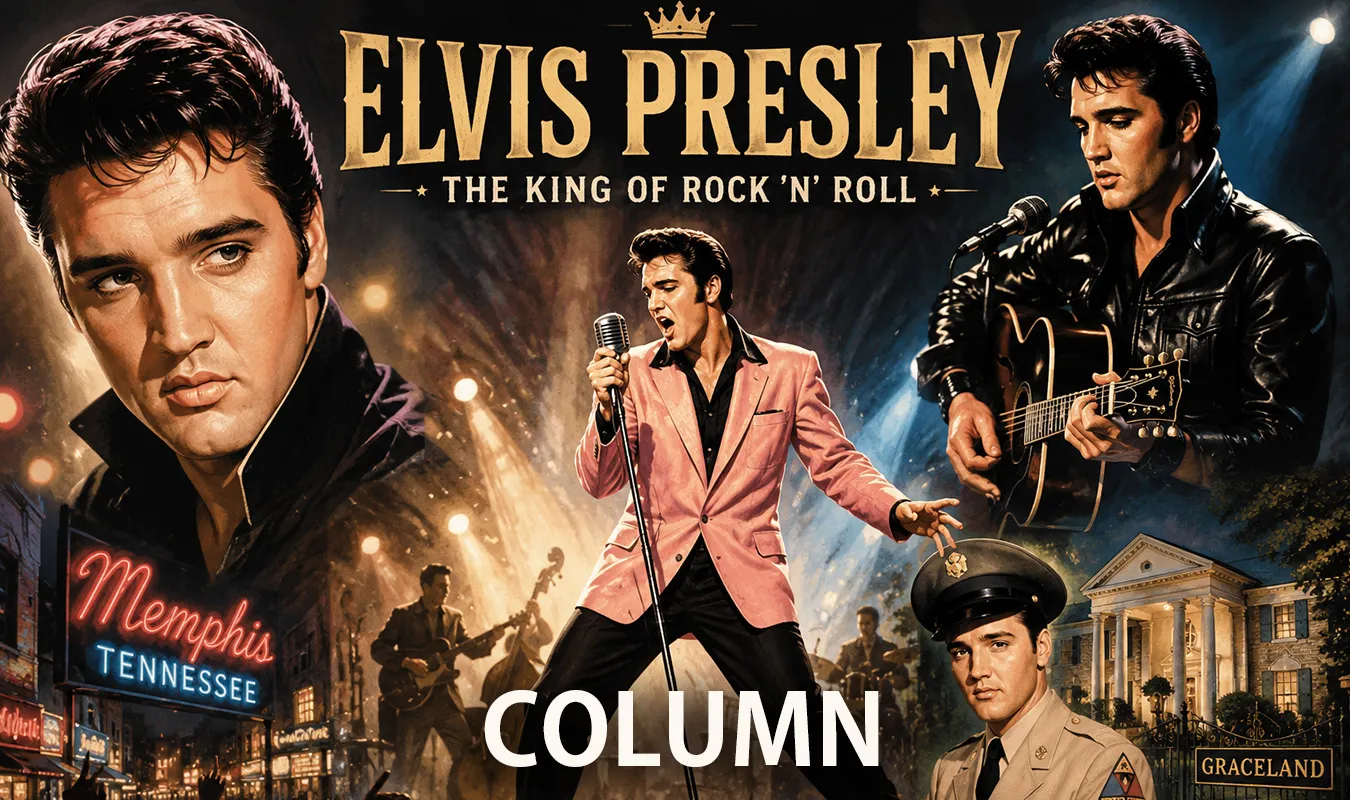
[Column] Elvis Presley: The birth of rock and roll and the biggest star of the 20th century
Column en Music History Rock Rock n Roll
Introduction
Text: mmr|Theme: Tracing the life and achievements of Elvis Presley, who fused gospel, blues, and country and spread rock”n”roll to the world.
When discussing the history of 20th century popular music, there are certain names that cannot be avoided.
Elvis Presley.
Known as the “King of Rock and Roll,” he was more than just a popular singer.
The America in which he appeared in the 1950s was a society with clear boundaries between races, cultures, and generations.
At a time like this, a young white man from the South boldly incorporated the influence of black music, fused it with country and gospel, and presented it to the world as a completely new music.
The impact is not limited to the music industry.
It changed fashion, movies, television, youth culture, and even pop culture itself around the world.
Elvis wasn’t the only person who created rock and roll.
But he was the man who turned rock”n”roll into a worldwide phenomenon.
In this article, we will re-examine Elvis Presley’s influence while tracing his life and musical achievements along with the historical background.
The story of Elvis is not just the success story of one star, but also the cultural history of the 20th century.
Young Elvis and Southern America
January 8, 1935.
Elvis Aaron Presley was born in Tupelo, Mississippi.
The family was never wealthy.
His father, Vernon Presley, had many regular jobs, while his mother, Gladys, supported the household while raising her son.
Elvis was born as a twin, but his older brother Jesse was stillborn.
As a result, he essentially grew up as an only child.
From an early age, he attended church and became familiar with gospel music.
This experience greatly influenced his later singing style.
On the other hand, he was also absorbing country and blues music through the radio.
In the American South, black and white music existed geographically close to each other.
However, they were socially divided.
Elvis was one of the few young people who naturally crossed that line.
In 1948, the family moved to Memphis, Tennessee.
This migration would greatly change later history.
Memphis was a city where blues and country intersected.
It was the ideal musical environment for young Elvis.
Later rock and roll was born from the diverse musical experiences he absorbed as a boy.
Fateful encounter with Sun Records
1953.
Elvis, now 18, visits Sun Studios in Memphis.
He paid a few dollars and recorded an acetate record as a present for his mother.
This action will change your life.
Sam Phillips, who ran Sun Records, had been looking for a ““white singer with a black musical sensibility’’ for some time.
Elvis was close to exactly that condition.
In 1954, he did a recording session with guitarist Scotty Moore and bassist Bill Black.
Arthur Crudup”s blues song ““That”s All Right,’’ played during the break, received a great response.
History begins from here.
The song that was played on the radio quickly became a hot topic.
The audience could not tell whether the person singing was white or black.
He had a different sensibility from traditional white singers.
From 1954 to 1955, he toured extensively in the South.
At the live venue, young people were starting to get excited.
The Sun Records era was a time when Elvis discovered his own musical language.
Rock”n”roll explosion moment
End of 1955.
Elvis signs a contract with major label RCA.
From here, run up the stairs to the star.
“Heartbreak Hotel”, released in 1956, reached number one in the United States.
The following songs, ““Hound Dog” and ““Don’t Be Cruel,” also became big hits.
At the time, the youth music market was rapidly expanding in America.
Elvis becomes a symbol of this.
However, his popularity cannot be explained by music alone.
The intense hip movements he showed on TV.
Unique hairstyle.
A performance that can be called provocative.
Conservative adults strongly objected.
Meanwhile, young people were enthusiastic.
Some TV stations even took measures to not show people from the waist down.
That’s how much he shook up the values of his time.
The arrival of Elvis was more than a revolution in youth culture than music.
Success as a movie star
From 1956 onwards, Hollywood also took notice of Elvis.
Her first film, Love Me Tender, was a commercial success.
From then on, he appeared in many films until the early 1960s.
Representative works include the following.
- Love Me Tender
- Jailhouse Rock *King Creole *Blue Hawaii
- Viva Las Vegas
In particular, the dance scene in ““Jailhouse Rock’’ is still talked about as a famous scene in rock history.
The movie further expanded Elvis’ popularity.
It has spread not only to music fans but also to the general public.
However, his film-centered activities were also criticized.
This is because many of the works have become similar in content and the musical challenge has decreased.
Although his success as a movie star was huge, it also led to stagnation as a musician.
Military life and changing times
1958.
At the height of his popularity, Elvis enlists in the U.S. Army.
The fact that he served as a regular soldier despite being a star became a hot topic.
While stationed in Germany, he met his future wife, Priscilla.
Discharged in 1960.
After returning to Japan, the single “It’s Now or Never” became a huge hit.
But the music world was changing.
In the early 1960s, a new generation of artists emerged.
In particular, the Beatles, who emerged from England, took the world by storm.
Rock begins to evolve in more diverse directions.
Although Elvis remained popular, he was gradually drifting away from the center of the era.
Military life marked a break in Elvis’ life, and the music scene was heading into a new era.
1968 Comeback Special
Late 1960s.
Elvis’ career was stagnant.
While his film appearances continued, his musical reputation was declining.
A TV special in 1968 completely changed that situation.
Commonly known as ““68 Comeback Special.’’
Elvis, dressed in black leather, sings in front of a small audience.
His appearance reminded me of the rebels of the 1950s.
He’s not a flashy movie star.
He was a pure rock”n”roll singer.
The program becomes a huge success.
Many critics consider this special to be one of the biggest comebacks of his career.
The 1968 revival marked a turning point for Elvis to be recognized as a musician again.
Las Vegas era
1970s.
Elvis mainly performs in Las Vegas.
Luxurious jumpsuit.
Large band.
huge stage.
The former rock”n”roll youth had become the king of entertainment.
In 1973, ““Aloha from Hawaii’’ was broadcast by satellite to countries around the world.
This is said to be one of the first large-scale global music broadcasts in history.
Live performances still received high praise.
However, problems increase in his personal life.
Deterioration of health.
Dependence on prescription drugs.
The emotional burden of divorce.
These problems gradually became more serious.
The Las Vegas years were a time of immense success and personal struggle.
Last days and sudden death
August 16, 1977.
Elvis died at his home, Graceland, in Memphis, Tennessee.
He was 42 years old.
Shock runs throughout the world.
Tens of thousands of fans gathered to pay their respects.
Even after his death, his popularity did not decline.
Albums continue to sell.
Video works will also be reevaluated.
New generations of fans continued to emerge.
Many stars are forgotten over time.
But Elvis was an exception.
He became a mythical figure.
His death in 1977 was not the end, but the beginning of a legend.
What Elvis left behind in music history
Elvis didn’t invent rock and roll.
However, as a popularizer he was unparalleled.
There are many elements that he bridged.
There are countless artists who say they have been influenced by him.
- the beatles
- Rolling Stones
- Bob Dylan *Bruce Springsteen *U2 *Many contemporary artists
Without him, pop music would likely look very different today.
Elvis was the person who established the very concept of a rock star in the world.
Chronology
| Year | Events |
|---|---|
| 1935 | Born in Tupelo, Mississippi |
| 1948 | Move to Memphis |
| 1953 | First recording at Sun Studio |
| 1954 | That’s All Right Announcement |
| 1955 | RCA contract |
| 1956 | Heartbreak Hotel No. 1 in America |
| 1958 | Enlisted in the U.S. Army |
| 1960 | Discharge |
| 1968 | Comeback Special |
| 1969 | Las Vegas performance begins |
| 1973 | Aloha from Hawaii |
| 1977 | Passed away |
Why is Elvis still talked about?
Despite being an artist born over 90 years ago, Elvis is still talked about all over the world.
It’s not just because they had a lot of hit songs.
He crossed musical boundaries.
It transcended racial barriers.
It transcended generational barriers.
Through music, he presented the values of a new era.
Rock and roll wasn’t just a music genre.
It was a symbol of freedom and change.
At the center of this was Elvis Presley.
Elvis’ legacy lies not only in his songs, but in the power of music to change culture.