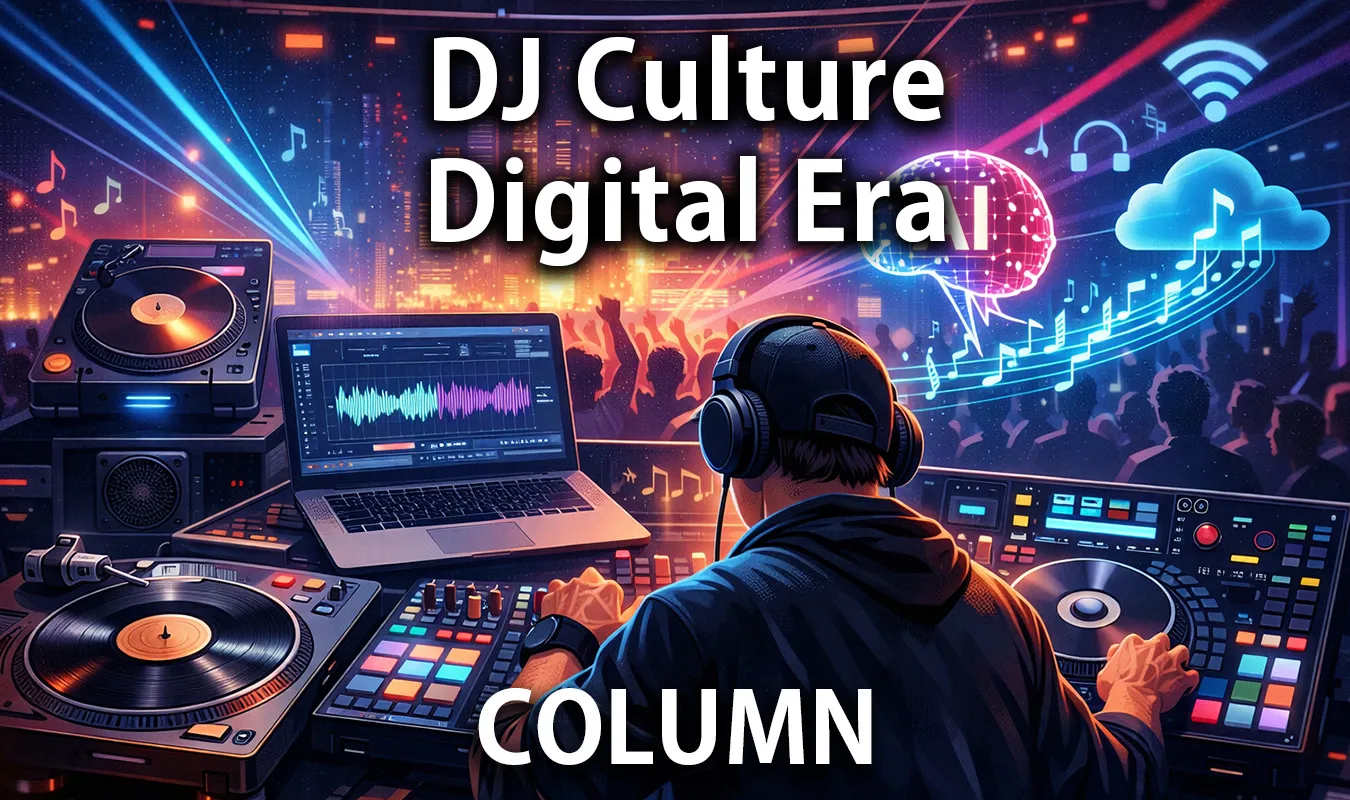
[Column] Digitalization of DJ culture: From turntables to algorithms

Column en Culture DJ Digital
[Column] Digitalization of DJ culture: From turntables to algorithms

Prologue: When the needle and the beat ruled

Text: mmr|Theme: The history of the evolution of DJ culture, where the physicality of analog and the efficiency of digital intersect, redefining the meaning of the act of selecting music.

DJ culture is a culture born from extremely physical constraints. Born in the Bronx, New York in the 1970s, hip-hop was established as a practice of reconstructing existing music. DJs like Grandmaster Flash were at the center of this.

Using two turntables and a mixer, they extended the groove for the dancers by looping certain breaks on the record. The important thing here is that this operation was completely manual. Matching the tempo required the use of ears and fingertips, and any discrepancies had an immediate effect on the floor.

Furthermore, records were not just a sound source, but also cultural capital. A DJ’s personality was determined by which records he owned and which parts of each record he knew. Relationships with record shops and distributors were also important, and information and physical distribution were closely intertwined.

DJs of this era were not ““those who reproduce sound” but ““those who cut out and reconstruct time.” Music was beginning to be treated as editable material rather than something that flowed linearly.

Physicality honed within constraints formed the basis of DJ culture


Maturation of analog technology and expansion of club culture

From the 1980s to the early 1990s, DJ technology and club culture rapidly developed. House and techno were born in Chicago and Detroit, and DJs changed from being mere party organizers to being the ones determining the direction of music.

During this period, turntable technology was further refined and advanced techniques such as scratching, transformers, and juggling were established. These were developed in the context of hip-hop, but also influenced club music.

At the same time, the club space itself evolved. Elements such as large sound systems, lighting and long sets are integrated, and the DJ becomes responsible for building the narrative throughout the night.

At this stage, analog music was still the mainstream, and there were physical constraints such as the weight of records and the cost of transporting them. However, they were also factors that encouraged careful selection of songs and made the DJ’s style stand out.

Restrictions were an inconvenience, but at the same time they were a device for creating style.


The advent of CDJs: the first wave of digitalization

In the late 1990s, DJ culture underwent its first major digital transformation. The CDJ, developed by Pioneer DJ, is a piece of equipment that aims to reproduce the feel of a turntable while using digital media called CDs.

The appearance of the CDJ-1000 was symbolic, allowing operations that were difficult to achieve with analogue devices, such as scratching with the jog wheel, setting cue points, and looping. This allows DJs to play with greater precision and repeatability.

In addition, the CD medium was lighter than records, making it easier to transport. This allows DJs to carry more songs with them, giving them more freedom in their sets.

On the other hand, there were also criticisms regarding the sound quality and operation feel, and not all DJs made the switch immediately. However, as CDJs became standardized as club equipment, their widespread use became decisive.

Digital has gradually rewritten the standard in the field due to its convenience.


File-based DJ and software revolution

In the 2000s, music became more digital. With the spread of music files such as MP3, sound sources have begun to be completely separated from physical media. Symbolizing this change is the emergence of DJ software such as Serato DJ and Traktor.

These software integrate functions such as sound source management, waveform display, beat analysis, and effect processing, centralizing the DJ’s work. Of particular importance was the Digital Vinyl System (DVS), which made it possible to operate digital sound sources while using a traditional turntable.

Waveform displays introduced a visual element to the DJ’s work. Beat matching, which previously relied only on the ears, can now be checked on the screen, improving accuracy and speed. On the other hand, some argue that this has led to a relative decline in the importance of ““techniques for adjusting by ear.’’

Additionally, the method of obtaining sound sources has also changed. With the spread of online stores, it has become possible to instantly purchase and download music from all over the world, greatly easing regional restrictions.

Music has changed from physical objects to data, and the working environment of DJs has been fundamentally restructured.


Controller culture and interface transformation

As software evolves, dedicated MIDI controllers appear. This gives DJs a new interface that doesn’t rely on traditional turntables.

Using pads to trigger samples, complex effects operations, and loop subdivisions, the controller has changed from a device used to ““play” songs to an instrument used to ““manipulate” songs. This change blurred the line between DJing and live performance.

Furthermore, it will become easier to operate multiple decks at the same time, and methods such as mashups and real-time remixes will become commonplace. DJs have evolved into people who combine existing songs and create new structures on the spot.

At this stage, the role of the DJ has clearly changed. He has become more than just a music selector, he has become a performer who edits music in real time.

Changes in the interface changed the way we handle music itself.


Streaming Era: An Endless Catalog

In the late 2010s, the center of music consumption shifted to streaming. Services such as Spotify and Beatport have also influenced DJs’ sound source management.

Some DJ software now integrates with streaming, allowing you to play songs without having to store them locally. This will give DJs access to a catalog of tens of millions of songs.

However, this convenience also created new challenges. These include dependence on internet connectivity, audio quality issues, and licensing restrictions. In addition, the endless options also made it more difficult to choose songs.

In the past, the optimal selection of songs was made from a limited number of records, but now it is necessary to decide ““what not to select’’ from a huge number of songs.

Infinite options have made the act of selecting music even more meaningful.


AI and automation: the future of music selection

In the 2020s, AI technology is starting to have an impact on DJ culture. Automatic beat matching and key analysis have already become standard features, making it possible for even beginners to mix with a certain level of quality.

Furthermore, AI-based song recommendations and playlist generation are changing the song selection process itself. Algorithms suggest optimal songs based on vast amounts of data, but these are only statistical optimal solutions.

In the space of a club, non-numerical elements such as audience reaction and atmosphere are important, and it is difficult to completely reproduce these with an algorithm.

Therefore, AI is not positioned as a replacement for DJs, but as a supporting tool. The final decision is still left to humans.

As technology evolves, the value of human intuition increases relatively.


Timeline: Digitalization of DJ culture

timeline title DJカルチャーの進化 1970s : ヒップホップDJ誕生 1980s : ターンテーブル技術の高度化 1990s : CDJの普及開始 2000s : DVSとDJソフトウェアの登場 2010s : コントローラーとストリーミングの統合 2020s : AIと自動化の進展

Structural diagram: Changes in technology layers

flowchart LR A[analog record] --> B[CD] B --> C[digital file] C --> D[cloud] D --> E[AI recommendation]

Conclusion: DJing as an art of choice

The digitalization of DJ culture is not just a technological advance, but also a change in the relationship with music. Freed from physical constraints, DJs now have more freedom than ever before.

But that freedom also comes with responsibility. What to choose from the infinite options and how to arrange them? That judgment is what determines the value of a DJ.

In the past, the selection of record bags was naturally limited by physical constraints. Now, that restriction has disappeared, but the importance of choice has actually increased.

A DJ is not someone who plays music, but someone who edits time and space. That essence remains unchanged even in the digital age.

What remains after digitalization is the artistry of the act of selection itself.


Monumental Movement Records

Monumental Movement Records