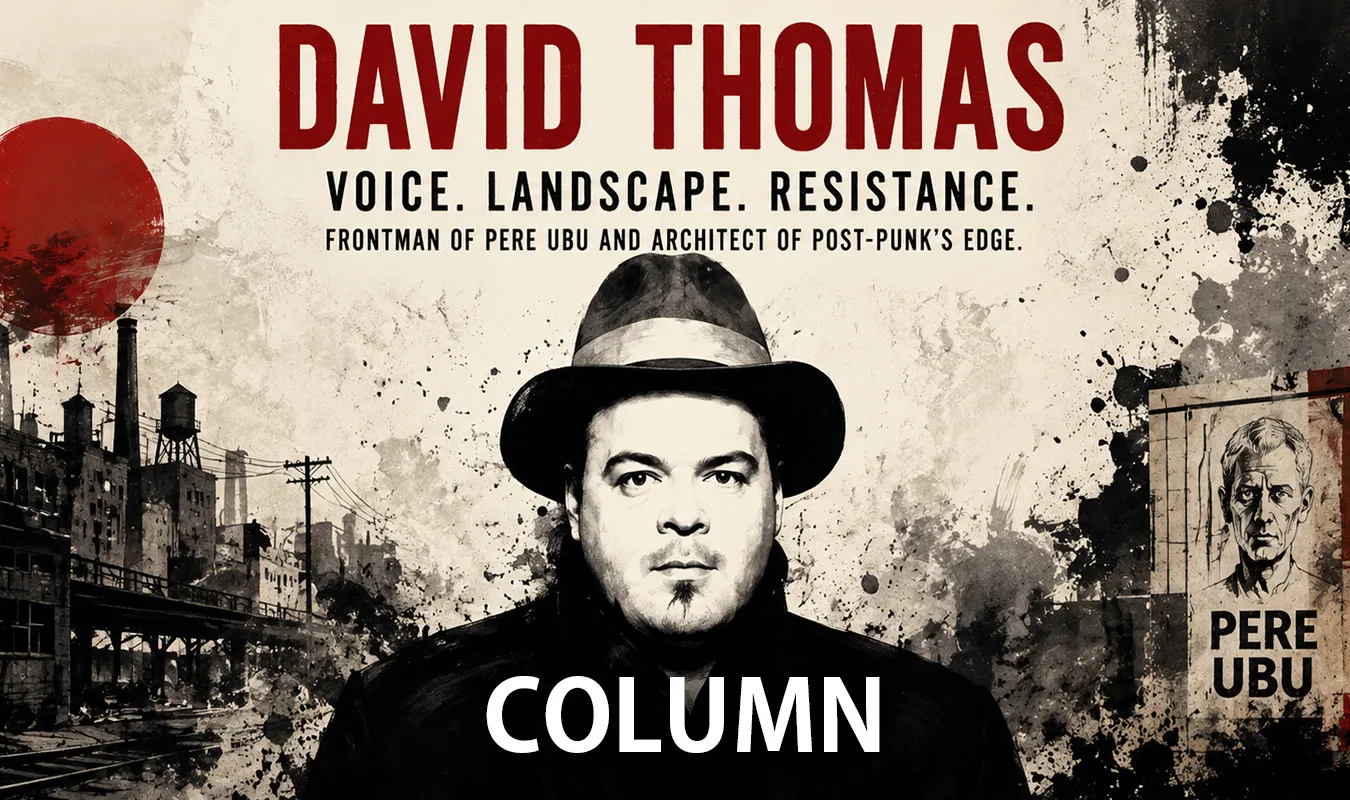
[Column] David Thomas and the horizon of post-punk: The moment when the voice becomes a landscape

Column en Avant-Garde Post-Punk
[Column] David Thomas and the horizon of post-punk: The moment when the voice becomes a landscape

Prologue: Another rock opened by a strange voice

Text: mmr|Theme: Expansion of voices and the formation of urban imagination in post-punk

An existence that turns the premise of rock “singing” upside down

In rock, the ““voice”’ has often been treated as a medium to carry melody. However, the arrival of David Thomas quietly but decisively undermined that assumption. His voice isn”t beautiful or even. Rather, he is unstable, sometimes shouting, sometimes muttering, and sometimes speaking. That ambiguous line is the core of his music.

In the late 1970s, his music was formed in the desolate landscape of the industrial city of Cleveland, Ohio, USA. The sound was not just an extension of punk, but an ““environment itself’’ that absorbed the noise of the city, the fatigue of work, and fragments of culture.

Pere Ubu, which he led, was more than just a band, it functioned as a ideological device. There, music existed not as a story but as a landscape.

By deviating from the common sense of rock, they were an existence that expanded the possibilities of rock.


Childhood and Formation: The Sound Space of Cleveland

Distorted sensibilities created by industrial cities

David Thomas was born in America in 1953. He grew up in Cleveland, a typical Rust Belt city centered on the steel industry, which was in economic decline in the 1970s. This environment had a decisive influence on his music.

City noise, mechanical sounds, and inorganic landscapes. These later appear as “sound textures” in his works. It is due to this urban experience that his voice functions not just as a song, but as part of the environmental sounds.

In addition to music, he also had a strong interest in literature and movies. Avant-garde literature and experimental film in particular have influenced his structural view of music.

Urban decay and cultural fragments became the raw material for his music.


Rocket from the Tombs: Destructive Origin

Proto-punk underground core

In the mid-1970s, David Thomas joined Rocket from the Tombs. Although this band was short-lived, it had a huge influence on later punk/post-punk.

Although the songs of this period were rough and noisy, they already contained a structural experimental nature. Many of his songs were later re-recorded on Pere Ubu, and there is no doubt that this was the starting point for his music.

What is important is that this band was not just an ““initial form’’, but a piece of already completed thought. His music was “different” from the beginning.

A language of its own was already sprouting within the initial destructive impulses.


Birth of Pere Ubu: The beginning of sonic experimentation

Fusion of noise and structure

In 1975, David Thomas formed Pere Ubu. The band’s name is derived from King Ubu, hinting at their aesthetic at the time.

Their 1978 album, The Modern Dance, is considered a monumental work in post-punk. This album combines synthesizer noise, non-linear structures, and David Thomas’s unconventional vocals to create a sonic space completely different from traditional rock.

What is particularly distinctive is that the music does not move forward. The beat and melody propulsion of normal rock is intentionally dismantled, and instead a collection of fragmented sounds is presented.

graph TD A[cleveland urban environment] --> B[noisy sound] B --> C[Pere Ubu's musical structure] C --> D[The establishment of post-punk]

The attempt to present music as ““existence’’ rather than progression was completed here.


Voice as an instrument: David Thomas’s expression theory

The boundary between singing and storytelling

David Thomas’s greatest feature is his vocal style. His voice is very different from traditional singing, but rather falls somewhere between “talking” and “screaming”.

This style functions as a means of presenting a situation or landscape rather than a direct expression of emotion. He creates music by “talking” rather than “singing.”

This approach influenced many later artists. For example, you can see its influence on Mark E. Smith and David Byrne.

Freeing the voice from the melody opened up a new realm of expression.


Solo career and expansion: Beyond musical horizons

Introducing theatricality and storytelling

From the 1980s onwards, David Thomas began his solo career in earnest. His works become more narrative-oriented and feature dramatic elements.

Of particular note is the relationship between music and text. In his works, lyrics are not just an auxiliary element, but are treated as structural elements on a par with the music.

He also took a unique approach to live performance. The stage is not just a place for performances, but a space in which the story unfolds.

Beyond music, it expanded into a comprehensive form of expression.


Chronology: David Thomas’ journey

timeline 1970 : Rocket from the Tombs 結成 1975 : Pere Ubu 結成 1978 : The Modern Dance 発表 1980 : ソロ活動開始 1990 : Pere Ubu 再始動 2000 : 継続的な作品発表とツアー

Influence and recognition: the core of post-punk

The future indicated by “difficulty”

David Thomas and Pere Ubu’s music is often described as ““difficult’’. However, this difficulty was not just a sign of experimentation, but also an indication of new musical possibilities.

Their influence extends beyond post-punk to industrial, noise, and even contemporary music.

Although his music has distanced itself from commercial success, it has certainly continued to have an underground influence.

Music that is difficult to understand will become the language of the next era.


Conclusion: Music as landscape

What David Thomas leaves behind

David Thomas’ music is more than just a collection of works. It is a ““landscape’’ where cities, cultures, and individual experiences intersect.

He dismantled the framework of rock and took music to a new dimension. His influence continues to this day, and his efforts are by no means a thing of the past.

He continued to show that music is not just entertainment, but a medium that stimulates thought and the senses.

He was the person who changed music from ““something to listen to” to ““a space to feel.”


Monumental Movement Records

Monumental Movement Records