[Column] Why Bedroom Pop changed youth culture

Column en DIY Indie Pop Youth Culture
[Column] Why Bedroom Pop changed youth culture

Why Bedroom Pop changed young people around the world

Text: mmr|Theme: From home recording to worldwide distribution. Tracing how Bedroom Pop changed the sensibilities, creativity, solitude, and community of the SNS generation

DIY music culture before Bedroom Pop

Bedroom Pop didn’t just appear out of nowhere.

Its roots lie in 1970s DIY punk, 1980s cassette culture, and 1990s lo-fi indie.

For example, in the American indie scene, home recording using 4-track MTR was widely practiced. The concept of lo-fi itself does not negate the roughness of recording quality, but rather is born out of a sense of affirming its ““rawness’’.

In the late 1980s, underground networks through cassette tapes also expanded. Artists exchanged works by mail, and a small community was formed.

In the 1990s, the Internet gradually began to spread, giving rise to personal sites and an MP3 sharing culture. What is important here is that music distribution has gradually begun to move away from a centralized structure.

Furthermore, in the 2000s, low-priced DAWs such as Apple’s GarageBand became popular with general users. This has made it possible for young people without a professional studio to record, edit, and publish their work by themselves.

Bedroom Pop was established against this long history of DIY culture.

timeline title DIY音楽文化の流れ 1970s : DIYパンク 1980s : カセット文化 1990s : ローファイ・インディ 2000s : DAW普及 2010s : SoundCloud世代 2020s : TikTok時代

An era when the values ​​of home recording changed

In the past, home recording was often seen as a ““budget-strapped alternative.’’ However, in the late 2010s, these values ​​began to reverse.

Noise, environmental sounds, breathing, small recording mistakes.

These elements came to be seen as ““realism” rather than ““unfinished.”

Young people began to seek an atmosphere that was closer to their daily lives than highly polished, perfect sounds.

DIY culture, which existed before Bedroom Pop, has been expanded to a global scale by the digital age.


Music distribution changed by SoundCloud and YouTube

One of the biggest factors that pushed Bedroom Pop to global scale was the existence of SoundCloud and YouTube.

In the traditional music industry, there were many hurdles such as label contracts, distribution, radio, and music magazines. However, in the 2010s, an environment began to develop in which individuals could connect directly to listeners.

SoundCloud was a symbol of that.

Speed ​​over perfection.

Personality over professional quality.

The ease of uploading allowed young artists to create a “culture of instantly publishing their work.”

The same goes for YouTube.

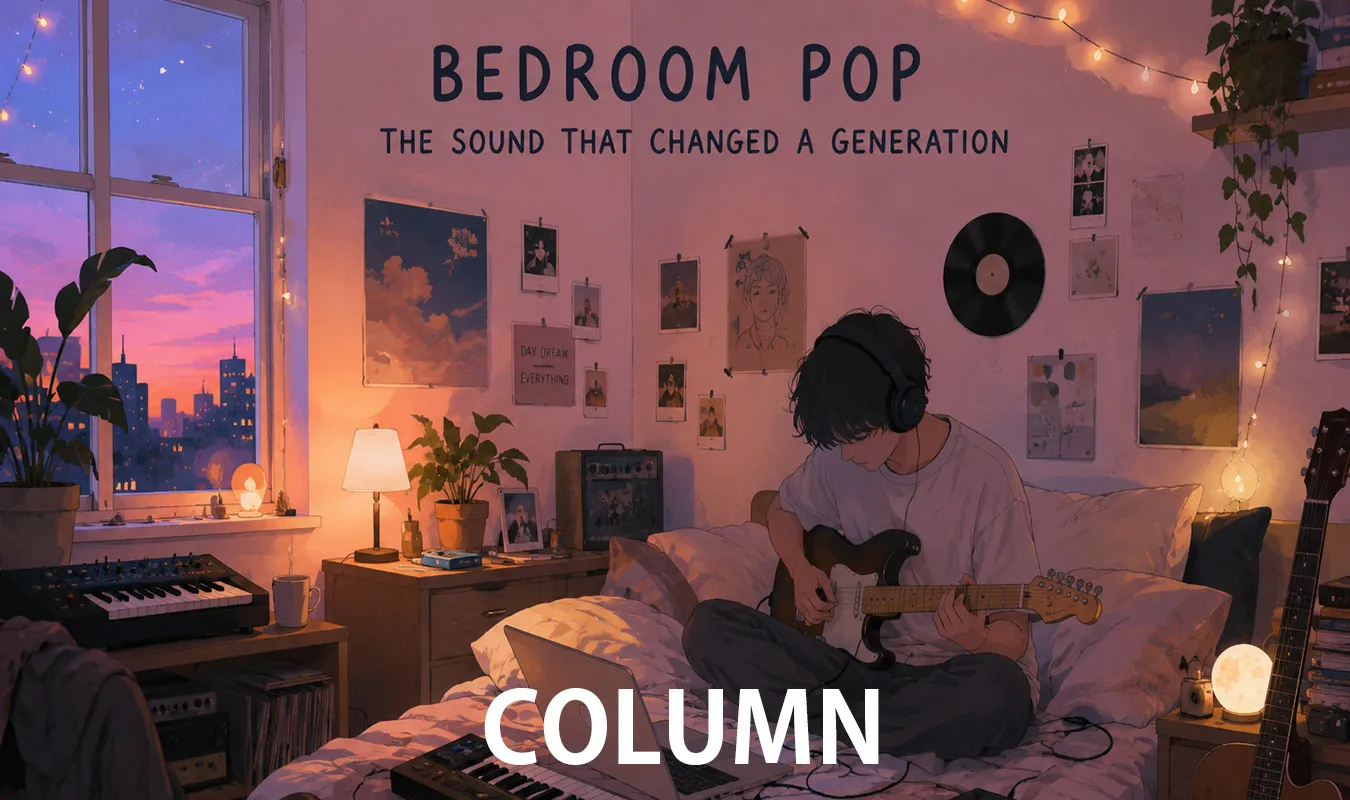
Particularly in Bedroom Pop, not only the music but also the ““room itself’’ became an important part of the production.

dark lighting.

A messy desk.

cheap furniture.

Guitar next to the bed.

Such images created a far more intimate feeling than a huge studio space.

The conventional star system was based on a “sense of distance.”

However, Bedroom Pop, on the contrary, placed value on ““proximity.’’

flowchart TD A[record company] --> B[distribution] B --> C[media] C --> D[listener] E[Bedroom Pop Artist] --> F[SoundCloud] E --> G[YouTube] F --> H[SNS sharing] G --> H H --> I[listeners around the world]

Compatibility with the viral era

Bedroom Pop was also extremely compatible with short-form video culture.

A quiet intro.

emotional vocals.

Chord progression that is easy to loop.

Lo-fi texture.

These were easy to spread on TikTok and Instagram Reels.

Particularly around 2020, fragments of Bedroom Pop songs will become memes and be mass-consumed as background music for youth culture.

Instead of ““listening to a song in its entirety”, a new form of consumption was born, in which ““you listen to a song as part of your emotions”.

Bedroom Pop was the earliest form of youth music culture optimized for the digital era.


Why “unfinishedness” was supported

Bedroom Pop’s biggest feature is its “unfinished atmosphere.”

Traditionally, pop music has focused on noise reduction, pitch correction, and precise mixing. However, in Bedroom Pop, the rawness was more appealing.

The reason behind this is SNS fatigue.

With the expansion of Instagram culture, many young people now feel pressure to look perfect on a daily basis.

Processed photo.

A staged daily life.

idealized lifestyle.

As a reaction to this visual culture, the ambiguity and weakness of Bedroom Pop gained sympathy.

In particular, the treatment of vocals is symbolic.

Whispering singing.

A voice that seems to disappear.

Emotional expression that avoids excessive shouting.

This was the complete opposite of the traditional image of a rock star.

Bedroom Pop artists were supported not as ““strong beings,” but as ““beings who share the same insecurities.”

pie title Bedroom Popが支持された要因 "親近感" : 35 "SNS疲労への反動" : 25 "DIY精神" : 20 "配信時代との相性" : 20

Lo-fi has become an aesthetic

In Bedroom Pop, the roughness of the recording quality itself functioned as a character.

Small environmental noise.

Microphone distortion.

Sounds of life.

These became “elements that create a sense of presence” rather than “things that should be deleted.”

In other words, Bedroom Pop was a culture that prioritized atmosphere over perfection.

Bedroom Pop has transformed “unfinishedness” into individuality rather than weakness.


Turning point after Billie Eilish

Billie Eilish was the most iconic figure in popularizing Bedroom Pop as a worldwide phenomenon.

His early works, which he produced at home with his brother Finneas, had a different atmosphere from ““pop made in a huge studio.’’

In particular, the bass-heavy mix, whispers, and quiet compositions brought the Bedroom Pop feel to the mainstream.

What is important here is that the information that ““produced in one’s own room’’ itself has become a brand.

In the past, home records were a hidden element.

However, in the late 2010s, the background of ““born in the bedroom’’ became valuable.

This had a strong influence on young people.

No need for expensive equipment.

There is no need for a huge label.

You can start from your own room.

This feeling extends not only to music, but also to video production, distribution, illustration, and fashion.

flowchart TD A[Bedroom production] --> B[SNS spread] B --> C[Empathy formation] C --> D[huge fandom] D --> E[mainstream]

Collapse of boundaries between indie and major

In the Bedroom Pop era, the line between “indie” and “major” became blurred.

This is due to an increase in the number of cases in which songs that go viral on TikTok directly become global hits.

In the past, it took a long time to go from the underground scene to the majors. However, in the age of social media, things can change in a matter of days.

Bedroom Pop symbolized this accelerated distribution of music.

Bedroom Pop has realized the feeling that ““even if you create something in your own room, it can reach the world.’’


The coronavirus pandemic and the explosive expansion of Bedroom Pop

Since 2020, the global pandemic has forced people to stay at home.

During this period, Bedroom Pop went beyond being a mere genre and became strongly connected to the ““atmosphere of the times.’’

Live houses are suspended.

Club culture is also limited.

Going out has also decreased.

For many young people, the music coming from their rooms had a sense of reality.

The closed spaces of Bedroom Pop overlapped with the feeling of living in isolation.

Furthermore, the amount of time people spend on TikTok has increased rapidly, and the spread of music through short videos has accelerated.

Many songs were popularized only in part, and these fragments functioned as emotional sharing devices.

An era of loneliness and empathy

Loneliness is a constant in Bedroom Pop.

Quiet room.

night.

A small voice.

Introspective lyrics.

These strongly resonated with the psychology of young people during the pandemic.

At the same time, however, Bedroom Pop did not affirm loneliness itself.

The important point was that it created the feeling that ““there are people all over the world who suffer from the same loneliness.’’

Through SNS, the feeling of isolation was transformed into a community.

sequenceDiagram participant A as 自室 participant B as SNS participant C as TikTok participant D as リスナー A->>B: 楽曲投稿 B->>C: 拡散 C->>D: 感情共有 D->>A: 共感フィードバック

Due to the coronavirus pandemic, Bedroom Pop has become “the sound of the times.”


Points that changed youth culture itself

Bedroom Pop didn’t just create a new style of music.

It has changed the very values ​​of young people.

Change in image of success

Once upon a time, musical success meant big studios, TV appearances, gigantic gigs, and a lavish lifestyle.

However, in the Bedroom Pop era, the feeling of being able to start from your own room is valued.

Success came to be seen as an ““extended event’’ rather than a distant dream.

Democratization of self-expression

The combination of TikTok, YouTube, and SoundCloud has made it possible for young people to publish their work at an extremely low cost.

As a result, the boundaries between ““viewers” and ““creators” become blurred.

The person who was a viewer becomes a poster the next day.

Bedroom Pop symbolized this boundary collapse.

Blurring of hobbies and professions

Among the Bedroom Pop generation, there has been an increase in the number of cases where music activities that started as a hobby turned into a career.

This is also linked to changes in the creator economy as a whole.

YouTube revenue.

Streaming revenue.

Patreon type support.

Goods sales.

Gradually, a structure was established that allowed the group to continue its activities even on a small scale.

flowchart TD A[viewer] --> B[Posted by] B --> C[community building] C --> D[Monetization] D --> E[professionalization]

Bedroom Pop broke the idea that ““creation is only for special people.’’


Influence on fashion and visual aesthetics

Bedroom Pop had a huge impact not only on music, but also on video and fashion.

Of particular importance is the ““aesthetics that avoids excessive production.’’

old clothes.

Dim lighting.

Film-style images.

Editing with a manual feel.

These elements are strongly connected to post-Instagram youth culture.

In the Bedroom Pop-style video, ““personality’’ was more important than luxury.

In other words, the feeling of entering ““someone’s living space’’ had value.

Re-evaluation of VHS sensation

In the late 2010s, VHS-style filters and lo-fi video processing rapidly became popular.

This can be said to be a reaction to digital images becoming too high-definition.

Bedroom Pop redefined “roughness” as an attractive feature not only in sound but also in video.

Connection with interior culture

With the growing popularity of Bedroom Pop, the ““room itself’’ has become a place for identity expression.

LED light.

record shelf.

A small synth.

Ornamental plants.

These elements will become established as visual culture on SNS.

Bedroom Pop expanded the culture of showing the room as a ““creative space’’ rather than just a living space.

Bedroom Pop changed not only music, but also images, fashion, and spatial presentation.


As music in the algorithm era

Bedroom Pop was extremely compatible with the algorithms of the streaming era.

On Spotify and YouTube, ““quiet and emotional songs’’ were more likely to be included in playlists.

For studying.

For late night use.

For relaxing.

Lo-fi playlist.

In this context, Bedroom Pop is being consumed in large quantities.

What is important here is that music can now be listened to based on the ““atmosphere” rather than the ““artist.”

In other words, Bedroom Pop was also connected to the era of “mood consumption.”

flowchart TD A[Bedroom Pop] --> B[Spotify Playlist] B --> C[BGM for studying] B --> D[BGM for late night] B --> E[sharing emotions]

Expanding playlist culture

In the streaming era, music is increasingly consumed in playlists rather than albums.

Bedroom Pop was easy to adapt to this change.

Short.

Emotional.

It has a loop property.

It has a strong sense of atmosphere.

These worked to their advantage in an algorithmic environment.

Bedroom Pop was emotion-sharing music optimized for the algorithm age.


Criticisms and limitations of Bedroom Pop

On the other hand, Bedroom Pop has its critics.

Homogenization problem

As a result of the compatibility with the distribution algorithm, songs with similar textures began to be mass-produced.

quiet vocals.

Reverb.

Lo-fi beat.

light code.

Many point out that these elements have become templates.

Commercialization of “friendliness”

Furthermore, there is also the aspect that Bedroom Pop style production itself has become marketing.

There has also been an increase in the number of cases where rooms are created to feel like one’s own room, even though large budgets have actually been invested.

In other words, DIY reality has become a commercial format.

Problems with mental consumption

Because Bedroom Pop is so introspective, some say that prolonged contact with it can cause emotional exhaustion.

Particularly in the age of social media, it has been pointed out that there is a danger that feelings of loneliness and anxiety are repeatedly amplified.

Still, the reason Bedroom Pop was widely supported is that it created a ““culture that doesn’t hide its weaknesses.’’

Even as Bedroom Pop experienced commercialization and homogenization, it continued to change the emotional expression of young people.


How will Bedroom Pop change in the future?

Since the mid-2020s, the term Bedroom Pop itself hasn’t been used as often as it was during its peak.

However, its influence has already permeated pop culture as a whole.

Nowadays, many major artists incorporate “intimacy” and “DIY feel” into their productions.

In other words, Bedroom Pop is no longer a temporary genre, but has become a fundamental sense of contemporary pop expression.

Furthermore, with the evolution of AI production technology and mobile production environments, it is believed that ““creation that can be completed by one person’’ will further accelerate in the future.

Music culture of the individual era

Bedroom Pop symbolized an era in which individuals, rather than huge organizations, drove culture.

This isn’t just about music.

movie.

Game commentary.

Podcast.

VTuber.

indie game.

What they all have in common is ““the feeling of connecting to the world from a small room.’’

Bedroom Pop was a symbol of that.

flowchart TD A[Bedroom Pop] --> B[Personal production era] B --> C[video culture] B --> D[delivery culture] B --> E[VTuber culture] B --> F[indie creation]

Bedroom Pop will remain in history as a symbol of an era in which individuals created culture.


Chronology

Years Events
1970s Expansion of DIY punk culture
1980s Expansion of cassette exchange culture
1990s Lo-fi indie penetration
2004 Expansion of GarageBand
2007 Started SoundCloud
2010s Expansion of YouTube home recording culture
Around 2016 The name Bedroom Pop became common
2019 Accelerating music spread via TikTok
2020 Bedroom Pop is rapidly expanding due to the coronavirus pandemic
2020s Bedroom Pop aesthetic goes mainstream

summary

Bedroom Pop wasn’t just a music genre.

It was a huge cultural phenomenon that combined the loneliness, anxiety, desire for creativity, and desire for self-expression that young people in the smartphone era were experiencing.

What is especially important is that it spread the sense that it is okay to communicate even if it is not completed.

This was a huge change in music history.

Traditional pop star culture was based on huge capital and a sense of distance. But Bedroom Pop valued intimacy, vulnerability, and individuality.

And its influence has spread to current video culture, SNS culture, distribution culture, and indie creative culture as a whole.

Bedroom Pop didn’t change youth culture; it changed “the very way individuals connect to the world.”

Bedroom Pop proves that creations that start in one’s bedroom can transform into global culture.


Monumental Movement Records

Monumental Movement Records