[Column] Musical thinking in Jean-Michel Basquiat: Painting production as a DJ-like collage

Column en Art Hiphop Jazz
[Column] Musical thinking in Jean-Michel Basquiat: Painting production as a DJ-like collage

Drawing in music: Basquiat’s production environment

Text: mmr Theme: Jean-Michel Basquiat’s production was shaped by a ““sampling mindset’’ that stood at the intersection of jazz and hip-hop. This article interprets the production process as a DJ-like collage.

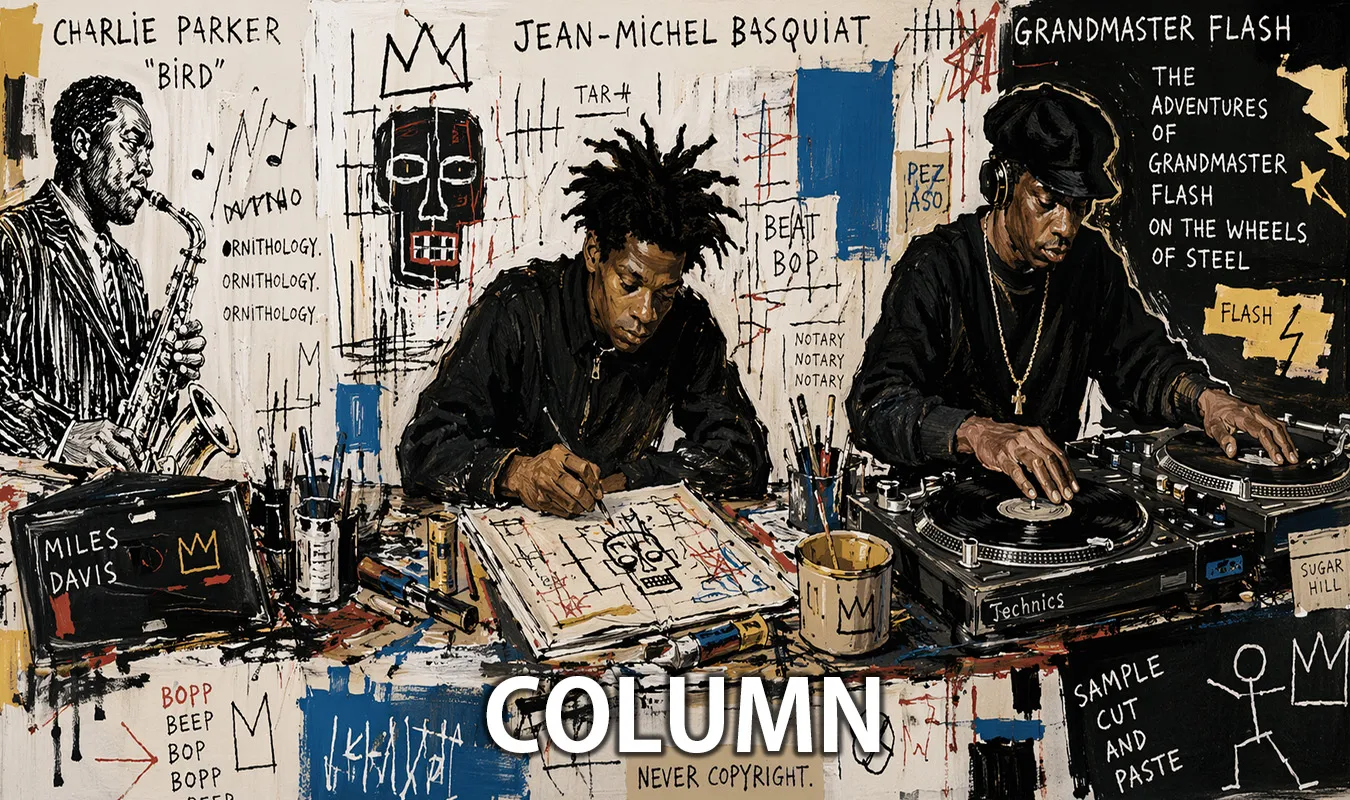
New York in the early 1980s. It is said that Jean-Michel Basquiat always had music playing in his Lower East Side studio. For him, sound was not just a background, but a device that determined the speed and structure of thought itself.

Of particular importance was the music of bebop innovator Charlie Parker. Fast, fragmented phrases, sudden modulations, tensions between repetition and deviation. These clearly echo the fragments of language, layering of symbols, and improvised overwriting in Basquiat’s paintings.

At the same time, he was deeply connected to the hip-hop culture that originated in the Bronx. Grandmaster Flash’s turntable technology presented a new way of manipulating time, chopping up sounds, rearranging them, and updating their meaning. Basquiat transforms this into a visual method.

Painting is not a static act. It is a performance that progresses in a time frame that is continuously updated in sync with the music.

Sound functioned not as a background but as the rhythm of thought itself


Layers of jazz structure and painting

Charlie Parker’s performance involves a process of presenting a theme, disassembling it, and reconstructing it. This is a so-called “head → solo → head” format, but what is important are the deviations and regressions that occur in between.

A similar structure can be seen in Basquiat’s work. For example, words and icons are written once, then erased, overwritten, and reappear. This repetition is not just a modification, but an ““improvisation of meaning.’’

flowchart TD A[Theme presentation] --> B[fragmentation] B --> C[improvised rearrangement] C --> D[Update of meaning] D --> A

This circular structure is consistent with jazz improvisation. The screen is not complete, but always exists as a work in progress.

In addition to Charlie Parker, Basquiat’s favorite jazz musicians include Dizzy Gillespie and Miles Davis, but what they have in common is an attitude of ““maintaining structure while destroying it.’’

This tension gives his paintings a unique rhythm and density.

Paintings exist as ongoing improvisations rather than fixed images.


Hip hop and sampling thinking

In the early 1980s, hip-hop was an experimental culture that had not yet been institutionalized. Grandmaster Flash treated the turntable as an instrument, extracting breakbeats from existing records and constructing new music.

This “sampling” is not just a quotation. It is an act of cutting and pasting different times and contexts to generate new meanings.

A similar process can be seen in Basquiat’s screens. Medical books, history, street culture, advertising, and poetic fragments. When these are decontextualized and rearranged, they take on new meaning.

flowchart LR A[Existing image] --> B[cutting] B --> C[Relocation] C --> D[new meaning]

This is exactly the same structure as a DJ mix. What is important is not ““creating something original,” but ““how to reconfigure existing elements.”

For Basquiat, who was active at the same time as the birth of hip-hop, this thought was extremely natural.

New meaning emerges by rearranging existing fragments


Noise, Repetition and Urban Rhythm

The city of New York itself was a huge soundscape for Basquiat. The noise of the subway, the buzz of the street, the bass of the club. All of them influence his production.

He wasn’t just listening to music, he was taking in the “sounds of the city.” As a result, his works have strong noise-like elements. Jumbled placement of letters, repetition of lines, and visual noise.

This also resonates with hip-hop’s loop structure. Minute changes accumulate in a certain rhythm.

flowchart TD A[city ​​noise] --> B[repetition] B --> C[subtle changes] C --> D[rhythm formation]

Through this process, Basquiat’s work becomes more than just visual art, but has an ““aural structure.’’

Seeing sounds and listening to pictures. This traversal of sensations is at the core of his expression.

City noise was directly converted into the rhythm of painting


Painter as DJ──Creation of editing

The key to understanding Basquiat’s production lies not in ““drawing” but in ““editing.” Rather than completing the screen in one go, he overwrites, deletes, and rearranges it over and over again.

This process is very similar to how a DJ mixes a record. What matters is not the materials at hand, but how they are combined.

In his works, the same words appear, are erased, and rewritten over and over again. This repetition has the same function as a loop in music.

flowchart LR A[material] --> B[arrangement] B --> C[delete] C --> D[Relocation] D --> B

Due to this cycle, the work has a structure that is constantly changing without being fixed.

As a result, Basquiat’s paintings exist not as ““completed images,” but as ““vestiges of editing.”

Creation is not about creating something from scratch, but about continuing to edit it.


Chronology: Basquiat evolves with music

timeline 1978 : SAMO活動開始 1980 : ニューヨーク・アートシーンに登場 1981 : ジャズへの傾倒が顕著に 1982 : 国際的評価の確立 1983 : 音楽的引用が作品に増加 1985 : ヒップホップ文化との接続深化 1988 : 死去

Conclusion: Sound as visual art

Jean-Michel Basquiat”s work lies at the intersection of two musical principles: jazz and hip-hop. Charlie Parker”s improvisation and Grandmaster Flash’s sampling. By merging these two, his unique expression was born.

His paintings are not only things to look at, but also things to listen to. Fragments, repetitions, noise, rearrangements. They all have a musical structure.

To understand Basquiat, you need to listen not only to his paintings but also to his sounds. This is because his production has always been accompanied by music.

This production process is also the prototype for all modern creations: sampling, remixing, and collage.

Basquiat’s paintings visualize the very structure of music.


Monumental Movement Records

Monumental Movement Records