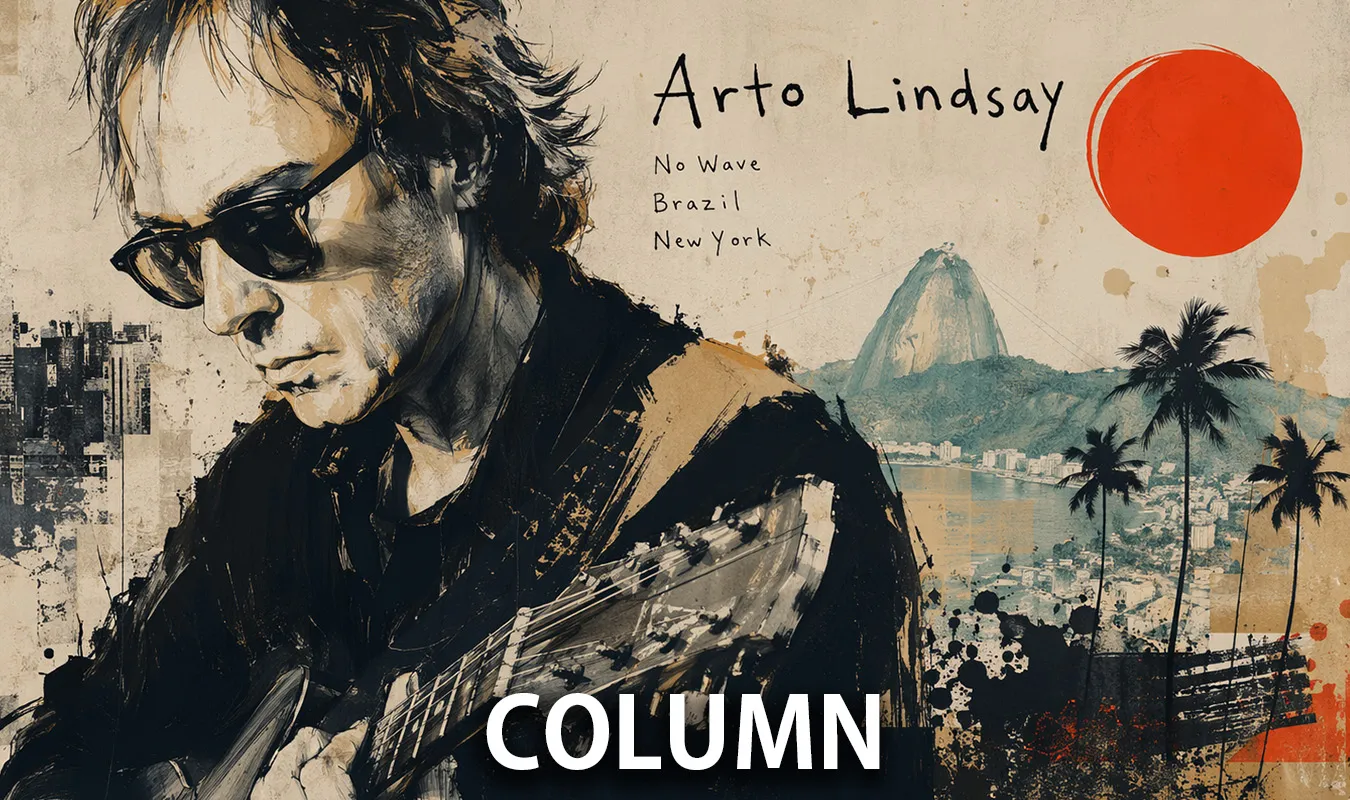
[Column] Border-crossing noise and bossa nova: Art Lindsay's trajectory
Column en Bossa Nova No Wave Nose
Prologue: Musicians who break boundaries
Text: mmr|Theme: The trajectory of Art Lindsay, who continued to traverse noise and Brazilian music and resonated with Japan.
Between noise and sensuality
When many people first hear the name Art Lindsay, they try to fit his music into one genre. But following his career, that attempt quickly becomes meaningless. He is one of the few who has been able to combine the noise of no wave and the softness of Brazilian music at the same time.
In the avant-garde music movement that formed in New York in the late 1970s, he transformed the guitar from a ““melodic instrument” to a ““device that produces physical collision sounds.” On the other hand, the humidity and physicality of Rio de Janeiro are deeply etched into his voice and compositions.
This duality is no coincidence. This is because his childhood experience in Brazil and his activities in the New York art scene coexist harmoniously within him.
His music always stands at the intersection of the city and the body, the intellect and the impulse.
Chapter 1: Feelings nurtured in Brazil
Childhood and cultural background
Born in the United States, Lindsay spent much of her childhood in Brazil. Because his parents were missionaries, he was deeply immersed in the local culture. This experience became an important factor in determining his later musicality.
The rhythmic fluctuations of Brazilian music, especially bossa nova and samba, the sound of Portuguese as a language, and the close relationship between the body and music. These feelings accumulate within him as natural sensations.
The reason why he often sang in Portuguese rather than English in later years was due to the influence of this period.
Music as physicality
One of the characteristics of Brazilian music is that sound is directly connected to the body. Rhythm is not just a structure; it is integrated with the movement of the body. Lindsay would carry this sensibility into his later experimental music.
An organic, humid sound that differs from the cold minimalism of New York. This background gives his music a unique “softness.”
For him, music was something that came from the body, not theory.
Chapter 2: New York and No Wave
Formation of DNA
In the late 1970s, a movement called ““No Wave’’ was born in downtown New York out of strong opposition to conventional rock. At the center of this was the band DNA, in which Lindsay was a member.
DNA is known for its extremely stripped-down compositions and almost violent sonics. His guitar almost ignored chords and scales, cutting through the space with a series of noises and fragmented sounds.
This style fundamentally denied traditional rock values.
The phenomenon of no wave
No Wave was more than just a musical genre, it was a cultural movement that intersected art, film, and performance. In doing so, Lindsay explores the relationship between music, the body, and visual expression.
DNA’s songs on No New York are still handed down as symbolic records of this movement.
His guitar was evaluated in a context different from the traditional “playing technique.” Rather, it was an attempt to deconstruct and reconstruct sound itself.
Noise was not destruction for him, but the creation of a new language.
Chapter 3: Return to Brazil and Integration
Ambivalent change of direction
In the 1980s, Lindsay gradually returned to Brazilian music. However, this was not just nostalgia, but a reinterpretation based on the experience of No Wave.
In his solo works, dissonance and noise-like elements naturally blend into the soft bossa nova-like compositions. This fusion was extremely original at the time.
Collaborate and scale
Lindsay also deepened interactions with many Brazilian artists. His relationships with Caetano Veloso and Marisa Monchi are especially important.
He also worked as a producer and guitarist, bringing new elements into the context of Brazilian music.
His music from this period is an intersection of New York experimentation and Brazilian tradition.
Rather than return, he created circuits that connected different cultures.
Chapter 4: Resonance with the Japanese noise scene
Contacts since the 1980s
Art Lindsay”s activities were loosely connected to Japan”s noise/underground scene. Although their direct ties as a band are limited, there is clearly a resonance at the level of musical attitude and aesthetics.
Especially since the 1980s, a unique noise culture has been formed in Japan. Here, the emphasis is on the physical intensity and experience of sound rather than musical structure. This direction overlaps strongly with Lindsay’s approach in the DNA phase.
Common Aesthetics: Destruction and the Body
Japanese noise artists such as Ai Yamazuka and Masami Akita separated sound from “meaning” and treated it as pure energy.
This is similar to Lindsay’s attempt to free the guitar from its traditional role. Sound is not a melody or chord progression, but a physical phenomenon such as contact, friction, or collision.
They also share a common emphasis on physicality in their performances. Sound is presented as something to be received by the body rather than something to be heard with the ears.
Indirect effects between scenes
Although acts such as Boredoms and Hijikadan did not have direct contact with New York no wave, they were contemporaneous and moved in a similar direction.
What is important is that Lindsay functions as “one of the starting points.” His presence shows that Japanese noise is not just a local phenomenon, but is positioned within the international flow of experimental music.
Post-90s as a reconnection
Since the 1990s, as global music networks have expanded, the Japanese and New York undergrounds have become more visible. Lindsay’s activities will also be reevaluated within this context.
His music differs from the extreme violence of Japanese noise, opening up to a more sensual and ambiguous direction. However, the underlying attitude of ““deconstructing sound’’ is common to all of them.
The noises produced in different places were different answers to the same question.
Chapter 5: Reconstruction of acoustics and space
Attention to the texture of the sound
What is more important in Lindsay’s music than melody or rhythm is the ““texture of sound.’’ Although his guitar often contains distortion and noise, it has delicate nuances.
The sound is not just an effect, but exists as an extension of a physical gesture.
Relationship between studio and live performances
He is conscious of the spatial spread of sound in both studio recordings and live performances. How the sounds are arranged and how they disappear. The process itself becomes part of the work.
This approach also influenced later ambient and experimental music.
Sound is constructed not only in time but also in space.
Chapter 6: Discography and history
Main work flow
His career has no consistent style. However, within these changes, there is always an axis of ““exploring the boundaries of sound.’’
Changes in musical characteristics
From early violent noise to late delicate bossa nova. Although the range of fluctuation is extreme, it is continuous in some way.
This is because in his mind, noise and harmony are not contradictory.
Change is not a discontinuity, but the result of continuous exploration.
Chapter 7: Impact and Evaluation
Impact on subsequent
Lindsay’s influence extends beyond genres. Many musicians in post-rock, ambient, and experimental pop have learned something from his approach.
In particular, the attitude of affirming ““imperfection” and ““noise” has become an important perspective in contemporary music production.
Critical review
Although his works have been far from commercial success, they have received very high praise from critics and musicians. He has always been on the outside of the mainstream, expanding the possibilities of music.
Valuation is measured by depth of impact, not market.
Final chapter: Continuing to cross borders
Attitude to reject genres
Looking back on Art Lindsay’s career, one constant is his ““resistance to being categorized.’’ He has always questioned existing frameworks and tried new connections.
The noise of no wave and the softness of Brazilian music. It is not easy to achieve both at the same time. But he does it naturally.
Suggestions for the future of music
His activities demonstrate that music is not just a collection of genres, but an intersection of culture, the body, and space.
In modern times, music is becoming increasingly diverse. A person like him gives us a hint to connect different elements.
Crossing borders itself is the essence of his music.