
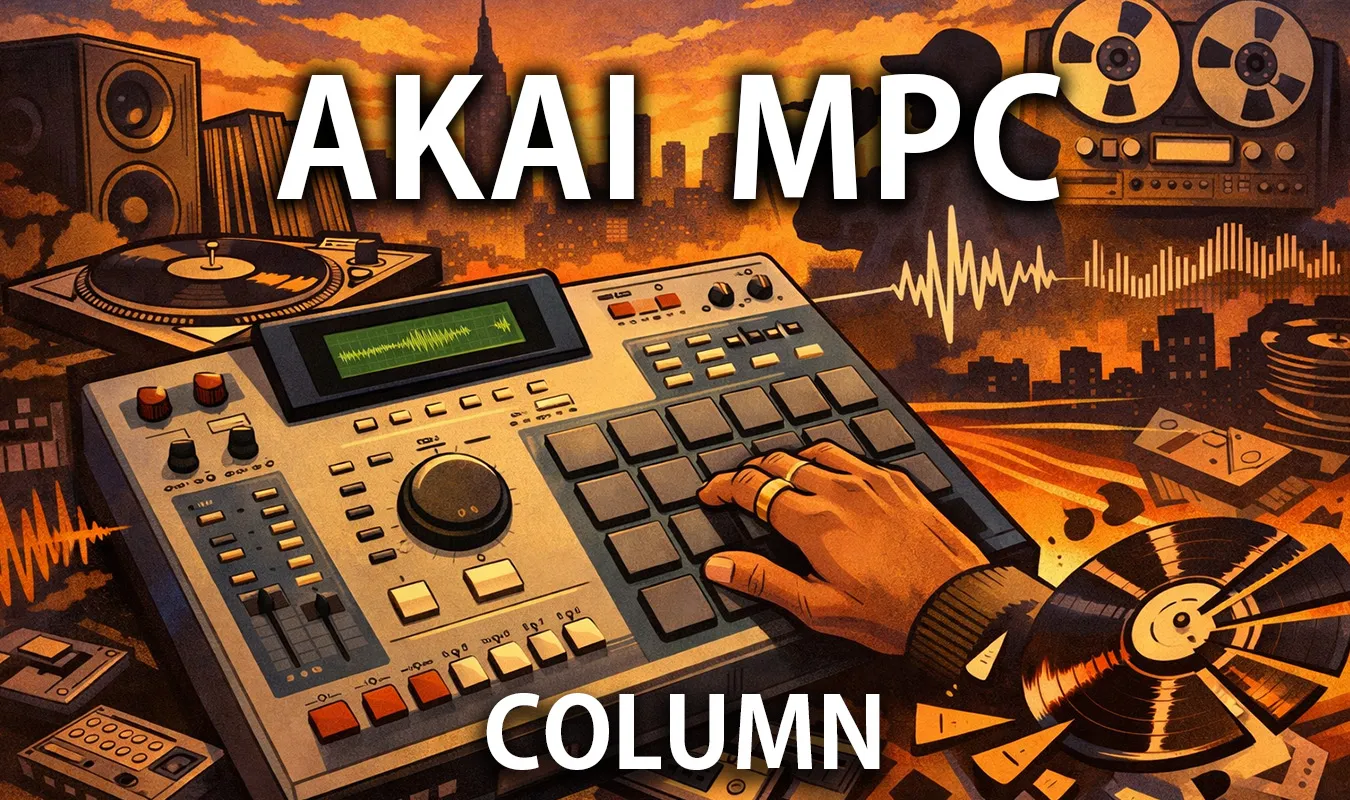
[Column] The birth of Akai MPC and beat culture: How sampling has changed the sense of time in music

Column en Akai HipHop MPC Sampling
[Column] The birth of Akai MPC and beat culture: How sampling has changed the sense of time in music

Introduction: Beats have become something to “beat”

Text: mmr|Theme: “Time” and “physicality” redefined by sampling and pad operation

In the late 1980s, the rhythms that had previously been confined to the studio began to descend into our fingertips. It”s not a keyboard or a musical score, it”s the physical act of creating music by hitting it. At the center of this was Akai’s MPC series.

This machine is not just a drum machine, nor is it just a sampler. It was a device that chopped up sounds, rearranged them, and reconstructed time itself.

The advent of MPC brought music production back to “performance.”


The eve of the birth of MPC: the separation between samplers and drum machines

In the 1980s, samplers already existed. But they were expensive and complicated to operate. On the other hand, drum machines allow you to input rhythms, but the sound material is fixed.

There is someone who has integrated these two functions and made it into a form that can be used intuitively. Roger Linn. He had previously changed the history of drum machines with the LM-1 and LinnDrum.

However, what he was aiming for was a more free rhythm generating device.

The fusion of sampler and drum machine gave rise to the idea of ​​MPC.


MPC60: The beginning of a revolution

In 1988, Akai MPC60 was born. This equipment had the following characteristics:

  • Key input using pad
  • Sampling function
  • Sequencer integration
  • Swing (groove) adjustment function

Especially important is the “swing.” Rather than a perfectly even rhythm, a slight deviation creates a human-like groove. With this function, the MPC has become not just a tool for driving, but a device that creates a ““glue.’’

graph LR A[sampling] --> B[pad playing] B --> C[Sequencing] C --> D[swing adjustment] D --> E[groove generation]

MPC60 has brought back the “human fluctuation” to the beat.


Fusion with hip-hop: expansion of sampling culture

MPC became explosively popular, especially in the hip-hop scene. This was because it perfectly matched the culture of cutting out sounds from existing records and reconstructing them in a new context.

For example, chopping up a funk or soul drum break and rearranging it creates a completely new beat. This act is not just a copy, but a “reconstruction.”

What is important here is the management of time. MPC treats sound as “material” and by rearranging it, the time axis itself can be edited.

flowchart TD A[record sound source] --> B[sampling] B --> C[slice] C --> D[Relocation] D --> E[new beat]

Sampling became an act of reinventing rather than citing the past.


MPC2000 and later: Establishment of standards

In 1997, the Akai MPC2000 was introduced, and MPC became even more popular. Prices have come down and more artists have access to it.

During this period, MPC became more than just a piece of equipment; it became a style.

  • Finger Drumming
  • Real-time performance
  • Sample-based composition

All of these are cultures born from the interface called MPC.

MPC has evolved from equipment to culture.


Physicality of beat making

MPC’s most important innovation lies in its ““physicality.’’ Rhythms are created by hitting pads rather than keys.

This changed music production.

*Visual → Tactile

  • Notation → Body memory
  • Precision → Groove

In other words, MPC encouraged a shift from “music that makes you think” to “music that makes you feel.”

graph TD A[theoretical composition] --> B[typing] B --> C[Introducing MPC] C --> D[physical performance] D --> E[Emphasis on groove]

Beats are no longer something you design, but something you carve with your body.


Redefining the digital era and MPC

Since the 2000s, music production has become completely digital with the spread of DAWs. But MPC did not disappear. Rather, it has evolved.

*Software version MPC

  • DAW integration
  • Return of standalone machine

MPC Software has adapted to modern production environments while maintaining traditional operability.

MPC maintains its core experience while adapting to the times.


Chronology: Evolution of MPC and Beat Culture

timeline 1988 : MPC60 発売 1990s : ヒップホップで普及 1997 : MPC2000 登場 2000s : DAW時代へ移行 2010s : ソフトウェア化・再評価 2020s : スタンドアロン回帰

The history of MPC is also the evolution of beat culture.


MPC Sample: Reinterpreting sampling in modern times

Modern MPC Samples make it possible to perform sampling in an environment free from previous hardware constraints.

But the essence has not changed.

*Turn off the sound

  • Relocate
  • Create new time

This process is the core of MPC and has been maintained throughout the ages.

Even if technology changes, the essence of sampling remains the same.


Why is MPC still used?

While many pieces of equipment have disappeared over time, MPC has survived. The reason is clear.

That’s because there is “experience”.

  • Feeling of tapping
  • Misaligned rhythm
  • Improvisation

These are not just functions, but sensual values ​​in music production.

MPC is chosen as an experience, not a feature.


Conclusion: What MPC has changed

MPC not only changed the way music was produced, but also changed the structure of music itself.

  • The idea of ​​cutting time
  • The act of making beats with your body
  • A culture that relocates the sounds of the past to the future

All of this started with MPC.

MPC is not a machine that creates sound, but a device that reconstructs time.
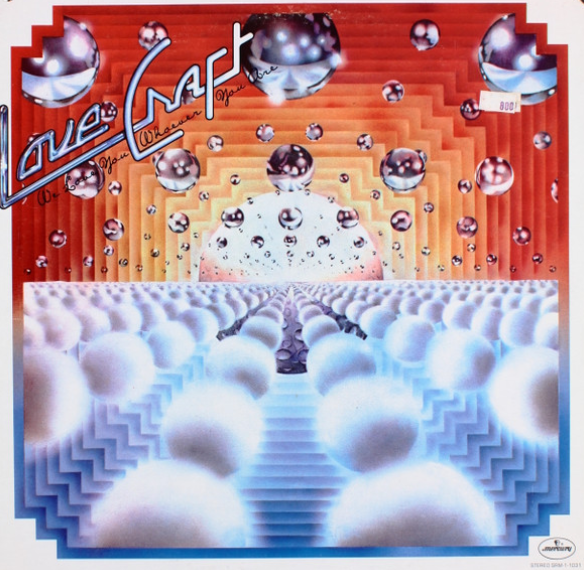

Monumental Movement Records

Monumental Movement Records