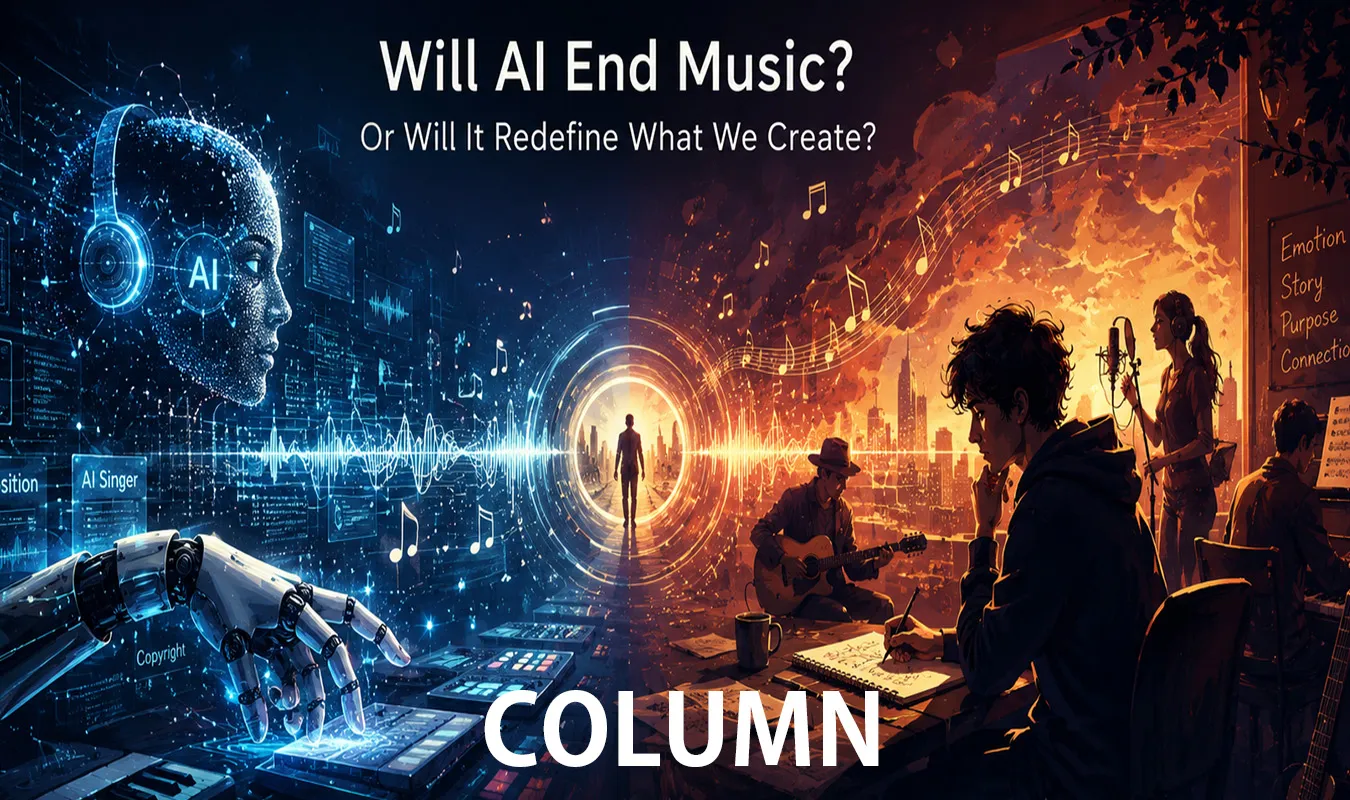
[Column] Will AI end music? Redefining creativity in the Suno/Udio era

Column en AI Suno Udio
[Column] Will AI end music? Redefining creativity in the Suno/Udio era

Will the music end? Or will the era in which humans monopolized music end?

Text: mmr|Theme: Will AI end music? Redefining creativity in the Suno/Udio era

In the mid-2020s, advances in generative AI pushed this question into real debate.

What is attracting particular attention is the emergence of AI services that generate music from text. Representative examples include Suno and Udio, which generate highly complete songs from short instructions, and are changing the very approach to music production.

Music used to require a clear process of ““performance,” ““recording,” and ““editing.’’ However, we are now entering an era where words become music.

Music is not disappearing, it is starting to change the shape of the entrance


Current status of AI composition ── Suno and Udio have changed the common sense of production

The essence of AI composition is not ““substitution of skills,” but ““compression of structure.” The traditional production process is suddenly shortened, and ideas can be converted directly into audio results.

Characteristic changes of Suno/Udio

  • Generate music just by inputting text
  • Vocals, lyrics, and arrangement are generated simultaneously
  • Style imitation across genres
  • Music output close to finished form in just a few tens of seconds

This change is not simply an evolution of tools. He is reconstructing the very definition of the act of ““composing’’.

What is particularly important is that music has become a “generated result” rather than a “performance result.” This freed music from time and technology and moved it into the realm of instruction and probability.

flowchart TD A["Human ideas"] --> B["Text instructions"] B --> C["AI generation model"] C --> D["Music output"] D --> E["Distribution/Sharing"]

In this structure, the existence of a conventional “performer” is not essential.

Composition is moving from a manual skill to a language skill.


Structural changes in music production: from studio to prompt

Before AI, music production was a multilayered physical process. Studio, instruments, engineering, mixing, mastering. Each was established as a collection of specialties.

But AI-generated models integrate this layer.

Comparison of traditional model and AI model

Item Conventional AI-generated
Composition Human Text instructions
Performance Required Not required
Arrangement Division of labor Automatic integration
Production time Several days to several months Several seconds to several minutes

This change is said to be a democratization of music production, but it also has the aspect of a ““dilution of specialization.’’

When anyone can create music, the question ““Who is a musician?’’ arises.

Creative freedom has expanded, but the contours of the profession are beginning to blur


The biggest issue in AI music is not technology but rights. Generative AI learns a huge amount of music data and creates new sounds based on its statistical characteristics.

At this time, the problem is “attribution of the original data.”

  • Who owns the learned music?
  • Is the style subject to copyright?
  • Can the product be called original?

In particular, the center of discussion is ““imitation of style.’’ When recreating the atmosphere or sound image of a certain artist, is it a creation or a reconstruction?

flowchart TD A["Existing music data"] --> B["Learning process"] B --> C["Statistical feature extraction"] C --> D["Newly generated music"] D --> E["Obfuscation of copyright"]

Currently, clear legal arrangements in this area have not caught up in many countries. As a result, the time gap between technological evolution and institutions is widening.

While music is being produced, the concept of ownership has not kept up.


AI singer and identity ─ Whose voice belongs to?

The evolution of AI music does not end with “composing”. With the advent of AI singers, synthetic voices, and vocal clones, “voice” itself has become data.

What’s happening here is more than just speech synthesis. That is “decomposition of personality.”

*Voice quality becomes separable data

  • Singing becomes a reproducible pattern
  • Representation is modeled

In other words, the existence of a singer changes from a ““fixed body” to a ““reproducible information structure.”

This change shakes the “proof of existence” in music.

When the voice becomes replicable, the question remains: Who is the singer?


Reorganization of the music industry: oversupply and algorithmic selection

Thanks to AI generation, music has moved from an era of “scarcity” to an era of “excess.” Every day, countless songs are created and released.

In this situation, the problem becomes discovery rather than production.

*Music increases infinitely *Human hearing ability is limited

  • Algorithm fills in the gaps

As a result, the value of music shifts from “production” to “recommendation.”

flowchart TD A["Mass production of AI-generated music"] --> B["Distribution platform"] B --> C["Recommendation algorithm"] C --> D["Optimizing the listener experience"] D --> E["Music visibility gap"]

What is important here is that value is beginning to be determined not by the music itself, but by whether it reaches the audience.

Music is changing from something that is made to something that is chosen.


Where is human creativity going?

When AI can generate music, will the role of humans disappear? In fact, the opposite phenomenon is occurring.

Humans are transitioning into beings that design “directions” rather than “results.”

  • It”s not about what you make, it”s about what you choose
  • Design for intent, not sound
  • Context generation, not completion

In other words, creativity is moving from “production ability” to “editing ability.”

Although this change appears to be a contraction, it is actually an expansion. This is because the freedom of choice may be wider than the ability to produce.

Human creativity is not disappearing, but increasing in layers


What is music? Philosophical redefinition

The ultimate question lies not in technology but in definition. What is music?

If music is something played by humans, then AI music is not music. However, if it is ““generating emotions through the structure of sound,’’ then AI is also creating music.

This contradiction means that the very definition of music is being shaken.

flowchart TD A["Definition of music"] --> B["Performance-centered model"] A --> C["Structure-centered model"] A --> D["Experience-centered model"] B --> E["Human only"] C --> F["Including AI"] D --> G["recipient dependent"]

The answer to the question ““Will AI end music?’’ will depend on which definition you use.

Instead of ending, music can be seen as branching out into multiple definitions.

Music does not end, it loses its single meaning and becomes multi-layered.


Conclusion──What ends is the border, not the music

Will AI end music? The answer is not a simple “yes” or “no.”

What is ending is not the music itself, but the following boundaries.

  • Man and Machine
  • Composing and reproducing
  • Original and imitation
  • Production and consumption

As these boundaries become blurred, music is moving into a different form.

It is not an “end” but a “relocation.”

Music doesn’t go away. However, it is no longer the same music as before.

The music never ends. However, it is no longer something that only belongs to humans.


Monumental Movement Records

Monumental Movement Records